Trending Topics

 Trending
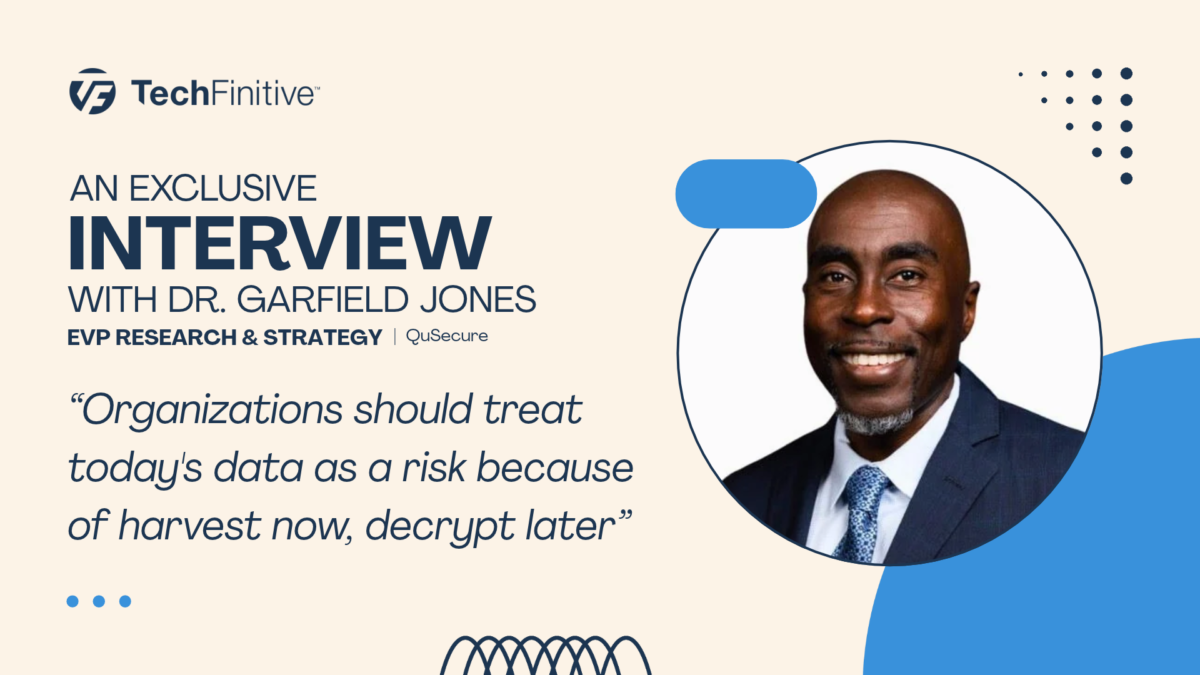
Dr Garfield Jones, EVP Research & Strategy at QuSecure: “Organizations should treat today’s data as a risk because of harvest now, decrypt later”
The arrival of cryptographically relevant quantum computers may still be some way off, but the security implications are already shaping how organisations think about protecting sensitive information. The threat of so-called ‘harvest now, decrypt later’ attacks means data encrypted today could become vulnerable in the future, putting pressure on businesses to rethink their approach to cryptography.
For Dr. Garfield Jones, EVP of Research & Strategy at QuSecure, preparing for this shift requires more than simply replacing existing encryption algorithms. It calls for a move towards crypto-agility: the ability to identify, adapt and update cryptographic systems continuously, without disrupting critical infrastructure or business operations.
In this interview, Jones discusses the practical challenges of post-quantum cryptography (PQC) adoption, from uncovering encryption buried in legacy systems and operational technology to navigating evolving standards, compliance requirements and interoperability issues. He also explores how artificial intelligence could accelerate both quantum-related threats and the tools organisations need to defend against them.
QuSecure has described cryptography as becoming an “ongoing operational discipline” rather than a series of one-time migrations. What has changed in the threat landscape to make that shift necessary, and what does crypto-agility look like in practice for an enterprise?
Resource estimates for cryptographically relevant quantum computers keep changing. Published estimates of the physical qubits a fault-tolerant machine would need to run Shor’s algorithm range from about 1 million down to as few as 19,000, depending on the assumptions. As qubit counts and quantum resources advance, organizations will need to be agile in how they mitigate risk and implement cryptography. The standards are also still evolving: NIST has not yet finalized algorithms such as HQC and FN-DSA. Organizations will need to adapt to their enterprise environments and, potentially, to the countries with which they communicate, since some countries will exercise sovereign cryptography.
NIST CSWP 39 defines crypto-agility as the capabilities needed to replace and adapt cryptographic algorithms in protocols, applications, software, hardware, firmware, and infrastructure while preserving security and ongoing operations. In practice, this requires organizations to build and maintain a CBOM so they know what cryptography they use and where it comes from. It also requires risk-based prioritization based on data lifecycle and IT/OT exposure and criticality, along with procurement and acquisition contracts that support the transition of algorithms and technology. Finally, organizations need automated certificate rotation, so that long-lived certificates do not put them at risk.
The “harvest now, decrypt later” threat is already driving urgency around post-quantum migration. How should organisations think about data that is being encrypted today but needs to remain confidential for years or decades?
Organizations should treat today’s data as a risk because of harvest now, decrypt later (HNDL), and should plan for the leakage or decryption that could occur once a cryptographically relevant quantum computer (CRQC) exists. They should weigh both the lifecycle and the sensitivity of their data, since together these determine what adversaries will want to decrypt. Data encrypted today should be protected with additional layers, such as hybrid or post-quantum key establishment and longer symmetric keys, so that it is harder to decrypt and exploit if taken.
QuProtect R3 is designed to provide continuous cryptographic inventory and policy-based remediation across existing infrastructure. What are the biggest practical obstacles organisations face when they try to discover where and how cryptography is being used across their networks?
The biggest obstacle organizations face is discovering all of the cryptography in every place it exists, including protocols, operating systems, firmware, and many other layers. Legacy and operational technology are especially hard to assess because they may be hidden and because manufacturers do not always disclose security details, including the cryptography used. Depending on the size of the organization, discovery can be immense in scale and slow to analyze if done manually. QuProtect R3 is designed to provide the continuous inventory and policy-based remediation that an ever-changing environment requires. Finally, senior leaders may not take the quantum threat seriously because of cost, uncertainty about the threat, and limited education, which can lead to disagreement over how to approach the coming threat of a CRQC.
There is a growing number of deadlines and standards around post-quantum readiness, including federal requirements coming into effect in 2027. Are organisations primarily approaching PQC as a compliance exercise, a security problem, or a broader infrastructure transformation and what does that distinction mean for how they prepare?
Organizations often approach PQC as a compliance exercise because they cannot observe the immediate effects of HNDL or of harvest now, forge later (HNFL, also called trust now, forge later, or TNFL). Those that do not treat it as a security problem often assume their data will no longer be valuable by the time adversaries can decrypt it. Their main concern is interoperability, since systems using PQC algorithms can communicate only with systems that support them. Deadlines set by governments and standards bodies also reinforce the compliance framing.
You argue that organisations need to be able to change cryptography without rip-and-replace infrastructure or application code changes. How difficult is it to introduce that kind of cryptographic agility into legacy environments, particularly where systems were never designed to have their underlying cryptography changed?
Introducing crypto-agility is difficult because cryptography across the environment is uneven. For legacy and OT systems, avoiding code changes and rip-and-replace is realistic in some cases, because the problem is often one of solution architecture that policy, standards, and design can solve. In other cases, parts of the enterprise will need to be replaced because a software-based solution cannot reach them. Some systems resist change because they contain hard-coded logic and statically linked libraries that do not lend themselves to software-based fixes. Similarly, some smart card readers and OT controllers lack the capacity to store larger PQC algorithms, and some networking equipment may not handle the larger handshakes that come with hybrid post-quantum key exchange in TLS 1.3. Validation requirements such as FIPS 140-3 and NIAP evaluation also limit what federal procurement can deploy, even where technically capable solutions exist. Finally, interoperability and regression testing add cost and can slow system performance.
Generative AI and quantum computing are both changing the cryptographic risk landscape, but in very different ways. How do you expect those two technologies to interact over the next few years, and what should security leaders be doing now that they might otherwise leave until the quantum threat becomes more immediate?
AI will help detect vulnerabilities in PQC algorithms. For example, Anthropic’s Claude Mythos Preview weakened one PQC candidate, HAWK, and found a new way to attack round-reduced AES. AI may also help advance CRQC development more efficiently. It will also help defenders identify vulnerabilities and misconfigurations and test implementations. Where the two technologies intersect, discovery and remediation tools are advancing, along with AI-assisted prioritization of assets, data sensitivity, and lifecycle risk.
You might also be interested
About The Author

Ricardo Oliveira
NEXT UP