Trending Topics

 Trending
Ireland and Intel show everything that’s wrong about tech investment in the UK

A whisper in my ear: “This is everything that’s wrong with tech investment in the UK.” I nodded: I had been thinking exactly the same thing. We were listening to Dónal Travers, Executive Director of IDA Ireland, and while laying out how the organisation had helped attract Intel to Ireland, he was making it all too clear that the UK could never do the same.
Nothing that Dónal said was controversial. But, like a silent assassin, his soft voice explained how IDA Ireland had worked with Intel and the Irish government to turn this once rural area into a key part of Intel’s worldwide operations.
“What you’ll see in Ireland is an extremely stable environment,” he said, “where from one government to the next, and governments typically last five years… enterprise policy does not change significantly from one government to the next, and that’s really important as a signal of stability for our biggest investors.”
Yes. Exactly. Compare that to the UK where there’s zero guarantee of stability from one government to another, where we replace prime ministers more often than some people change their bedsheets, and you can see why long-term foreign investment is so hard to find.
The key is the way we elect our governments. For an opposition party to be considered effective in this country, it must fight the incumbent tooth every step of the way. Fight, moan, complain, belittle your country. Anything to get back into power yourself.
That’s the danger of “first past the post” voting, where a party with one third of the popular vote can end up with almost two thirds of the seats in the House of Commons. The fortunate situation that Labour found itself in back in 2024.
Stable government is key
If you’re a supporter of the winning party then this a cause for hugs and celebration. We can make sweeping changes! Reform the welfare state! Except, you can’t. To create real, long-lasting change, you need to know that you’ll be in power for a decade or more. Otherwise all you’ll get is a constant cycle of temporary change, one that means public bodies and private institutions alike will struggle to make the long-term investments we desperately need.
Take the current UK political landscape. Labour was elected on the basis of bringing change, as the cover of its 2024 manifesto makes absolutely clear.

Now consider that the current insurgent in UK politics, the Reform Party, bakes the concept of change into its name. Something it continually backs up with its arguments and policies, not to mention its homepage:

Well, you know what? We don’t need change every five years. What we need is a stable government structure that rewards parties who work together so that we can do exactly what Ireland has done. Promise, invest, deliver.
And then repeat the cycle over decades and generations.
Why Intel chose Ireland for its fab
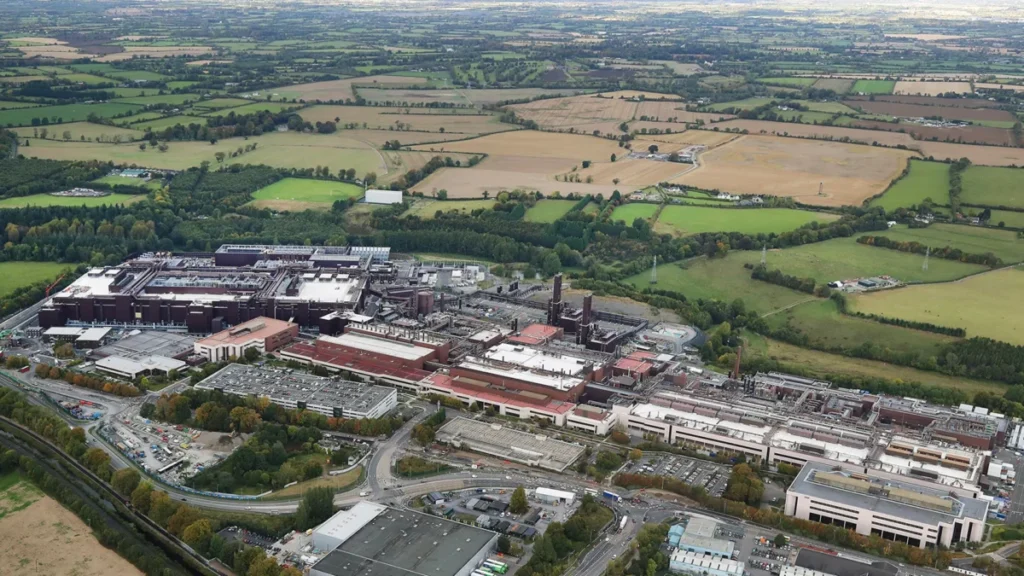
To illustrate this, I’m going to focus on the story of Intel, IDA Ireland and the Irish government. First, because I visited Intel’s manufacturing facility there this week; it was during this visit that my neighbour whispered those words in my ear. Second, I have the stats to hand.
The journey starts in the late 1980s when Intel was trying to decide where to set up its European operations. “They were on a whistle-stop tour, visiting about ten countries over the space of two or three weeks and so we were just one of many that were being considered,” said Kieran McGowan, the IDA Ireland’s Chief Executive between 1993 and 1998, in an interview with The Irish Times.
Ireland wasn’t the natural choice. It had no semiconductor industry, unlike Scotland with its Silicon Glen. In fact, I first donned a “bunny suit” when I visited the NEC fab in 2000 to see its impressive facility, only for it close down a year later.
When Intel made its decision to choose Ireland over Scotland, semiconductor manufacturing in Silicon Glen was in its pomp. Intel needed to be convinced that Ireland was committed to the long term – a mix of tax incentives, IDA grants and helpful planning permissions no doubt played their part.
But it wasn’t just about tax savings. The IDA also persuaded 130 Irish electrical engineers, then working in Silicon Valley, to meet Intel execs in a hotel and say they would move to Dublin to work in an Intel manufacturing plant if set up there.
Scotland had its equivalent to the IDA doing its best to persuade Intel, but ultimately it couldn’t match the long-term tax incentives on offer from Ireland. After all, if the British government gave 10% corporation tax to one high-tech company it would have to extend it to all Silicon Glen residents.
Importance of semiconductor strategy
From the early 2000s onwards, Silicon Glen went into decline. I’ve already mentioned NEC’s departure, but later that decade Motorola and Texas Instruments also mothballed their Scottish plants. While there are signs of a manufacturing resurgence in Scotland, it’s in niches rather than the semiconductor mainstream.
Niches are great, but they won’t move the economic needle. Fuelled by AI, the market for semiconductors is set to explode from $800 billion to $1.3 trillion in the next 18 months alone. That figure is only going to grow.

Unlike the UK, and no doubt many other countries, IDA Ireland can make long-term plans to grab a share of this money because it knows that its government – no matter which party holds most seats – will be stable. It will almost certainly be a coalition government, as it has been since 1989, and its broad aims will almost certainly stay consistent as a result.
There won’t be a new, radical plan every five years as the next “we’re here to change things” government comes into power. Only to inevitably fail and be replaced by a new one five years later.
It’s why Dónal Travers can stand on stage and say: “We’ve launched a national semiconductor strategy that sets out ambitious targets for the growth of the semiconductor sector here over the next 10, 15, 20 years, and really what it is, it’s taking our ambition to grow the sector here, to double it in size over that time frame, to add new manufacturing capacity, new R&D activity and new service capacity here in Ireland.”
And: “The government is investing up to 19 billion euros over the next five years in growing our electricity infrastructure here, and we’re working very closely with government on the infrastructure investment required, and for example, on the scale of renewables that will help support that. As a country, we are targeting 37 gigawatts offshore wind by 2050… so it’s a very significant statement of intent.”
Unlike a UK government long-term strategy with similar aspirations, we can be confident that the Irish government will deliver.
Intel’s long-term impact on Ireland
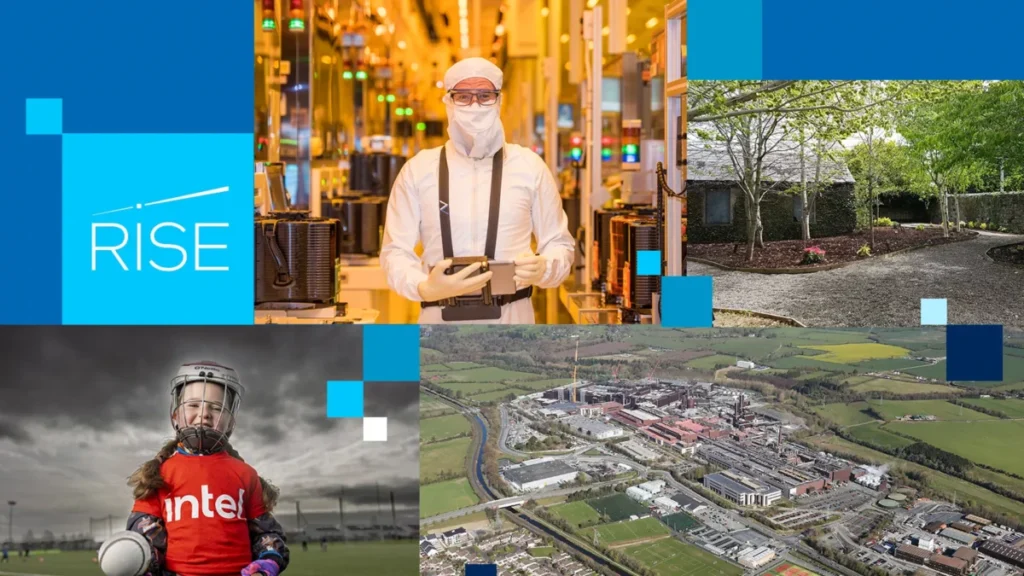
I’m not suggesting that the Irish approach is perfect. I’m sure that a lot of people who lived in Leixlip, the town outside Dublin that is now home to a huge industrial campus, weren’t happy about the drastic change to the quiet area in which they lived.
I also couldn’t help but think that when Intel crowed about giving €6 million to “communities across Ireland in the last three years” in one presentation slide that it rather paled in comparison to the site’s annual turnover.
However, some of Intel’s official numbers do bear out Intel’s impact on Ireland as a whole:
- €3.73 billion: its contribution to the Irish economy since 1989
- €8.4 billion: how much it’s spent on Irish labour in that time
- 0.9%: its contribution to Ireland’s GDP
- 1,115 suppliers supporting the Leixlip site
Now, I’m not suggesting that Intel would every shift from Ireland to Scotland or another part of the UK. That ship has sailed. But there are other companies. Since attracting Intel, the IDA Ireland has helped to convince AWS, Dell and Qualcomm to set up shop in the country.
I am suggesting that we need to have a long, hard look at ourselves. Sure, the UK offers tax breaks and grants to attract foreign investment. But there’s one thing that no member of the government or trade delegation can promise: stability.
We need to change if we’re to be stable
The sad thing about our current political system is that it rewards the big parties – the Conservatives and to a lesser degree Labour in the past, and almost certainly Reform in the future – so why would they vote for change?
I only have one small sliver of hope. That Andy Burnham, who will almost certainly be the UK’s next prime minister, has said in the past that he supports proportional representation. But as he edges closer to the hot seat, his words have become more couched in the rhetorical language of “less point-scoring, more problem-solving“.

Sorry Andy, but we’ve heard that kind of language from many politicians in the past, including David Cameron. In reality, this kind of thinking sucks you closer to the weeds – “we must pass this bill!” – rather than allowing the broad, long-term thinking that any country needs.
Perhaps Andy Burnham, if he becomes PM, will surprise me. Perhaps he will push for electoral reform that moves us closer to the more stable, Irish model of government. Or perhaps we will have to wait for the next coalition government when this becomes a “red line” for the likely kingmakers of the Liberal Democrats.
Either way, this means that I’m arguing for one thing: change. Damn.
More articles by TechFinitive editor Tim Danton
About The Author

Tim Danton
NEXT UP