Trending Topics

 Trending
Technology in space: 4 things we learned from astronaut Dr Serena Aunon-Chancellor

As part of HP’s Imagine 2026 event in New York last week, HP’s Antonio Lucio interviewed former NASA astronaut Dr Serena Aunon-Chancellor. While much of the interview focused on life aboard the International Space Station, where Dr Aunon-Chancellor spent almost 200 days in 2018, here we focus on five technology-related insights.
While the big news this week focuses on the launch of Artemis II, we can’t help wonder if the next people to stand on the moon will be checking their email, printing out favourite snaps and consulting an AI about why their knee hurts so much after one too many moon hop.
Emails and calendars still rule astronauts’ world
What do you do when you wake up of a morning? Chances are that, after you’ve doomscrolled for a few minutes, you check your email. It was the same for Dr Aunon-Chancellor. “I open up my workstation, I check my email, I quickly pull my hair back, put my clothes on. There’s no shower up there. I run to grab breakfast, which is usually freeze-dried eggs or oatmeal. I have my coffee. Coffee is critical on a space station, kind of like ketchup.”
Astronauts’ 12-hour working day starts at 7am, which means communicating with Mission Control. But not just Houston. “Japan, Canada, Europe, all the mission controls come together, get us ready with final notes, and then we start our day. We start chasing that red line that shows up on our calendar, and it slowly moves across the page tells us if we’re ahead or if we’re behind, but we literally work until about 7pm.”
While Dr Serena Aunon-Chancellor didn’t explicitly say which calendar they use, the red line suggests Google. But unlike my calendar, split into 15-minute sections, Dr Aunon-Chancellor says the astronauts’ calendars work in 5-minute chunks. “That’s how precious time is on board, five-minute increments. If you finish something five minutes early, you’re getting a phone call from Mission Control.”
There’s a printer on the International Space Station: who knew?
“We have the privilege, HP together with NASA, to create a printer that is in space today,” said HP’s Antonio Lucio. For those who missed its launch, this is the HP Envy ISS and it’s based on an OfficeJet 5740. HP even produced one of the shortest YouTube videos we’ve ever seen to watch it in action:
So what is the HP Envy ISS used for? “We have procedures that we have to follow… [it’s a] high stakes environment, sometimes dealing with things like very high pressure lines, or I’m double and triple checking my work,” said Dr Aunon-Chancellor.
“But if I have to work deep behind a rack – a rack is just a wall of the space station that we can lower out – and I’ve got a headlamp on, sometimes I need to print my procedures out.”
There are personal reason too. “We would also print out pictures that folks would email to us in orbit, so we could take a picture of it for them onboard the space station, and they can give it to their children, because that means something.”
AI may be the doctor on trips to the moon and Mars
“As a physician, I always think about, what if I’m on the surface of Mars – I’ll be way too old to go to Mars, by the way – but if I’m on the surface of Mars and someone gets ill, what if I need someone to help me diagnose that patient?” said Dr Aunon-Chancellor. “As smart as I may be, I need help. So I always look at support tools, decision support tools.”
For this, she believes that AI will likely hold the answer. After all, unlike the ISS where support can be provided near-instantly, when humans walk on Mars there will be anything from a four-minute delay to 24 minutes (depending on how close Mars is to the Earth in its orbit).
The moon is much closer, with 1.3 seconds latency caused by distance and a few extra seconds due to signal processing. So, near instant. And in other good news, we can expect 4K and full-colour TV signals from Artemis II rather than the grainy black-and-white visuals from the 1960s and 1970s.
Space exploration is now a trillion-dollar industry… and it’s growing
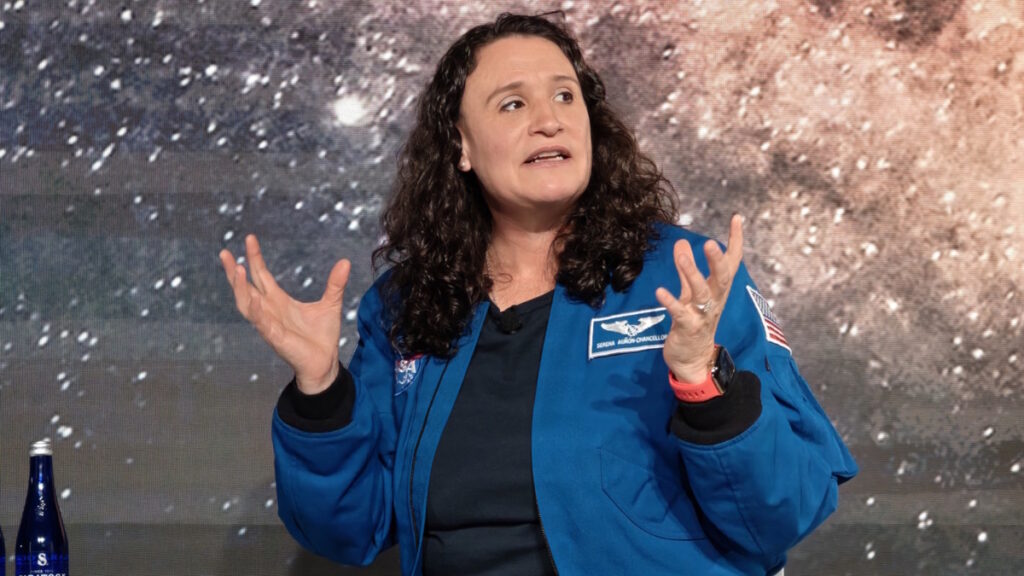
We’ve already seen signs of space tourism, whether that’s tech billionaires being blasted into the edge of space or the first all-female space flight last year. But commercial companies also want in on the action, not to mention nation states. In short, the space business is booming.
“Space is not just a NASA endeavour anymore,” said Dr Aunon-Chancellor. “It is a global commercial enterprise.” That means the ISS is now home to scientists from large institutions and they need to justify every five minutes of time – that alone costs thousands of dollars, adding up to millions for a company that’s footing the bill.
Much of Dr Aunon-Chancellor’s work at Texas A&M University revolves around an aerospace medicine programme. “Aerospace medicine is the study of how to prevent disease in folks who fly in space,” she said. “That used to be a very small number – it’s not anymore. My husband likes to term it, ‘Grandma and Grandpop are headed to space’. And they are, if they have enough money – how do you support those missions?”
She added: “The commercial space flight industry is a trillion-dollar industry. It is only getting bigger.” And the days of the Lost In Space may be coming. “When someone says, ‘Do you think we’re going to fly kids?’ And my first thought is no, but it’s gonna happen. It’s coming, right? Families, how do we handle that as a nation? How do we handle national defence?”
Urine luck if you like coffee…
Now this isn’t part of the tech bit, but we all love coffee, right? Well, perhaps it’s best to look away if you’re currently sipping a brew on the ISS, as that distinctive aroma may not be entirely due to the beans.
“I don’t think people realise we do turn today’s urine into tomorrow’s coffee [on the ISS],” said Dr Aunon-Chancellor. “Not the coffee you’re drinking here today, but we reuse everything.”
She added: “We collect sweat, condensation from your breath, any water we can reclaim, and we send it through a special processing assembly.”
And things are only going to become more intense in the future. “We’re spoiled in low Earth orbit, because we have cargo vehicles coming to and from every few weeks delivering supplies, food, medicine, science, and then that game will change as we head further out.”
Just to finish off – look away now if you’re of a sensitive disposition – Dr Aunon-Chancellor had this to say about sweat. “Sweat beads up on their skin. It doesn’t fall, right? We don’t have gravity. So if you’re the lucky person that’s passing by somebody as they work out and they wipe their forehead, you may get a shower.” We did tell you to look away.
You might also be interested in…
About The Author

Tim Danton
NEXT UP