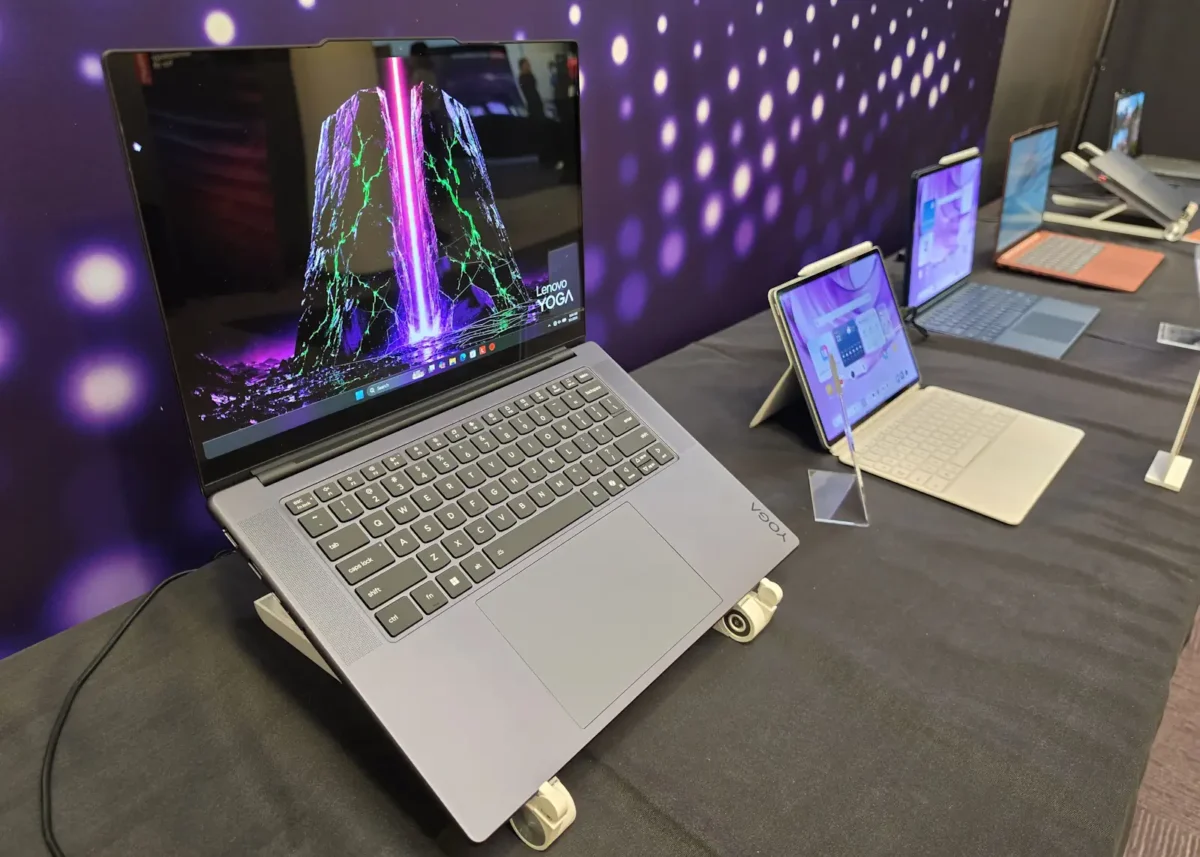
I got my hands on three different Nvidia RTX Spark laptops at IFA 2026: the Lenovo Yoga Pro 9n, its 2-in-1 sibling and the upcoming Dell XPS 16 with RTX Spark inside. But let me be entirely frank with you: Dell’s laptop was switched off while I wasn’t allowed to do anything with the Yoga Pro 9n systems other than press the Windows key to show that it did indeed work.
To misquote The Joker in The Dark Knight, “Why so cautious?” Well, I suspect that Nvidia doesn’t want anyone to use the laptops out of its own controlled conditions right now. We know that Windows running on ARM chipsets – as is the case with the RTX Spark – isn’t as easy to implement as on traditional x86 architecture.
Qualcomm has certainly been burned by reviews of its first flurry of laptops, and people still have a perception that Windows on ARM will have compatibility problems. In reality, that won’t be the case for most people – all mainstream apps now run natively on ARM, and those that don’t use Prism translation to run pretty darn smoothly.
So, I’ll repeat the question: Why so cautious, Nvidia?
Why Nvidia is cautious about RTX Spark laptops
The first reason is obvious: there are still bugs. I know from chatting to execs that there are “safe areas” to discuss but also numerous topics that are off the table. One person told me that it was so complicated, they decided not to talk about RTX Spark at all for fear of revealing something they shouldn’t.
It would be wrong to put all the emphasis on Nvidia. Its engineers will be working in tandem with Microsoft’s, and while Windows on ARM is now quite mature – Windows 10 on ARM launched in December 2017 – the RTX Spark platform is ambitious.
For a start, Nvidia is making big promises on games. To be precise, that AAA games will run at over 100 frames per second at 1440p (2,560 x 1,440 resolution). Until now, gaming has been a weak point on Windows on ARM: I’ve typically seen around 30fps at 1440p in AAA games, even on the top-end Qualcomm X2 Extreme chipsets. That’s if the games run at all.
While Nvidia obviously comes with truckloads of gaming experience, it is going to face challenges like no other to make games run at the promised rates.
The other question mark is over the AI developer experience. A Microsoft exec at the Acer IFA press launch said that one priority was to create “a streamlined experience to help builders build faster and create”. It’s one thing to do that for Windows 11 on x86, quite another on ARM.
Reasons why Lenovo, Nvidia and Dell can be cheerful about RTX Spark laptops
I may be proved wrong, but there are other areas where I think the hardware manufacturers, Nvidia and Microsoft won’t struggle. The first is battery life. This is an inherent strength of the ARM architecture, and while traditional Nvidia GPUs suck enough wattage to dim the sun I would expect them to work efficiently when not being pushed.
The other factor is that all of these RTX Spark laptops are beasts. Not up to the 3kg of older gaming laptops, but chunky and typically around 1.7kg to 2kg. That means plenty of space for big batteries – there’s a 92.5Wh unit in the Yoga Pro 9n – so I’m optimistic in this area.
The other factor is compatibility outside of games. Nvidia and Microsoft know they have to nail this out of the gate, and while they may say that older peripherals won’t be supported – drivers for aged hardware such as scanners and printers remains a challenge for Windows on ARM – I believe most of these challenges are now solved.
What about the Lenovo Yoga Pro 9n hardware itself
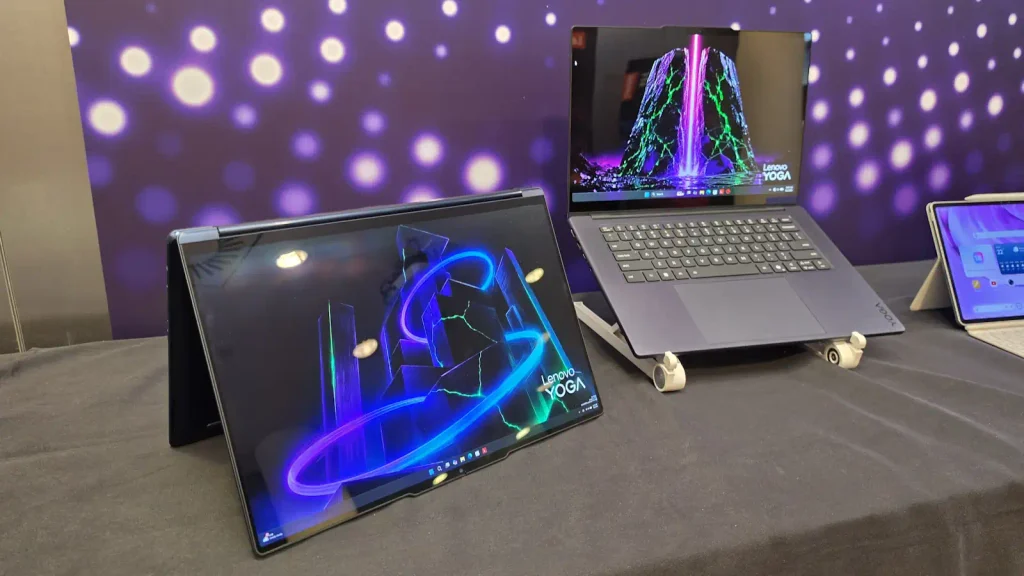
Lenovo Yoga Pro 9n 2-in-1 (left) next to the Lenovo Yoga Pro 9n (image: TechFinitive)
There is nothing overly remarkable about the Lenovo Yoga Pro 9n. It weighs 1.65kg (3.64lbs) and packs a 15.3in OLED panel with a 2,560 x 1,600 resolution. Which looks as good as you would expect on a premium laptop such as this.
It will come with up to 128GB of 256-bit 9,400MHz LPDDR5X RAM and include two SSD slots. One of these is slower (PCI-Express Gen 4 rather than Gen 5), going up to a maximum of 1TB. The other supports Gen 5 SSDs up to 2TB.
There are numerous ports, including a UHS-II SD card slot and two USB-C 4 ports. Plus the usual sprinkling of two USB-A ports, a 3.5mm jack and HDMI 2.1. This adds up to a strong setup, albeit lacking Thunderbolt or physical network ports (naturally Wi-Fi 7 is present).
It feels extremely solid in the hand, but so it should with a 100% aluminium chassis. It isn’t the slimmest around, however, and I confess that I find its Thunder Grey finish rather boring.
The final spec is its RTX Spark processor with a Grace CPU that includes up to 20 cores. The Blackwell RTX GPU will include up to 6,144 CUDA cores.
Lenovo Yoga Pro 9n 2-in-1
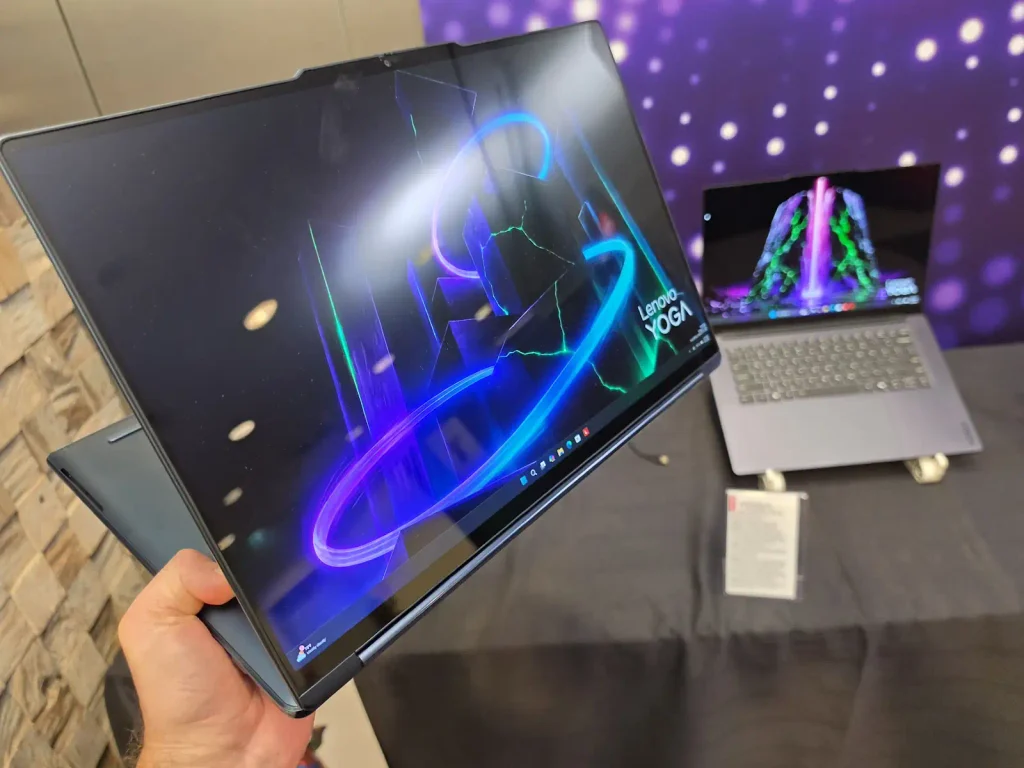
Lenovo Yoga Pro 9n 2-in-1 at IFA 2026 (image: TechFinitive)
Then we come to the Lenovo Yoga Pro 9n 2-in-1. I will concentrate on its differences to the Pro 9n, starting with a larger 16in panel (2,880 x 1,800 resolution). Once again, it’s a punch OLED display, so no complaints there.
Here the RAM goes up to 64GB and there’s only room for a single 2TB Gen 4 SSD. However, the battery is larger – 99.9Wh versus 92.5Wh – which is reflected in its 1.94kg/4.28lb weight. Again, it feels superbly built with a 100% aluminium chassis. It’s dressed in Cosmic Blue this time, but again this feels conservative.
It’s of similar bulk to the Yoga Pro 9n and packs identical ports, although this time the SD card slot is rated at UHS-I rather than UHS-II. And the CPU offering is identical.
Price and availability of RTX Spark laptops
So, we don’t yet have pricing on any RTX Spark laptops. That will come when they launch properly this autumn. When in the autumn? Well, I’ve been told off the record that this could be as soon as October. Only weeks away. Let’s hope that any bugs are fully squashed by that point.
About The Author
Tim Danton
Tim has worked in IT publishing since the days when all PCs were beige, and is editor-in-chief of the UK's PC Pro magazine. He has been writing about hardware for TechFinitive since 2023.
To provide the best experiences, we and our partners use technologies like cookies to store and/or access device information. Consenting to these technologies will allow us and our partners to process personal data such as browsing behavior or unique IDs on this site and show (non-) personalized ads. Not consenting or withdrawing consent, may adversely affect certain features and functions.
Click below to consent to the above or make granular choices. Your choices will be applied to this site only. You can change your settings at any time, including withdrawing your consent, by using the toggles on the Cookie Policy, or by clicking on the manage consent button at the bottom of the screen.
Functional
Always active
The technical storage or access is strictly necessary for the legitimate purpose of enabling the use of a specific service explicitly requested by the subscriber or user, or for the sole purpose of carrying out the transmission of a communication over an electronic communications network.
Preferences
The technical storage or access is necessary for the legitimate purpose of storing preferences that are not requested by the subscriber or user.
Statistics
The technical storage or access that is used exclusively for statistical purposes.The technical storage or access that is used exclusively for anonymous statistical purposes. Without a subpoena, voluntary compliance on the part of your Internet Service Provider, or additional records from a third party, information stored or retrieved for this purpose alone cannot usually be used to identify you.
Marketing
The technical storage or access is required to create user profiles to send advertising, or to track the user on a website or across several websites for similar marketing purposes.
To provide the best experiences, we use technologies like cookies to store and/or access device information. Consenting to these technologies will allow us to process data such as browsing behaviour or unique IDs on this site. Not consenting or withdrawing consent, may adversely affect certain features and functions.
Functional
Always active
The technical storage or access is strictly necessary for the legitimate purpose of enabling the use of a specific service explicitly requested by the subscriber or user, or for the sole purpose of carrying out the transmission of a communication over an electronic communications network.
Preferences
The technical storage or access is necessary for the legitimate purpose of storing preferences that are not requested by the subscriber or user.
Statistics
The technical storage or access that is used exclusively for statistical purposes.The technical storage or access that is used exclusively for anonymous statistical purposes. Without a subpoena, voluntary compliance on the part of your Internet Service Provider, or additional records from a third party, information stored or retrieved for this purpose alone cannot usually be used to identify you.
Marketing
The technical storage or access is required to create user profiles to send advertising, or to track the user on a website or across several websites for similar marketing purposes.

 Trending