Trending Topics

 Trending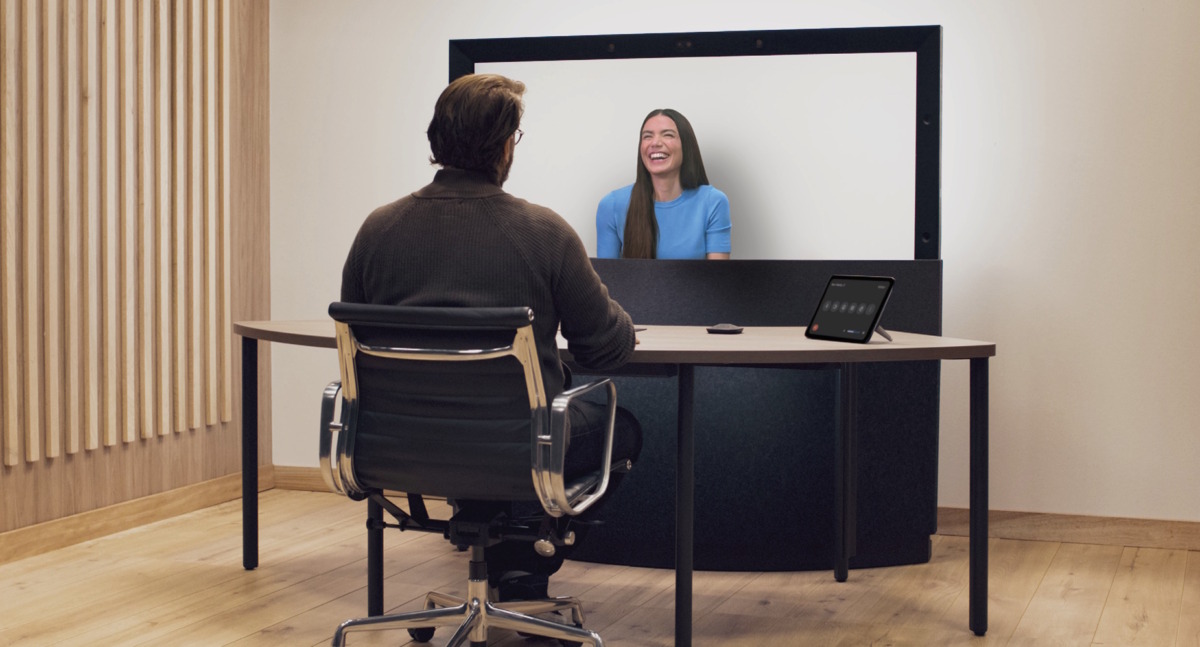
First-look review: HP Dimension with Google Beam

“So, what’s in there?” I asked Brian Phillips, HP’s Director of Product Marketing, who was guarding the door. “We’ll speak afterwards,” he said, a knowing smile on his face. “You’ll just have to wait.”
After a couple more attempts I gave up. Phil wasn’t for turning: I would just have to wait my turn in the demo room. All I knew was that I was dog-tired after a full day of announcements at HP Imagine 2026.
It was almost 5pm and, truth be told, I’d had my fill of demos at HP’s New York showcase. I was ready to head back to the hotel and collapse. Nothing was going to impress me at this point. Right?
Google Beam: a recap
Let me give you some background that Phil deliberately didn’t share before opening the door.
First, I’m going to take you back to May 2021, so in the midst of the Covid-19 pandemic, when Google announced Project Starline. “Imagine looking through a sort of magic window, and through that window, you see another person, life-size and in three dimensions,” Google promised. “You can talk naturally, gesture and make eye contact.”
It would take four years of research and development before Google was ready to make its next big announcement. But finally, at IO 2025, Google gave Project Starline a proper name of “Google Beam” and said that HP and Zoom would both be key partners.
One month later, HP revealed the official launch product, HP Dimension with Google Beam, at InfoComm 2025. After that it has been seen by the organisations HP and Google have in mind for such technology: think Deloitte, NEC, Salesforce.
And now TechFinitive. Once Phil let me into the room.
Google Beam me up
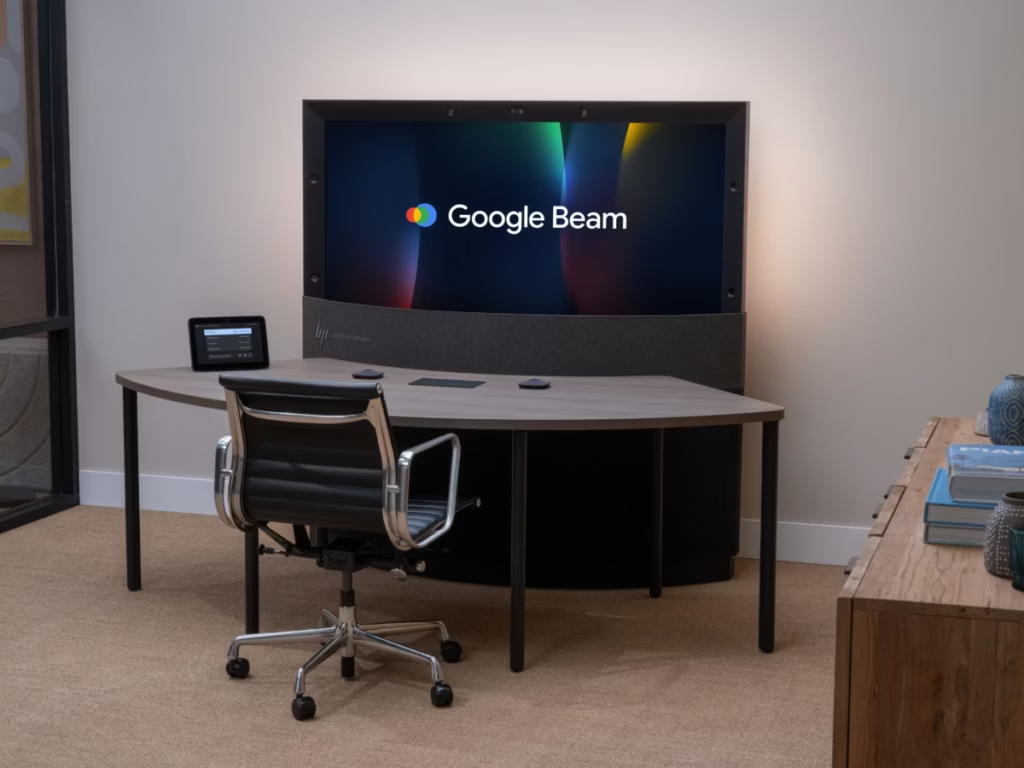
Phil is a cruel man and wouldn’t let me take a photo of the demonstration itself. Here, though, is the setup I saw as I walked in.
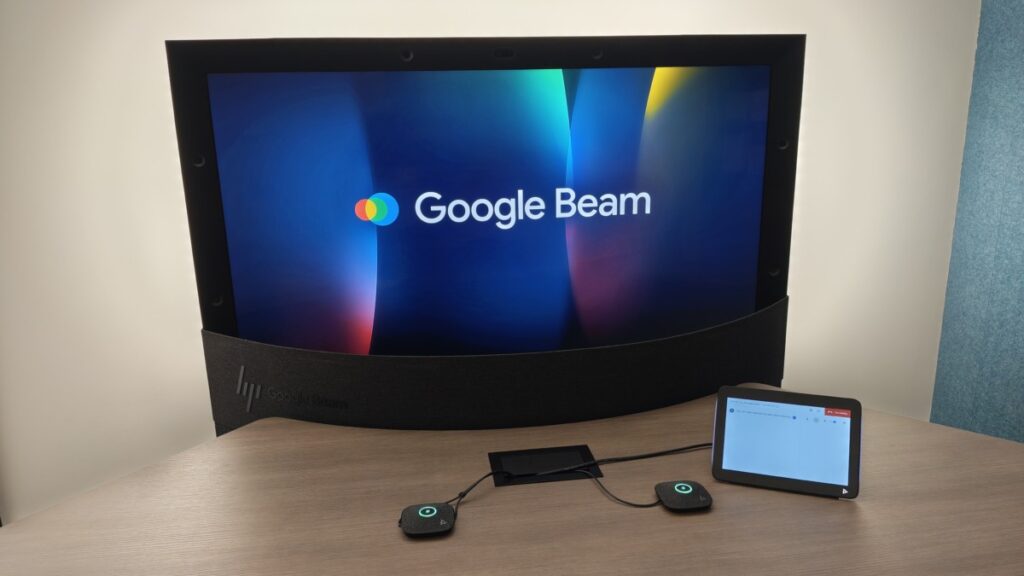
A giant screen surrounded by, if you look closely, multiple large-lens cameras. Check out the desk and you’ll see a pair of HP Poly microphones connected to a control tablet.
And that’s it. I could have been in any office anywhere in the world, right down to the faintly grim carpet.
Then Diane* appeared.
If I had closed my eyes before the screen sprang into action, I might have believed that Diane had walked through the door and sat opposite me: the effect is that realistic. As far as my eyes were concerned, she was sitting directly in front of me, just a couple of feet away.
The effect goes way beyond basic 3D. It boils down to Light Field technology, which captures exactly how light is bouncing off you and the person you’re viewing, from multiple angles. In this case, it’s immediately converted into a real-time video stream.
Here, it’s a high enough resolution that the human eye can’t see individual pixels – certainly I didn’t spot any – and the result is astonishingly close to the real thing. As if someone was there, two feet away.
But, Diane explained, she was actually sitting in an almost identical room almost 2,000 miles distant in Austin, Texas. There was no hint of lag to suggest this or the immense processing work happening in the background.
To demonstrate the 3D effect, Diane picked up an apple and held it out. “Go on, take it,” she said. I would love to tell you that HP and Google have also solved teleportation, but sadly when I reach for the apple my fingers clasped nothingness. But it’s a great demo of how physical this interaction feels, and how easy it would be to show photos, blueprints, papier-mâché replicas of famous New York buildings.
This done, there wasn’t much else to say to Diane. She ended the call, but even a day afterward I could recall her features just as vividly as other people I interviewed that day.
How the HP Dimension with Google Beam tech works
There are three key components to the HP Dimension with Google Beam. First, a 65in, three-dimensional light field display. Second, a system of seven cameras that capture your image from different angles. Third, a 12-mic beamforming array to ensure your every utterance is caught. These are accompanied by four high-fidelity speakers to add realistic spatial audio.
Google has spent the past five years working on the AI algorithms to turn all that captured information into one realistic stream. All of which requires no special glasses to work. You just sit there and let the magic (and it really does feel like magic) happen.
HP Dimension with Google Beam spoilers
On leaving the room, Brian was far more willing to chat. I confessed to being impressed, and asked the obvious question: how much? “We’re still figuring that out,” he said, although with the system due for release later this year HP needs to nail it down soon. “Around $25,000. Somewhere a little north of that, we think.”
Obviously, you will need two systems to make this work, so if we take that $25K figure at face value then it’s a $50K investment for a business. That’s a lot of money, but if it means you can avoid ten flights then the figures should quickly rack up.
Another use case is interviews for job roles. Again, you’ll get a far better idea of who you’re dealing with if they’re face to face. Plus there’s no room for AI deepfakery: you will definitely be speaking to another person on the end of the line.
And I genuinely think that for many use cases it’s worth it. For example, I know someone who works for a big tech company who manages a team of remote software developers: he’s in the UK, they’re in India. He flies out a couple of times a year for face-to-face meetings and uses Zoom for one-to-ones the rest of the time. It’s okay, but this tech would help strengthen those messages and provides visual cues that normal video simply can’t match.
Limitations of the tech
I’ve focused on one-to-one scenarios because right now that’s all the system can do. But HP told me that they haven’t ruled out future versions that support multiple people; however, that won’t be a software upgrade but a full v2 of the hardware.
The other downside is of course how much room this system takes up. I don’t think there’s a way to use this as your main work monitor, so it really is for a single use. One that will require a separate room dedicated to it in an office to avoid distractions.
There’s also the fact it will only launch with support for Zoom and Google Meet. I’m sure others will be added to that list if the Google Beam succeeds, but right now that’s a big limitation.
Nor will it go on sale worldwide. Initially, the HP Dimension with Google Beam will only be available only in the US, UK, Canada, France, Germany and Japan. (US companies can inquire here.)
Despite these limitations, I’m a huge fan of the technology. As I explained to Phil, I’ve stopped interviewing people over video as it’s too impersonal, too forced. This is a different experience altogether. Not quite face to face, but surprisingly close.
*I’m not sure Diane was her real name, but I forgot to ask. The effect was too distracting. Sorry, Diane/not Diane.
About The Author

Tim Danton
NEXT UP


