Trending Topics

 Trending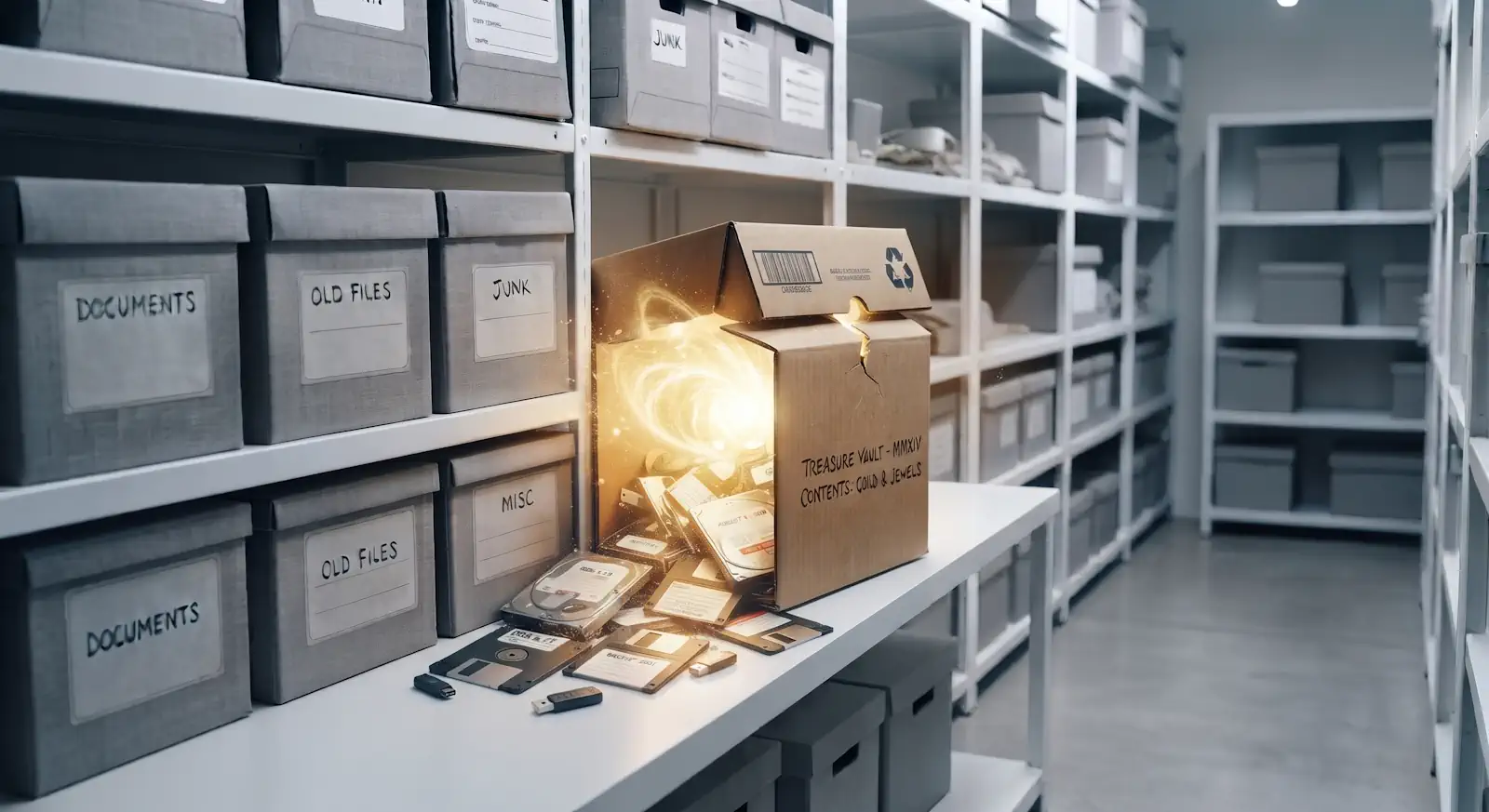
That box in storage might actually be your next revenue stream

Companies have spent years paying to store data they barely use, but firms like Iron Mountain are betting those forgotten archives can be turned into something people will actually pay for

Most companies are sitting on decades of material they barely use. Not because it lacks value, but because it is buried, disorganised, or simply too awkward to access. It sits in boxes, on tapes, or in cold storage, quietly racking up cost while doing very little else.
The idea that those archives might generate revenue is not new. Media companies have long licensed footage, and museums have built businesses around access to their collections. What’s changing is the push to industrialise that process, turning it from a niche activity into something repeatable and scalable.
That is the gap Iron Mountain believes it can fill with its Iron Mountain Amplify platform.
From preservation to profit
For years, the focus has been on protecting and digitising information. Organisations have spent heavily on storing physical assets and converting them into digital formats, often as part of compliance or risk reduction efforts. The result is a vast layer of content that is safe, searchable, and still largely underused.
Internally, the company frames this in three stages. As Rodrigo Coelho Ferreira, head of Product Management at Iron Mountain, puts it: “You’re going to hear three words a lot: ‘protect, connect and activate.”
The first two are well established. “If you think about it, in 2018 Iron Mountain was doing an amazing job in terms of protection… but no activation at all,” he says.
That final step, activation, is where the focus now sits. The goal is to take material that has already been stored and digitised and turn it into something that can be used, shared and, crucially, monetised.
“People are going to see us as a cost centre,” Ferreira says. “They’re buying the protection, they’re buying the connection, but it’s still just a cost to them.”
The shift is about changing that perception. “How can we enable them to activate it? How can we help them monetise what they have stored with us?”
The problem with “dark” archives
A recurring theme is just how much material sits unused. In one conversation that helped shape the product, an archive owner revealed that 95% of everything stored with Iron Mountain was never seen by the public.
That’s not unusual. Archives are built to preserve, not to promote. Content is catalogued, stored securely, and then left alone. Over time, it becomes effectively invisible.
Ferreira says the process tends to follow a familiar path, starting with getting a handle on what is actually in the archive and bringing it into a usable format.
“For the last seven years we’ve been maturing the solution… to understand what we have there, and help our customers to make more out of the data.”
That might sound obvious, but it is often the missing step. Even well-digitised archives can remain effectively “dark” if no one has defined who they are for or how they should be used.
Turning archives into products
Iron Mountain Amplify is designed to sit on top of the search and organisation foundation, adding a commercial layer. In practical terms, that means building out ways for organisations to package and increase the reach of their content to other businesses or consumers.
Some of those routes are familiar. “The first one is licensing, pure licensing,” Ferreira says.
Others are more structured. The platform can be used to create dedicated portals where partners can access and use material. “Creating a portal for commercial partners to come and have access to curated, pre-cleared assets,” he explains.
There is also a push into newer models, particularly around creators. One example involves opening up archives to content creators who can build new material on top of historical assets, sharing revenue in the process.
“Their idea is, I want creators to have access to the original and often forgotten stories,” Ferreira says.
As those creators publish and monetise their work, “the revenue comes back to the content owner.”
The emphasis throughout is on storytelling as much as technology. Even unlikely candidates can find an audience if the narrative is right. A cement company, for example, may not sound like a natural fit, but its archive spans major infrastructure projects and decades of industrial history.
“There are a lot of interesting stories, such as companies being part of the development of communities, fostering well-being and innovation. These can’t be fabricated, can’t be copied, they are heritage differentiators that deserve to be amplified and known by the public.” Ferreira says.
The challenge is surfacing those stories in a way that the audiences will engage with.
Proving what is real
One of the less obvious hurdles in monetising archives is trust. If content is going to be licensed or sold, particularly at scale, buyers need confidence in its authenticity.
That is where Iron Mountain Amplify’s “Iron Verify” component comes in. The idea is to tie each asset back to its origin, using metadata and digital fingerprints to prove provenance.
“We want to prove that whatever we were offering in the storefronts came from the archives,” Ferreira says.
The process involves collecting key metadata, such as where an item is stored, who created it, when, then anchoring that information in a blockchain record. Digital assets are digitally fingerprinted to create a unique identifier.
“In the future, if I want to prove that this image is the same original one that was found in the archives … I can prove that,” he says.
It is a technical layer that sits behind the scenes, but one that becomes increasingly important as archives move from internal systems into commercial environments.
Building value through collaboration
To maximise the impact of every archive, the platform focuses on close partnership and co-creation. Amplify is expanding through active customer onboarding, with each deployment tailored to the unique goals of the organisation.
That reflects the hands-on nature of the work. Activating and monetising archives is not just a technical exercise, but one that involves defining pricing, rights, distribution and audience on a case-by-case basis.
“So far, it has been a process of working together,” Ferreira says.
In some cases, customers arrive with a clear idea of how they want to commercialise their content. In others, the approach is developed collaboratively, with the platform and customer shaping the model together.
This collaborative model is validated internally: as Iron Mountain celebrates its own 75th anniversary, the company applied these exact archival capabilities to its own legacy. By taking 20 boxes of fragmented historical records – including a rare 1930s–1950s mushroom can from the company’s origin – and ingesting the digitised items into Amplify, the team transformed dormant history into searchable, shareable assets that actively power its 75th-anniversary campaign.
“As we have more customers, I think we’re going to naturally create this database of best practices,” he says.
A familiar idea, harder in practice
The broader idea behind Amplify is not particularly radical. Organisations have always known their archives have value. What has been missing is a straightforward way to unlock it.
The reality is that doing so requires more than just making content available. It demands structure, context, technology, and a clear route to market. This becomes even more critical in an AI-driven landscape, where proper content attribution to original owners is frequently lost. Amplify provides a framework that enables content owners to reclaim control, establish clear provenance, and directly realise the true value of their intellectual property.
With robust architecture and deep expertise across physical and digital management, the platform is establishing asset activation as a core capability for modern organisations. The shift from secure storage to measurable revenue is proving to be a natural evolutionary step for enterprise heritage and data – ensuring that without deliberate activation, archives may remain what they have long been: valuable, but largely untouched.
About The Author