Trending Topics

 Trending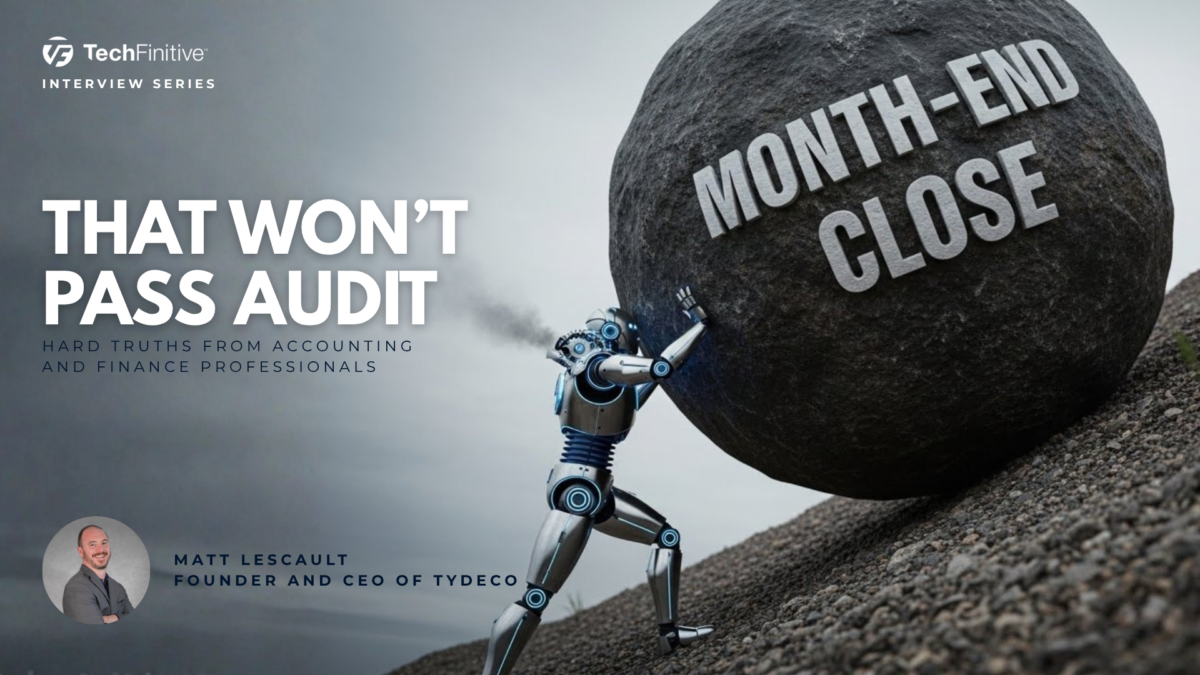
Matt Lescault, Founder and CEO of TydeCo: “I don’t think enough businesses truly value the revenue impact that a finance department delivers”

Matt Lescault has built his career around one simple principle: better systems lead to better businesses. As founder and CEO of TydeCo, he’s working at the intersection of finance and technology, helping businesses transition from manual processes to scalable cloud-based environments. He has the background: TydeCo itself grew from “a college attic with and idea and a Craigslist ad” he told us. It’s now a multinational advisory group.
For Matt, the evolution of finance in recent years has been both necessary and incomplete. As the pandemic accelerated the shift towards automation and cloud technology, organisations were forced to rethink how finance operates in the face of a fractured workforce. Despite that shift, he notes that there is still “a lot of talk around technology and a lot less doing”. Many teams today are stuck in a phase of uncertainty, unsure how to reach full potential for the modern finance function.
In short, while the tools available to finance teams have advanced significantly, adoption hasn’t kept up with that pace. Matt notes that processes like revenue recognition still largely remain managed through spreadsheets, meaning much of finance teams’ manpower is “being eaten” by unnecessary manual oversight. At the same time, without strong connections between systems, teams are left dealing with a “huge knowledge gap” between systems, making it harder for individuals to act on data even when given the opportunity to focus on un-automatable tasks.
But this isn’t a negative interview. Matt believes that the key to progressing through these issues lies in how organisations are managing this change internally. While the pressures to digitise continue to grow, he stresses that this adoption must be managed carefully, particularly where teams are lacking in confidence. “Fear drives decision-making more than probably any other human emotion,” Matt explains, and “to reduce fear for a team is to show them quick wins and how technology can make their life easier.”
With these challenges firmly in focus, we started by asking Matt how finance teams have already changed in recent years, and where the biggest oversights remain.
How has the role of the finance function changed in the last three to five years, and what do you think most organisations still underestimate about that shift?
Five years ago, COVID had been in full swing for about a year, and the entire world was in shutdown. If I think back to then, we were already seeing the advent of how AI (artificial intelligence) could impact the finance world. You saw AI in accounts payable, automation, and things of that nature. Before COVID, accountants felt less forced to embrace technology than post-COVID. In many ways, the pandemic shifted our reality of what we need to do as finance organizations. If we look at today, I’m still not seeing that finance professionals have fully embraced technology. What I am seeing is a lot of talk around technology and a lot less doing. There seems to be an analysis paralysis phase for some people who just don’t know how to execute, how to choose the right tech stack, and how to embrace the right approach and process change within the organization.
Three to five years ago, it was a concept and a forced approach to do what allowed us to be remote today, and we’re still not utilizing it in the same realm that we should be. Through the access and adoption of technology, organizations should be far more along the path of relying on finance as a strategic department within their organization, as opposed to a call center. What I mean by that is a lot of organizations view accounting as a thing that they have to get done, not as something that drives growth or strategizes with the organization. In my experience, I find that organizations underestimate the impact and value that a strong technology-driven finance team can bring to their organization, whether that’s an in-house team or an outsourced team. I think that non-finance people just assume that the accountants of yesterday have the skill set to drive forward the embracing of technology and that shift of the finance function.
Which accounting or finance processes are still far more manual than they should be, and what’s stopping teams from automating them?
There are many processes within accounting that can be more automated. Perhaps not fully automated, but more so than they are today. I’ll focus on two that I find very impactful and tend to be overlooked in my view. One is revenue recognition, and the other relates to expense allocation.
When it comes to revenue recognition, most organizations rely heavily on Excel and workbooks or worksheets to manage how they want to report revenue through different revenue streams or buckets. Whether that’s professional services, software revenue, or other areas similar to that. The reliance on the spreadsheet has a lot to do with the capability of the accounting software, as well as the overall structure of data within the accounting software.
When revenue recognition is managed through spreadsheets, especially as organizations scale from small businesses into mid-size, you’ll find that a large portion of their finance team’s capacity is being eaten by the management of these types of schedules. What we find in higher-level products and in solutions that support automation of revenue recognition is the ability to create functional statements or methodologies through the utilization of strong data structures. If you look at a database, it’s built out over fields and items that tell us what type of transaction we’re dealing with. So if we create methodologies around this in which the system knows how to defer revenue, recognize revenue, put it into certain buckets, and provide analysis over it, this moves us from spending most of our time in the tactical and transactional world of managing the actual revenue recognition. We can reallocate that time to actually evaluating or analyzing the information that it’s giving us.
Expense allocations are similar. Most organizations have some level of allocation. Increasingly, as businesses evolve, they have variable factors that go into how expenses should actually be allocated into appropriate buckets so that we have strong budgeting tools.
When you are able to be sophisticated in your budget and your cash flow management, then you are really able to be sophisticated in your forecasting. The first key to that is actually having strong allocation into your budgeting departments or budgeting buckets. Automated expense allocations are dynamic and variable, creating consistency around the data flow, allowing for strong end-of-day forecasting.
What are the biggest integration challenges between finance systems (ERP, payroll, billing, reporting), and how do they affect accuracy and agility?
Payroll integrations between payroll companies and ERPs are some of the more simplistic integrations that can be done and should be able to be handled pretty seamlessly at this point, given where technology is today.
CRM integrations are a different story. You need strong and true integration between organizations, CRMs, and their back office accounting solution. Some organizations find this integration challenging. CRM is driving the influx of revenue into organizations, managing the pre-sales through a contracting approach to a new client journey within the organization. This means that it holds the majority of data that the finance side of the house needs to actually invoice and operate for an organization, whether that’s product-based, service-based, or software-based.
What I find is that many organizations, especially those that are still in the emerging market component, have these disparate systems that are separate from each other. The CRM stops at the CRM, and the finance has to pick that up, creating this huge knowledge gap between the two systems and a large process gap, which integration would solve by reducing errors and increasing information and reporting from the organization from a true operational perspective.
What skills do modern accountants and finance professionals need today that weren’t essential five or ten years ago?
An invaluable skill is understanding how data structures impact analysis, and how to leverage that analysis.
Five years ago versus ten years ago is a huge difference and change in where technology was. Ten years ago, a server-based product was okay, and cloud-based was the future. Five years ago, a cloud-based product was the standard, but we had a disparate group of third-party products that did certain things.
What has always helped me from the very beginning of my career, almost twenty years ago, is my pure understanding of how databases work and how data structures support analysis. What’s transpired over the last five or ten years is that organizations understood this and started gathering data, but didn’t know how to really dig into it because it was all over the place. Now with AI and machine learning, you can really extract value from larger data sets. Ten years ago, an accountant needed to understand debits and credits, and I think today they need to be able to understand how data structures impact analysis, and how to take the analysis provided by AI and machine learning and extrapolate meaning from that information to drive business decisions. That’s a huge shift in what is expected from a finance department 10 years ago to five years ago to today.
What advice would you give to finance leaders who are under pressure to ‘digitise’ but lack internal buy-in or technical resources?
It’s an interesting question because it makes an assumption that there is pressure to digitize by the greater organization, and hesitation from the internal finance department, and potentially a lack of skill set in a finance department. That’s a tough combination of factors for a finance leader. The reality is that a set of expectations is being put on you that isn’t necessarily understood by the people giving that expectation. Now you become a change agent for the broader organization and your department. You have to start with figuring out what that lack of buy-in is and how to actually put together professional development for the staff to grow into that vision of the finance department.
I think it has a lot to do with fear when people push back if you’re trying to incorporate technology. And fear drives decision-making more than probably any other human emotion. To reduce fear for a team is to show them quick wins and how technology can make their life easier and how it can positively impact them. The first approach I would take would be to evaluate the processes and try to find some really simple ways to incorporate true technology into my team without them having to change a lot about what they do. For example, with enabled AP automation, the technology could auto-capture and auto-code recurring vendor invoices. This would enable an accountant to only review and approve, instead of manually entering data. Or, through using Ramp, which automatically imports, categorizes, and matches credit card transactions in real-time, eliminating the need to chase receipts and clean up at month end. If you can show how technology can support the organization, you start to shift that fear of change into an acceptance of change. If you go to the next step and you’re using products that have AI natively built into them, but it requires human intervention, and it shows how we can get answers faster, we’re breaking down that fear of change. By doing this, you are also giving them development around utilizing technology and providing a path forward.
There are two ways to handle this. You can do it the way I’ve mentioned above, by bringing along a team that may need a lot of coaching to get there, or you can go through a complete change and overhaul. This is an individual organization decision point. My preference is always to bring people along and get them to adapt to where the organization needs to go. Driving clear expectations to the team and to the greater organization is essential. Explaining that it will be a slower process and why. Make sure you own that message, and you manage those expectations. Because if you don’t, they will grow impatient.
Looking ahead, what do you think the finance function will be measured on in five years that it isn’t today?
I don’t think enough businesses truly value the revenue impact that a finance department delivers. What isn’t always evident is that a strong finance department, through cash management, tax strategy, investment strategy, invoicing collection, and process communication, impacts the bottom line of an organization far greater than ever has been communicated in a wide way in the business world. I think that finance departments have always tended to be looked at as a means to an end. The devil we have to have, because we have to have compliance.
I can tell you, from firsthand experience, that a strong finance team with a strong leader can make the company more valuable, produce more money, and create growth. If we, as a business community, shift towards that mentality and look at our investment in finance in that way, not only will we have stronger businesses, we’re going to unlock potential that we never knew we had.
Want to hear more from Matt? He co-hosts The Unofficial Sage Intacct Podcast, exploring the latest trends, challenges, and opportunities in the rapidly evolving world of Sage Intacct and the broader accounting industry.
More interviews
- Mat Clothier, CEO and Founder, Cloudhouse: “Change for the sake of change and rushed modernisation will only increase risk”
- How IT departments can stretch their budgets in 2026, repairable ThinkPads and what “AI PC” really means (exclusive interview with Lenovo)
- Alex Baulf, VP of Global Indirect Tax and e-Invoicing, Avalara: “AI works best when it is combined into well-governed processes”
- Dan Owens, CFO of Maxio: “The goal is not to automate everything”
- J.R. Faris, President and CEO of Accountalent: “Finance systems hardly have a common language”
About The Author

Rowan Campbell
NEXT UP


