Trending Topics

 Trending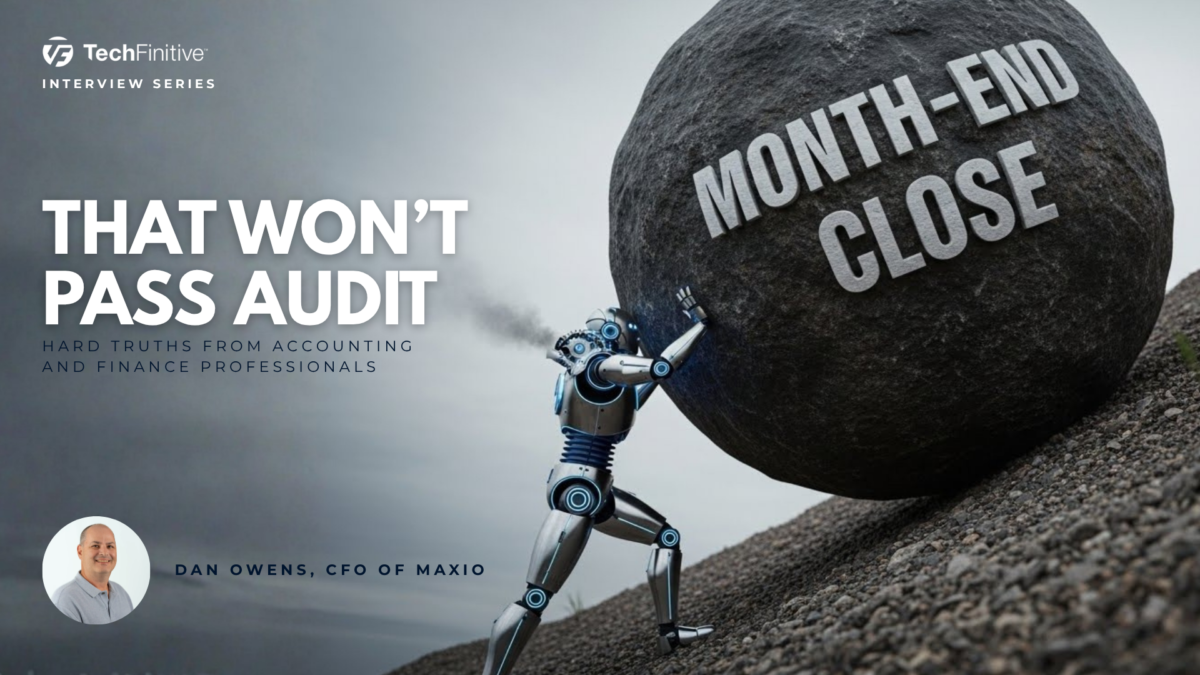
Dan Owens, CFO of Maxio: “The goal is not to automate everything”

The role of finance has changed forever. What once operated as a retrospective function has evolved into something far more future-focused, with finance teams now expected to “guide the business”. This is the shift that underlies our interview with Dan Owens, Chief Financial Officer of Maxio, who has two decades of experience with both private and public tech companies.
He explains that while this shift has allowed finance to play a more influential role, it’s also exposed challenges that many organisations fail to recognise. Especially when it comes to the strain on talent, with financial positions facing “a shortage similar to software development”.
Some might consider AI to be the perfect solution under all of these pressures, but Dan takes a more measured perspective. While “AI can improve efficiency”, he notes, finance functions operate best when human talents like “judgement, context and accountability” remain in focus. The real opportunity in Dan’s eyes comes when AI takes charge of the low-value grunt work, allowing teams to focus on applying their expertise where it can make the greatest difference.
So what does this mean for the future of finance? For Dan, it isn’t so much about doing things faster, but instead about doing the right things at the right time. He expects the function to soon be measured on its ability to deliver accurate information “early enough to act” rather than simply reporting results after the fact.
With this clear future in mind, the question is how companies can get there? With that in mind, we started by asking Dan about what exactly has already changed, and what issues we should focus on in the near future.
How has the role of the finance function changed in the last three to five years, and what do you think most organisations still underestimate about that shift?
Over the last three to five years, finance has shifted from a historical reporting function to a forward-looking, strategic partner expected to guide the business. That shift accelerated during COVID, when remote work disrupted the traditional apprenticeship model of learning through observation and informal mentoring. At the same time, the profession experienced a meaningful exodus, with experienced professionals leaving and fewer new entrants replacing them.
What many organisations underestimate is how structural that talent challenge is. Finance is facing a shortage similar to software development, but without the same attention or investment. Recruiting is difficult, and mentoring is harder when informal learning has been replaced by scheduled calls and async review. The risk isn’t just slower output. It’s thinner controls, greater reliance on tribal knowledge, and increased pressure on remaining teams.
There’s also an expectation, often at the board level, that AI will solve this. AI can improve efficiency, but finance is a control function where judgment, context, and accountability matter. The real opportunity is using technology to remove low-value work so teams can focus on analysis, forecasting, and advising the business, without assuming the expertise that makes finance reliable can be automated away.
Which accounting or finance processes are still far more manual than they should be, and what’s stopping teams from automating them?
Many finance teams still rely heavily on manual processes for revenue reconciliation, contract reviews, billing adjustments, cash application, and month-end close. These workflows often begin as reasonable stopgaps during rapid growth or pricing experimentation but tend to become permanent. The result is a patchwork of spreadsheets and manual checks that work, even when fragile. This is especially common in recurring revenue businesses where usage-based billing, mid-contract changes, renewals, and bespoke terms create constant edge cases.
What stops automation isn’t a lack of tools, but concern about risk. Finance teams are cautious about automating processes that affect revenue recognition, financial reporting, and audit outcomes. When automation is layered onto fragmented systems without clear ownership, audit trails, and exception handling, it creates new issues rather than eliminating old ones. Teams lose trust and fall back on manual work because a spreadsheet feels controllable, even if inefficient.
Another barrier is bandwidth. Finance teams are under pressure to close faster and respond to leadership while running day-to-day operations, leaving little capacity to redesign workflows. Organisations that succeed treat automation as a control-strengthening exercise, not just an efficiency play. When governance is built in through approvals, logging, and exception handling, finance trusts the outcome and auditors respect it.
How are you currently using data and analytics to support decision-making beyond compliance and reporting?
The real value of data and analytics is helping leaders understand what’s happening while there’s still time to act. In my role, that means using the data flowing through our platform to connect financial outcomes directly to operational drivers: contract terms, pricing decisions, usage patterns, retention dynamics, and the factors that drive expansion or churn. That connection allows finance to move beyond compliance and operate as a strategic partner.
Timeliness is critical. Perfect information that arrives weeks late doesn’t create leverage. Using Maxio, I work with consistent, trusted metrics that let me assess performance as it unfolds rather than after the fact. That includes seeing churn risk earlier, understanding cohort softness, evaluating the margin impact of discounting, and anticipating the cash implications of billing changes. When I trust the underlying data, I can engage earlier and help shape decisions instead of reconciling outcomes later.
The challenge is fragmentation. One of the biggest advantages of using Maxio internally is having billing, revenue, and reporting tied together in a single source of truth. That alignment reduces time spent defending numbers and increases time spent interpreting them. Instead of asking which number is right, the conversation shifts to what the data is telling us and what action to take next. That’s where finance adds the most value.
What impact has AI had on your finance or accounting workflows so far and where do you see the most realistic near-term value?
AI’s impact on my workflows and my team’s workflows has been practical rather than transformational, which is appropriate given finance’s role in risk management and control. At Maxio, we’ve focused on using AI in very specific areas where it can support analysis and reduce manual effort without replacing judgment or compromising auditability.
One clear example is during month-end close. We don’t have a dedicated FP&A function, so we’re using AI to act as a first-pass FP&A layer. At month end, it helps us analyze ARR movement, perform variance analysis against budget, and summarize what changed in the period. That allows the team to quickly identify patterns, anomalies, and areas that warrant deeper review – work that would otherwise take significantly longer to do manually.
Importantly, this doesn’t replace oversight or decision-making. The value is in narrowing the field of review so the team can focus on the issues that actually matter. Instead of spending time scanning for what might be wrong, we can start with a more informed view of what changed and why.
Finance operates under regulatory and audit requirements that demand explainability and accountability. The most realistic value I’ve seen is when AI strengthens controls and analysis by improving focus and consistency, rather than acting as a black box. Used that way, it helps experienced finance professionals work more effectively and with greater confidence.
How do you balance speed and automation with control, auditability, and regulatory compliance?
Speed and control are often treated as competing priorities, but in practice, they should reinforce each other. Well-designed automation should strengthen controls, not weaken them. The real risk shows up when organisations automate in the interest of speed without embedding clear approvals, audit trails, segregation of duties, and exception handling. In those cases, automation does not reduce risk. It amplifies it.
The goal is not to automate everything. It is to remove manual effort from repetitive, well-defined processes while preserving judgment where it matters most. Finance teams need clarity around what should happen by default, what requires review, and what triggers escalation. When those decisions are designed into workflows, consistency improves and compliance becomes part of day-to-day operations rather than a separate exercise that happens after the fact.
Regulatory expectations are also increasing, not decreasing. Finance teams cannot afford to trade governance for efficiency, especially as complexity grows. The organisations that move fastest over time are the ones that treat auditability as a design requirement from the beginning. That includes how changes are logged, how approvals are captured, and how exceptions are documented.
In practice, the fastest close is rarely the one with the fewest steps. It is the one that avoids rework because the controls were sound from the start. When automation is paired with discipline and transparency, finance can move quickly with confidence, knowing the numbers will hold up under scrutiny.
Looking ahead, what do you think the finance function will be measured on in five years that it isn’t today?
In five years, finance will be measured less on how quickly it can close the books and more on the quality and timeliness of insight it provides. Accuracy and compliance will remain essential, but they will be considered baseline expectations. The differentiator will be whether finance can help leadership understand what is happening in the business early enough to act, and whether those insights hold up under scrutiny.
Finance will increasingly be evaluated on its ability to connect financial outcomes to operational drivers and explain cause and effect. Leaders will expect finance to articulate why performance changed, where risk is emerging, and what trade-offs should be considered. In recurring revenue models, this also includes explaining retention dynamics, expansion drivers, pricing and packaging impacts, and the cash implications of billing terms.
In an environment where data is abundant but trust is scarce, credibility will become a primary measure of finance performance. Finance teams that can provide consistent answers quickly and show the story behind the numbers will have an outsized influence. Teams that invest in both strong systems and strong talent will be best positioned for this shift. Ultimately, success will be defined by decision confidence and the ability to move forward without relying on numbers that will not pass the audit.
More interviews
- Jean Marc Pestoni, Head of North America Business at Data Migration International (DMI): “When ERP works properly, leaders stop debating whose numbers are correct”
- Wendy Walker, VP of Regulatory Affairs at Sovos: “Finance increasingly serves as a bridge between accounting, IT, operations and compliance”
- Tim Stuart, Chief Financial Officer at Ricoh Europe: “Finance teams do need a stronger grasp of data”
About The Author

Rowan Campbell
NEXT UP


