Trending Topics

 Trending
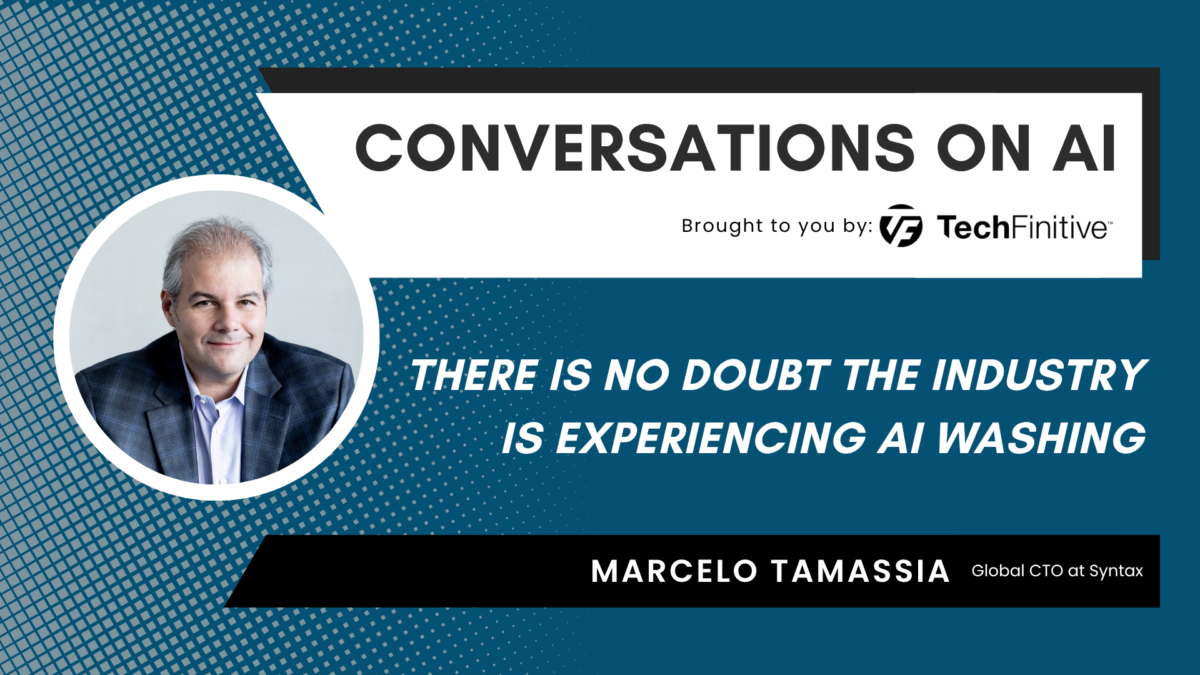
Marcelo Tamassia, Global CTO at Syntax: “There is no doubt the industry is experiencing AI washing”

We’re not totally sure if Marcelo Tamassia, Global Chief Technology Officer of Syntax, was a diver in his past, but if not then he’s come up with one of the more striking metaphors for enterprise AI adoption. “I think of it as a little like diving: when you leave the board, you can only see so many yards in front of you.”
At start, he explains, your field of view is dominated by technology. So you “sign up for OpenAI, ChatGPT, Anthropic or another model provider and assume that having access to the technology solves the problem”.
Then they go deeper, says Marcelo, and “discover that integration alone doesn’t make AI work in an enterprise environment. They need governance. They need to understand security and trust.”
And so the journey continues, at which point many companies are possibly consumed by the whirlpool of AI despair. That’s our metaphor, not Marcelo’s, because if you immerse yourself in this interview – part of our series Conversations on AI – then you will hopefully start to see the wider picture.
Before you dive in yourself, a brief word on why you should listen to Marcelo at all. First, he’s been there, seen it and bought the swimsuit over a 20-year career – including being Co-Founder of EmeraldCube Solutions, before it was acquired by Syntax in 2019.
He now leads Syntax’s AWS cloud practice and software R&D, having previously managed global ERP projects, and holds advanced certifications from AWS, Oracle and Microsoft.
Our huge thanks to Marcelo for taking the time to share his thoughts on this pivotal subject.
Everyone says AI is transforming software, but where do you believe the industry is still overestimating its impact and where is it underestimating it?
We are overestimating companies’ ability to deploy transformative AI solutions, and actually this isn’t simply an AI-specific problem. Transformation has an enormous impact on the business, so leaders naturally want to move as quickly as possible. But the human element, along with legacy systems, tools and processes can only move so fast. The reality is that technology is advancing faster than most companies’ ability to adopt it, and that adoption gap gets wider as companies accumulate more technical debt.
Think about the AI value chain: AI labs are investing billions in GPU capacity to build increasingly capable models. Those models then move into the hands of people building applications, solutions and systems that ultimately deliver outcomes to customers. At each step down that value chain, the pace slows. The last mile is particularly difficult because it involves customers, people, resources, processes and real-world constraints.
At the same time, we are underestimating what the technology itself can do. AI is advancing at a pace that is difficult for organisations to fully comprehend. That creates a widening gap: AI capability is accelerating while organisational adoption remains constrained. The challenge for companies today is figuring out how to close or manage this gap.
Many SaaS vendors now describe themselves as “AI-powered”. What actually separates companies creating real customer value from those simply adding AI features?
There is no doubt the industry is experiencing AI washing. Almost every SaaS company now describes itself as “AI-powered” or has added AI capabilities, making it increasingly difficult for customers to separate marketing from meaningful AI maturity.
The key question customers need to ask is this: Is AI simply being layered onto an existing product, or is it fundamentally changing how the product works and its value proposition?
Any company can build a copilot-like chatbot or add an AI feature to an existing workflow. Those capabilities can be useful, but they are often duct tape on an existing process. The companies creating real customer value are further along the AI maturity curve. They are redesigning workflows, interfaces and entire processes around what AI makes possible, fundamentally changing the user experience and the outcomes customers can achieve.
One of the clearest indicators of that maturity is the commercial model. If AI changes the product but doesn’t change how the company charges for it, that’s a signal worth questioning. When AI truly transforms the value being delivered, companies can pass that value downstream to their customers by creating a different commercial construct that aligns pricing with the outcomes customers receive.
So, you’ve got AI washing on one end, copilots and add-ons in the middle, and AI-native transformation with new commercial models on the other end. Customers should look for where a company sits on that spectrum.
What is the biggest misconception enterprise customers still have about adopting AI within business-critical software?
Honestly, there’s more than one misconception, and it changes depending on where a customer is on the AI maturity curve.
I think of it a little like diving: when you leave the board, you can only see so many yards in front of you. Early on, customers tend to see AI as primarily a technology problem. So, they sign up for OpenAI, ChatGPT, Anthropic or another model provider and assume that having access to the technology solves the problem.
Then they get a little deeper and realise they need to connect AI to their systems and data. Once they do that, they discover that integration alone doesn’t make AI work in an enterprise environment. They need governance. They need to understand security and trust. They need to manage costs and determine where AI actually delivers a return.
And that’s the bigger misconception: there is no single AI adoption problem to solve. New obstacles emerge at each stage along the AI maturity curve. Early on, it’s about adoption. Then it becomes about data, integration, governance, trust and ultimately economics. Each layer exposes the next challenge.
The key to overcoming them all is viewing AI adoption as a maturity curve rather than a technology solution.
How is AI changing the role of your customers? Are you replacing repetitive work, augmenting decision-making or fundamentally changing how people do their jobs?
I believe AI is changing customer expectations more than it is changing their role. CFOs want to pay less. CIOs want to get more value from their investments. And CIOs increasingly need data and measurable results to take to their boards and demonstrate that the company is actually capturing value from AI. Across all of these stakeholders, the expectation is the same: better, faster and cheaper.
This isn’t new. We’ve seen the same dynamic play out with the internet, email, cloud, containers, SaaS, and other major technology transformations. Every time, technology changes what customers believe is possible, and once that happens, those new expectations become the baseline.
AI is accelerating that cycle because it can fundamentally change how quickly and efficiently companies execute. Customers understand that if a provider can deliver the same – or better- outcome with dramatically less effort, that increased productivity should ultimately be reflected in the commercial model.
That is why I believe we’re going to see a fundamental shift away from traditional time-based billing. Customers don’t ultimately care how many hours it takes to produce an outcome. Rather, they care about the outcome itself. As AI changes the economics of delivery, we’ll see more milestone-based, consumption-based and, ultimately, outcome-based commercial models.
How do you balance innovation with responsible AI? Where do you draw the line between moving quickly and ensuring customers can trust the outputs?
I don’t think the balance is between innovation and responsible AI. Responsible AI has to be part of how you innovate. Move quickly but never move faster than your ability to establish trust.
Most companies still treat AI risk primarily as a compliance problem. I think that’s too narrow. It’s fundamentally a trust problem. When AI is deployed without clear guardrails, the exposure goes beyond technical vulnerabilities to privacy, compliance, security and reputational risk.
Trust is the foundation of every digital relationship. Customers trust you with their data and trust your systems to make decisions responsibly. AI introduces a new question into that relationship: Can I trust your intelligence?
If you can’t explain what data an AI system is using, how it generates its outputs, how decisions are made, or how bias and misuse are being addressed, then you haven’t built trust.
That’s why I believe in secure and responsible AI by design. Governance, security, privacy, explainability/traceability and accountability need to be embedded from the first design decision, not retrofitted after deployment. This formula allows companies to innovate rapidly while maintaining responsible AI and security throughout.
Compliance gives you a floor. Trust is the ceiling. The goal isn’t to choose between moving fast and moving responsibly. It’s to engineer trust into the system so you can do both.
Beyond productivity gains, what business outcome are your customers most excited about when they invest in AI?
Most customers are trying to answer one fundamental question: What does AI look like in the P&L, and how do I tell that story to my board?
Productivity gains are part of that equation, but at this point, they’re becoming table stakes. We’re more than three years into the generative AI cycle. If a company isn’t already using AI for things like translation, email, summarization and other basic productivity use cases, it’s severely behind.
What really excites customers is AI as a leap mechanism for transformation—the ability to do something they couldn’t realistically do before. And what that looks like varies significantly by industry.
If you manufacture doors, for example, generative AI probably isn’t going to completely transform your manufacturing floor. It can certainly create efficiencies, but the bigger opportunity might be transforming how you engage customers, personalize experiences or bring products to market.
The companies getting most excited about AI are the ones identifying an opportunity to do something they couldn’t do before and leapfrog their competition—whether that’s through customer service, the broader customer experience or the product itself.
That’s the story customers want to take to their boards. It’s no longer enough to show that AI simply reduced a cost line. They want to show that it changed what the business is capable of doing. That’s what turns AI from a productivity investment into a strategic one and ultimately determines where the next dollar of AI spending goes.
More great interviews
- Egor Dubrovsky, CEO and Co-Founder of Filmustage: “Software won’t fix a culture where 74% of people kept working through a personal crisis with no support”
- Natalie Ogude, Partner at JMAN Group: “The future will be about applications moving towards becoming a group of intelligent agents”
- Ilia Razvin, Founder and CEO of IOSYA: “The future is not an improved yesterday.”
- Derek Slager, Co-Founder & Co-CEO at Amperity: “We are overestimating AI’s impact on traditional software”
About The Author