Trending Topics

 Trending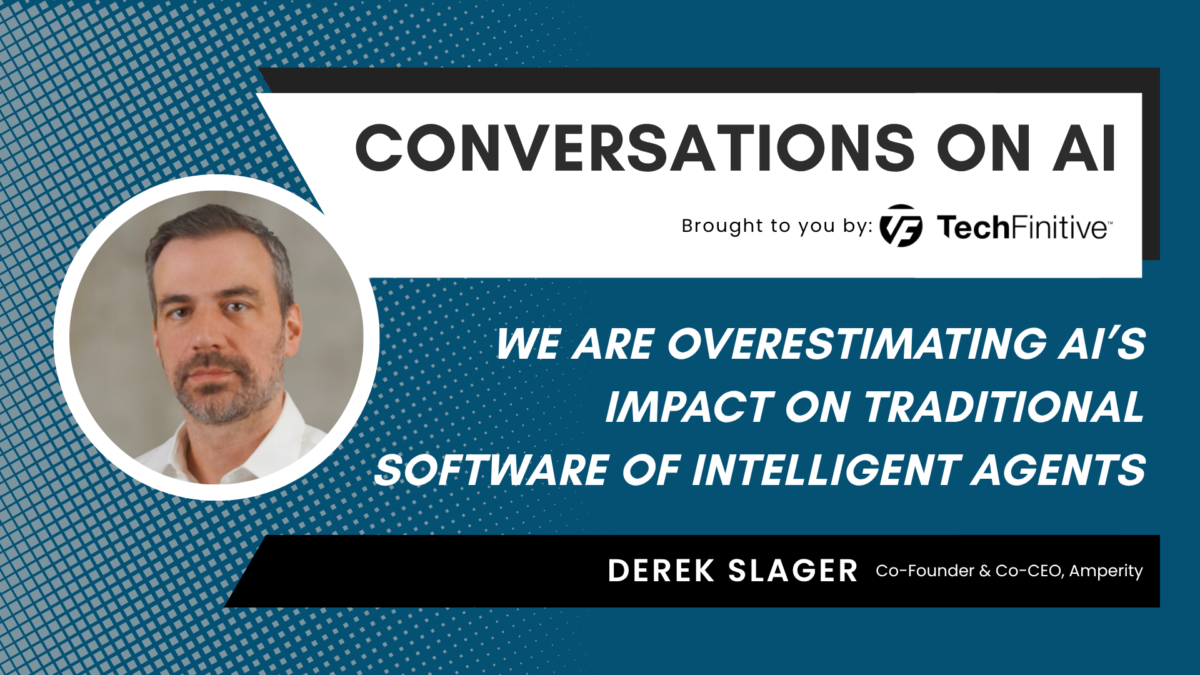
Derek Slager, Co-Founder & Co-CEO at Amperity: “We are overestimating AI’s impact on traditional software”

Have you just vibe coded a dashboard and given yourself a pat on the back for your cleverness? Not so fast, says Derek Slager, Co-Founder and Co-CEO of Amperity. “Yes, anybody can trivially vibe code a dashboard or an app,” he concedes in this Conversations on AI interview, “but what does that look like six months later after 50-100 AI additions?” The answer is that no-one knows. Which is why expertise still matters.
There’s certainly shortage of expertise at Amperity. The company, founded a decade ago, describes itself as “the AI-powered Customer Data Cloud that helps brands act on real-time customer context”. And it’s used by many famous brands, including DICK’s Sporting Goods, Virgin Atlantic and Wyndham Hotels & Resorts.
You’ll notice the phrase “AI-powered” in Amperity’s description, and it’s clear that Derek isn’t always impressed by companies that use the term loosely. “The companies using AI to create real customer value are getting paid for it, because it correlates to business results,” he says. And merely boosting workflows by a few percentage points doesn’t impress him: it’s just not worth paying for.
It’s also fascinating to hear Derek’s take on what separates the companies that are thriving in this AI era and those who aren’t. Often the ones who “throw out what was working and replace it with what they expect to work in the near future”, he says.
But don’t confuse this with abandoning the data that sits beneath any successful model. “Building a strong data foundation to enable models to perform well will likely continue to be the single best investment a company can make in the AI era,” says Derek.
The good news is that Derek is a man who chooses his words wisely. Reading this interview should only take you three minutes. And it may well be the best three minutes you spend all day.
Everyone says AI is transforming software, but where do you believe the industry is still overestimating its impact and where is it underestimating it?
We are overestimating AI’s impact on traditional software, and underestimating its transformative ability in coordinating and organising work.
I like to remind people that SaaS has two S’s, and only one of them is software. Yes, somebody can vibe code a basic app over the weekend. But ensuring that it’s available 99.99% of the time, secure and well supported is still the domain of professional teams focused on operational excellence.
At the same time, I think people underappreciate the value of AI in distilling information and coordinating work. A frontier AI agent can effectively read the equivalent of a Harry Potter book worth of information in seconds, and make or suggest decisions on what to do with that information in essentially real-time. This can be transformative for companies willing to realign their business processes to take advantage.
Many SaaS vendors now describe themselves as “AI-powered”. What actually separates companies creating real customer value from those simply adding AI features?
Bluntly put, follow the money. The companies using AI to create real customer value are getting paid for it, because it correlates to business results. This is not to say that an AI-powered assistant in a traditional product surface isn’t useful, but speeding up an existing workflow by 10-20% isn’t transformative in the AI era and it’s certainly not worth paying for. The focus should be on outcomes which drive substantial improvements in measurable financial metrics.
What is the biggest misconception enterprise customers still have about adopting AI within business-critical software?
The biggest misconception is that anybody can use AI to do things that are outside of their domain of expertise. Yes, anybody can trivially vibe code a dashboard or an app, but what does that look like six months later after 50-100 AI additions? Even the best AI models tend to follow the path of least resistance, and expertise is required to keep a system architecture coherent and to make something reliable and maintainable. Expertise still has substantial value at the frontier, and likely will for the foreseeable future.
How is AI changing the role of your customers? Are you replacing repetitive work, augmenting decision-making, or fundamentally changing how people do their jobs?
Of course it’s all of the above, at different scales depending on the company, industry and risk profile. I think the most important point is that fundamentally changing how people do their jobs typically requires significant organisational change. Teams must work differently and coordinate differently to fully benefit from AI’s capabilities, and that’s often far more difficult than simply deploying technology.
The ‘easy wins’ for AI tend to make things move faster within existing structures, and while these are often quite valuable they do not allow an organisation to move an order of magnitude faster. There are many small AI-first and AI-native companies proving that this is possible if you build for it from the beginning, the challenge will be for legacy organisations to have the boldness to rethink how work gets done to compete.
What has been the hardest challenge in bringing AI capabilities into your products? Technology, data quality, customer trust, regulation, pricing or something else?
The hardest challenge is that AI is a very fast moving target. The “right approach” to AI just one year ago is substantially different today given major leaps in model capabilities and tooling. Organisations that are thriving in this era are often the first to throw out what was working and replace it with what they expect to work in the near future.
With that said, some things are always true – regardless of model capabilities, having a rich and reliable context layer will be a massive amplifier for those capabilities in one’s organisation. Building a strong data foundation to enable models to perform well will likely continue to be the single best investment a company can make in the AI era.
There’s growing discussion around AI agents replacing traditional software workflows. Do you see the future as applications becoming collections of intelligent agents, or will conventional interfaces remain central?
Conventional interfaces will be around for the foreseeable future, but I don’t think we should see these as competitive. For many tasks, a well designed conventional interface will simply be the fastest and most reliable way to accomplish a task. However, for tasks that drift outside of those well-defined boundaries, AI agents will undoubtedly do a great job filling in the gaps.
The magic of AI agents is that they can essentially build on-demand solutions to challenging problems that don’t quite fit into the neat lines often expected by conventional interfaces. This adds significant value to both, in that conventional interfaces can be more focused on the repeatable use cases, making them simpler and more reliable, with AI agents filling in the rest.
Some great reads from our Opinions section
About The Author