Trending Topics

 Trending

Exclusive interview: UCL Professor Mark Miodownik explains what washing machines tell us about the state of sustainability in 2026

Have you ever wondered why technology is so expensive and difficult to repair?
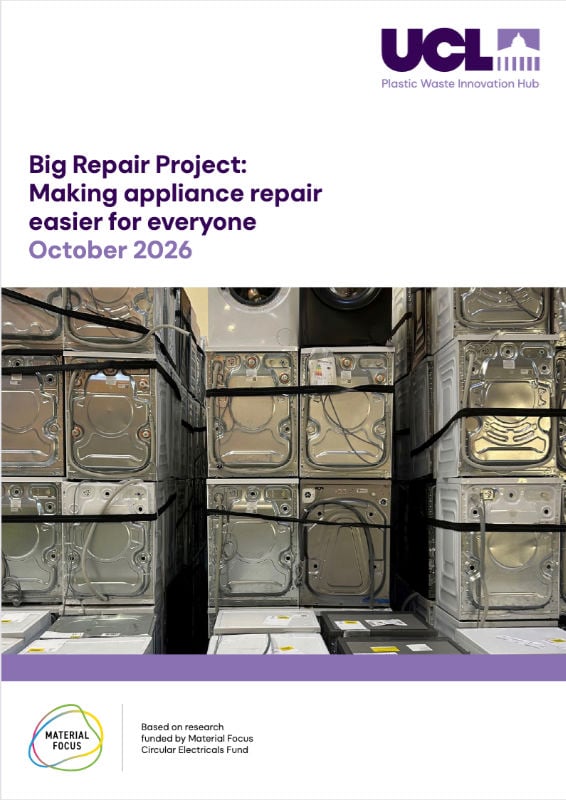
A new report from University College London, “Making appliance repair easier for everyone”, reveals that our desire to fix is not stymied by an unwillingness to repair, but by systemic business practices using poor supply chain management and outdated business models.
Professor Mark Miodownik led the research. In this exclusive interview, he explains why the humble washing machine could unlock greater business profits and generate customer loyalty whilst averting an incoming e-waste crisis.
Domestic appliances rarely come to mind regarding tech supply chains. Why did you base your study on washing machines?
Washing machines have a 98% penetration of the UK market. It’s a ubiquitous, important product that’s not a luxury. It’s important for equality, for people’s quality of life and a must-have. All the boxes are ticked in terms of people needing it whilst getting the best value for money. The question is, what is best value for money and how do we make that align with sustainability?
For technologies like washing machines, which are very mature, it doesn’t make sense that their lifespan is going down. We’re flagging up the fact that you can see there’s an argument for churn in smartphones around innovation, but there’s little argument in the washing machine world.
As washing machines are a mature technology, are they easy to fix?
No, and it’s the outcome of high competition in the marketplace, which is providing increasingly reduced prices of a new machine and incredible service. If you buy a new machine, you can get it installed the next day. They turn up and take your old one away. That is a triumph of the manufacturers.
What’s not being optimised is repair and longevity because that isn’t what the market wants. Having done a deep dive, I don’t blame the manufacturers. I think it’s an inevitable systems outcome of a highly competitive market. It externalises environmental costs so that manufacturing don’t have to pay them and the users don’t have to pay them.
What you get is the cheapest stuff with no incentive to make them repairable.
Your report notes that past repair experience drives future repairs. Does this suggest a strong public appetite for fixing things?
Yes. The first thing that drives repair is cost and it’s pretty much the major factor in decision driving. Once people have decided that repair is a decent offer, they want to do it. Sadly other barriers come into play which might mean they don’t have it repaired.
One thing we wanted to address is that people want to repair stuff. They just find it too expensive. Then, even when they don’t find it too expensive, they still find it hard to do. We went in real depth and it seems like the state could do something about those barriers.
Was there anything that surprised you from your deep dive?
One puzzle from an engineering point of view is why there are so many parts across all the different models when it’s a very mature technology? Part development has not converged. It’s done the opposite and that is a barrier to repair. Things like which part do you need and is it available? Also, what part number does it have? Even within the same OEM, there are different part numbers for the same thing. These things seem confusing.
We visited the parts factories, which was like that scene at the end of “Raiders of the Lost Ark”. A warehouse that went on for beyond your eyesight could see housing over a million spare parts for the UK and for all the models of washing machines.
Why doesn’t it make sense for that OEM to converge to a much smaller set of spare parts? That was one puzzle we were trying to get our heads around and say, “Why are they constantly having many types of motors and different types of bearing? Why does the business drive it that way? Why does the global supply chain drive it that way?”
We didn’t get fantastic answers but we were told that there’s a distributive supply chain with many suppliers of each type of part. That’s intentional because they want it to be robust. Then, an individual part might have some problems, so there’s an adjustment to the design. That then goes into production but it doesn’t talk to another model which has a different supply chain for the same part. The parts diverge and never come back together again, so you can never get the same motor or the same pump for all the machines.
Isn’t this a hindrance to the manufacturer?
You’d imagine that the complexity of this supply chain would be a downside but in order to converge them, the company needs to do a lot of work, which I would have thought would be rewarded. However, repair is not deemed, in most of these organisations, a profit centre. Essentially, it’s just a way of meeting their warranty liabilities.
You don’t get the same people in charge saying, “If we want to increase profits in repair, we really need to do this bit of work”. It’s deemed that you have to constantly compete in the marketplace by reducing costs for the new machines. There seems to be much more concentration on pleasing the customer who is buying new and not pleasing the repair customer who wants their machine to last for 20 years.
Overarchingly, it’s about the complexity of supply chain, which is a business decision and it’s about profit centres within the businesses which are not concentrated on longevity of the product.
Is it that to satisfy customers who are not buying new products, technology vendors are often not trying hard enough?
Yes, and I hope that the business sector really takes this on board because we showed that the ability to wash clothes in your home is a service and not an opportunity to constantly sell you new stuff.
If manufacturers were to approach it that way by delivering a new machine and then make money keeping it going over time, it’s a more profitable business model. We showed that really clearly.
This is very true for the middle range washing machines, so £350 in the UK, and for the higher range. That’s where the money is. At the bottom end (cheap washing machines), manufacturers are making £5 profit per new machine, which is ridiculous. People make more profit from a meal at a restaurant. So there’s a global supply chain with a complex set of factories making £5 profit because there is so much competition at the bottom end.
However, they make £30 profit on a repair and what they can’t do is switch their business to persuading their customers that they’ll support their machine for longer. It’s still a win-win because the customer pays them £150 for a repair after five or six years, which is still cheaper than buying a replacement. Our survey showed people are happy to do that, so the manufacturers could make £30 profit rather than £5.
It makes sense if they could deliver that repair, but one barrier is that the customers don’t trust them. Out of warranty, they will not go back to the manufacturer because they think they’re a corporate who will just want to sell them an expensive new product. Customers don’t even think it’s worth talking to them.
That’s fascinating.
It’s so interesting. As the repair economy is not a thriving economy for the OEMs, the customer experience is often sub-optimal. All the customer experience and loveliness is concentrated on trying to sell you something new.
In order to make the shift, these companies really have to believe that’s where the money is. It’s also where the sustainability is, so it could be a win for everyone and the environment.
If OEMs stopped spending 90% of their effort trying to sell you a new machine and 10% of their effort repairing it under warranty and switched to 10% selling a new machine which would last 20 years in your home, then people would pay decent prices and they make a profit. Everyone’s happy.
That’s where the future is. However, the shift of this business model is just head-scratchingly hard for the OEMs.
Much of the Right-to-Repair legislation focuses on the availability of spare parts and not on the pricing. How much of a problem is that?
I’ll give you an example of why it’s difficult. Some companies make the parts business a separate entity within their group. Therefore, it has to make a profit. They give the parts at cost price for warranty repairs, but sell them for profit within the company for non-warranty repairs. The prices go up and people don’t want them. If you want to switch your business model, sell cheap parts and make money on the customer service by turning up on time and doing a good job.
Another factor is how to make a profit from repairs. Right to repair is driven by individuals who are very passionate but I think it’s the professional repairers who need the most help from legislation. We also pointed out that they need a recognised certification so people feel assured. It can be independent and doesn’t need to be associated with an OEM but someone really needs to kind of professionalise repair.
As a country, it is dignified and strategically vital that every home has access to a professional repairman for electricals. They did it for gas, which was a safety issue and the government should do it for electricals. I think that would be our big ask.
Amen. Critically, we’re also losing skilled repair technicians because of an aging workforce.
People should be able to make a career out of it. We should dignify it and I come back to that word. It should be well paid because we’re losing jobs and if you go towards the repair economy. We can bank jobs in the UK, good local jobs, and people can lead a dignified life.
If you go down the route we’ve gone down, which is selling cheap, you’re basically paying for jobs in other countries. It reduces the resilience of the country to any disruption and that doesn’t seem like a smart move at the moment.
Some of the UK’s ability to recycle white-goods has reached a point where processing has stopped. As the system is not built for repair, we buy new and too much waste is generated. Are we stuck in a linear economy?
It’s a strange situation that we’re in. Essentially, we’re picking up the bill in the UK for waste. As soon as you get the huge waste pile, it becomes expensive, so the local authorities charge customers and then people start dumping. It seems so obvious that the circular economy, and particularly the repair economy, would really ameliorate some of these issues that are becoming extreme.
It would be very hard for the British government to say, “If you sell a washing machine to this country below a certain price, it’s just actually going to be a net loss for the country because we are picking up the pieces of the waste”. It’s then hard for politicians to then say, “You have to have a minimum quality of repairability”. As this would increase costs, people will say that prices have risen.
The truth is that below a certain price, it isn’t cheaper to repair. It’s more expensive.
I’ve met people who’ve said “The cheapest way for me to have a washing machine is to buy the cheapest one on the market, and as soon as there’s one thing wrong, even it’s just a button, I just get a new one”.
So is there an e-waste crisis rocketing towards this country?
Yes. We visited an e-waste recycler and business is thriving. As there’s so much e-waste, of course, it’s a fantastic business to be in to get out the valuable metals.
They separate the aluminium, the steel, the stainless steel and the motherboards but the money is not coming back into the UK. That all gets exported. They just do the sorting here. We’re programmed to buy lots of stuff, throw it away and then we pay twice. We are ripping ourselves off.
The way to fix this is legislation. I don’t think the market forces will ever do this for us, unfortunately. Markets will give the cheapest price and not include any extras because that’s not what they’re asked to do.
When we talked to marketing people, they explained how people love to buy a new gadget. When we talk to people, they just want it to keep washing clothes and they know which buttons to press. There’s such a mismatch between what the marketing people think and what people actually want from a washing machine.
How has the industry responded to the report?
Well, funnily enough AMDEA, the UK’s home appliance association, have made some commitments to some of our key recommendations. They’re going to back professionalisation of the sector and certification. They’re banging the drum for the repair economy as the growth sector for their members.
No one has said to us, “You’re wrong, and actually, this is a profitable area to be in”. What they recognise is that it requires a skill set to grow their market share in repair, and a different setup for their company.
Unfortunately, either legislation will have to be a bit more prescriptive or the climate crisis will get so bad that customers really will just scream at them to change.
If the customers stop buying the cheap machines that break, the manufacturers will have to change.
More interviews by Lee Grant
- Fiona Dear, Co-Director at the Restart Project: “In the next 10 to 15 years, we could lose all repair services that aren’t phones or laptops”
- James Pennington, Global Sustainability Services Director at Lenovo: “We sell fully re-manufactured, enterprise-grade solutions that cut costs and carbon without sacrificing performance”
- Dr Elizabeth Chamberlain, Director of Sustainability at iFixit: “John Deere had more lobbyists in the building than there were congresspeople. It was wild.”
About The Author

Lee Grant
NEXT UP