Trending Topics

 Trending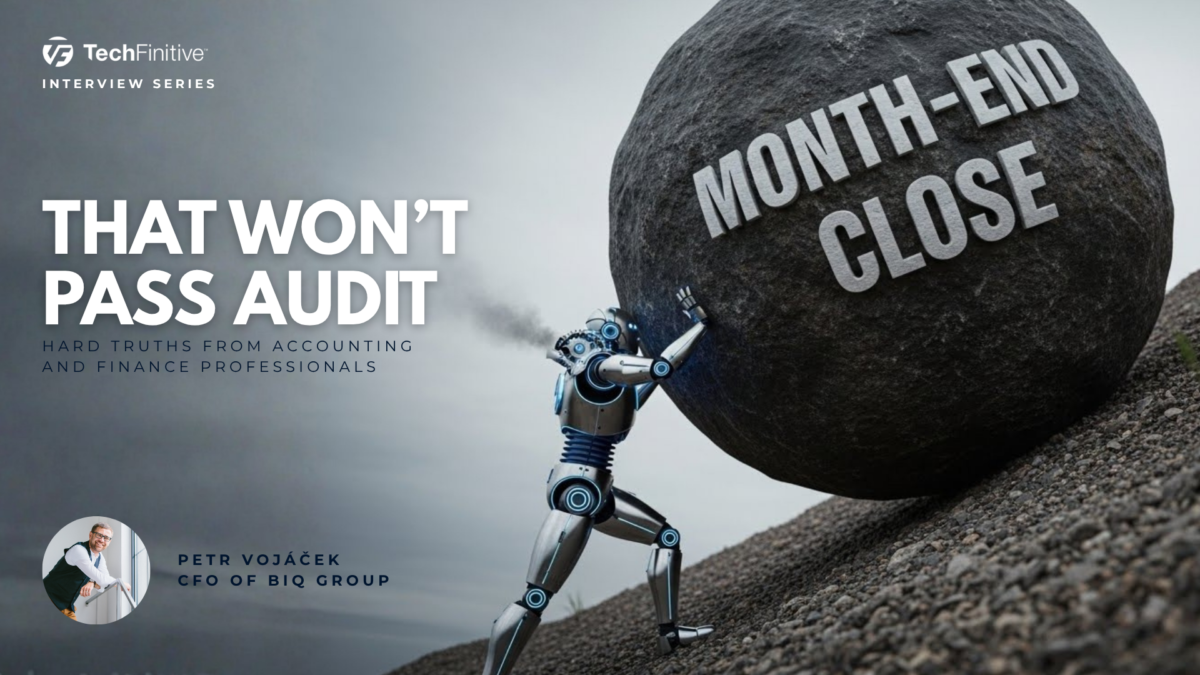
Petr Vojáček, CFO of BIQ Group: “Finance is primarily shifting from the role of data procurers to the role of interpreters of the meaning that data provides us”

If you take nothing else from our interview with Petr Vojáček, CFO of BIQ Group, head down to the section where he talks about how his company – a tech company at heart – is using AI.
“[We] have an AI strategy, an AI Hub competence centre, a centre of excellence focused on sharing expertise and establishing clear principles that define why and how we implement artificial intelligence,” Vojáček explains. “We set specific and measurable KPIs to know the average time savings in development and overall project delivery.”
He goes on to explain how he uses AI himself, and we won’t steal his thunder by revealing all here. But it’s interesting to see how a C-level executive with many years of experience is using AI to complement his skills and save time.
Before joining BIQ Group in 2022, Petr Vojáček spent ten years at CPI Property Group, where he advanced from a Financial Manager position to the Head of Finance Management and Controlling.
At BIQ Group, he’s the standard setter. He optimises processes, including the streamlining and automation of administration, which is yet another reason to listen to him talk about the use of AI. In particular, the importance of getting the foundations right before rushing in with the latest tools.
Which leads us in nicely to our first question: how the finance function is changing and the mistakes organisations make when embracing new technologies.
How has the role of the finance function changed in the last three to five years, and what do you think most organisations still underestimate about that shift?
I see three main changes: a shift towards greater digitalization and data-driven decision-making, new technologies and AI, and the necessity of flexibility due to external changes such as rising costs of financial resources, inflation, new regulations, and other external “shocks.”
Finance is primarily shifting from the role of data procurers to the role of interpreters of the meaning that data provides us. Today, they increasingly point to options and variants of the future development of financial indicators when various assumptions and scenarios are met. In this way, they help their organisations make better decisions based on hard data and clear assumptions.
Furthermore, the speed of technology adoption has changed, with AI increasingly becoming the centre point. At the same time, financing has become more expensive, the price of resources (financial and human) has increased, along with the pressure on economy, finance, and financial management. Consequently, there is greater pressure on the role of the CFO and finance in general, and an emphasis that decisions cannot be made without them.
Therefore, I see the biggest change at the level of finance’s priority and the role of the CFO, who must work closely with the CEO and view things from a broader perspective and a long-term point of view.
Specifically for us, this mainly concerns new acquisitions financed by external sources. At the same time, we are reducing internal pressure for extensive growth and replacing it with intensive growth – the increase in work productivity through AI tools.
It’s widely discussed how companies fail to grasp AI. The choice of a partner who can truly implement it so that the solution is actually useful to management or the board is underestimated. The real benefit is often not addressed. A lot can be invested in this area, but by far not in all cases does it have the desired effect, for example, if ERP systems are not well integrated or if the available data is not of sufficient quality.
Which accounting or finance processes are still far more manual than they should be, and what’s stopping teams from automating them?
There were automations, scripts and robots long before ChatGPT. The main problem hindering a higher degree of automation is the IT and data structure or architecture of companies. Everything should be accessible in one ERP, then automation is possible. If the architecture is decentralized, with many customizations or specialized tools, the data flows and connections between tools must be resolved. A data warehouse that stores and cleans data should be part of such IT infrastructure. Then, more advanced analyses, automations, and AI deployment can be performed on top of it. Robust ERP systems natively contain these functions, but the pace of development and deployment of new automations and features can be slower.
In our case at BIQ Group, we maintain a certain degree of decentralization after acquiring new companies. We have a centralized core, meaning the main processes, and we are gradually integrating the group in terms of methodologies, processes and systems. These can be continually automated. Remember that this is a gradual process that never ends, and sometimes it’s good to take a step back and simply eliminate some reports that are no longer needed. Generally, I am a proponent of the ESOAR methodology – Eliminate, Standardize, Optimize, Automate, Robotize.
How are you currently using data and analytics to support decision-making beyond compliance and reporting?
Since I joined BIQ Group, we have moved towards data-driven operations. We make decisions not only based on data but also by monitoring a longer time horizon: how business figures, projects, and sales pipelines are developing. We monitor data very carefully, and we make key decisions based on it, not on feelings. In this regard, we have made a big step forward.
What impact has AI had on your finance or accounting workflows so far and where do you see the most realistic near-term value?
In our case, as an IT company, the biggest benefit is not so much at the back-office level, but in increasing the productivity of developers. This is the alpha and omega for maintaining our competitiveness in the upcoming years. Not just for individual subsidiaries, but for the group as a whole. That’s why we have an AI strategy, an AI Hub competence centre, a centre of excellence focused on sharing expertise and establishing clear principles that define why and how we implement artificial intelligence. We set specific and measurable KPIs to know the average time savings in development and overall project delivery. Half an FTE in the back office is not as crucial for us as the efficiency of developers, meaning delivering more work/projects in the same amount of time. We look not only at the amount of code written, but also at the overall delivery and the delivery process.
For me personally, the realistic use is at the level of simplifying administration, writing drafts and official emails for partners, where Copilot has proven successful, or summarizing business correspondence. Furthermore, it is searching through repositories or communication tools. AI is an admin assistant for me who is always at hand. I use it for quick checking, summarizing, and orientation with contracts and long documents. Another example of use is searching and brainstorming. However, it still can’t keep track of more complex things and potential “traps” for me. I still see limits to AI in financial analysis. But the development is moving forward really fast.
What are the biggest integration challenges between finance systems (ERP, payroll, billing, reporting), and how do they affect accuracy and agility?
The biggest challenges are where it hurts. Back-office teams often don’t like big changes. It is therefore difficult to embrace the change, sell it well internally, and not underestimate change management. The support of top management is essential. There should be absolute agreement on this across the company. Otherwise, it is always painful, and people’s dissatisfaction grows. Everything is a matter of preparation and management, i.e., the experience of the implementation team. They must be able to convey the enthusiasm that we have something that will make our work more efficient. The benefits must be well communicated, and people must see how, for example, the unnecessary multiple entry of the same data in different places will be eliminated. Financial teams need to move from manual control to partnership for business and business decision-making. A shift towards a data-driven company must be visible. The basic prerequisite is always a good analysis and budget.
It’s also necessary to evaluate the change from the perspective of human resources, financial resources, and management. To make an analysis and carefully consider everything, because there can be only one shot. It’s necessary to know the possibilities and position of individual companies. Financial processes are the same everywhere, but there may be unique know-how that cannot always be transferred to off-the-shelf solutions, and somewhere the core business must ultimately be left in a custom solution. The more information you have beforehand, the higher the chance of success.
How do you balance speed and automation with control, auditability and regulatory compliance?
Automation should improve and simplify internal controls and systems, and the internal controlling system in general. At the same time, it reduces error rates. Our goal is to automate the process as much as possible, ensuring that human oversight requires only a fraction of the time rather than becoming a full-time task.
What skills do modern accountants and finance professionals need today that weren’t essential five or ten years ago?
Today, the key skill is multifunctionality. The CFO used to be seen as the “chief accountant” who knew about every item. But our job is less and less about that. More important is working with data, putting things into context, monitoring markets, participating in key decisions, and strategic direction. A company can no longer be managed without a CFO. Being strong in finance is a basic prerequisite in our field, but increasingly important is a business background, the ability to oversee the future impacts of decisions, and evaluating financial, business, and legal risks. And in the digital age, technical proficiency goes without saying.
How is finance collaborating with other parts of the business – such as IT, operations, or marketing – and where does friction still exist?
The positions of CFO are gradually being connected with other agendas such as legal, HR, or IT. It makes great sense for the CFO to have controlling under them, through which they are well acquainted with the internal setup of the company, and by extension the group; the departments, processes, and relationships. For IT to receive high-quality assignments and be able to build the IT architecture, it needs an overview of the entire company, and finance can help with that.
In our specific case, I have very close and intensive cooperation with the CEO and COO because they have the greatest influence on the group’s operations. I wouldn’t say that friction arises anywhere; rather, some departments are better connected than others. We are gradually trying to eliminate that difference.
What’s one finance or accounting technology investment that delivered unexpected value, and why?
So far, everything we have implemented in BIQ Group for finance and accounting has moved us forward. The most significant was Power BI for the visualization and democratization of financial data towards management and subsidiaries. We gained a view of data in a digestible, nicely visualized form that is also available online. The real measure of a project’s success is its evolution into advanced stages, such as the visualization of project and business data.
How are finance teams preparing for increased regulatory complexity, reporting requirements, or scrutiny in the years ahead?
This is a real challenge. On one hand, we are trying to simplify our people’s work with automation and AI, and on the other hand, they have to absorb new directives and laws that increase the demands on what we must fulfill and report. Hopefully, we will succeed as a company in this race.
What advice would you give to finance leaders who are under pressure to ‘digitise’ but lack internal buy-in or technical resources?
The simple advice is: don’t try to handle it alone. Find people in the company, ideally from middle management, who see meaning and purpose in digitalization. Give them priorities, maximum support, and the authority to act. Furthermore, find a partner who can guide you through the transformation and manage it. Middle management is usually drowning in day-to-day operations, and the project then lacks clear leadership and direction. The situation is similar with technical resources – first, it is necessary to establish consistency and order in the company, and only then deal with the implementation of tools and AI. At the same time, seek support from top management to champion your initiative.
Looking ahead, what do you think the finance function will be measured on in five years that it isn’t today?
The speed of today’s changes makes long-term predictions very difficult. I believe, however, that the basic roles and functions of finance will remain.
The management roles will have to cooperate more, and the overlap into business will become increasingly important. The era of experts limited to individual domains is ending, and knowing the context across the company and flexibility will be far more important. Management will not make any fundamental decisions without the finance department, and vice versa. Finance must know the entire company and the needs of individual departments more than ever before.
More interviews
- Regi Vengalil, CFO at Pipedrive: “Companies are no longer looking for accounting-focused CFOs alone”
- Jay Kaplan, CEO and Co-founder of Synack: “Stop buying tools and start buying coverage”
- Marc Suidan, CFO of Backblaze: “There’s no digital transformation without cultural transformation”
About The Author

Rowan Campbell
NEXT UP


