Trending Topics

 Trending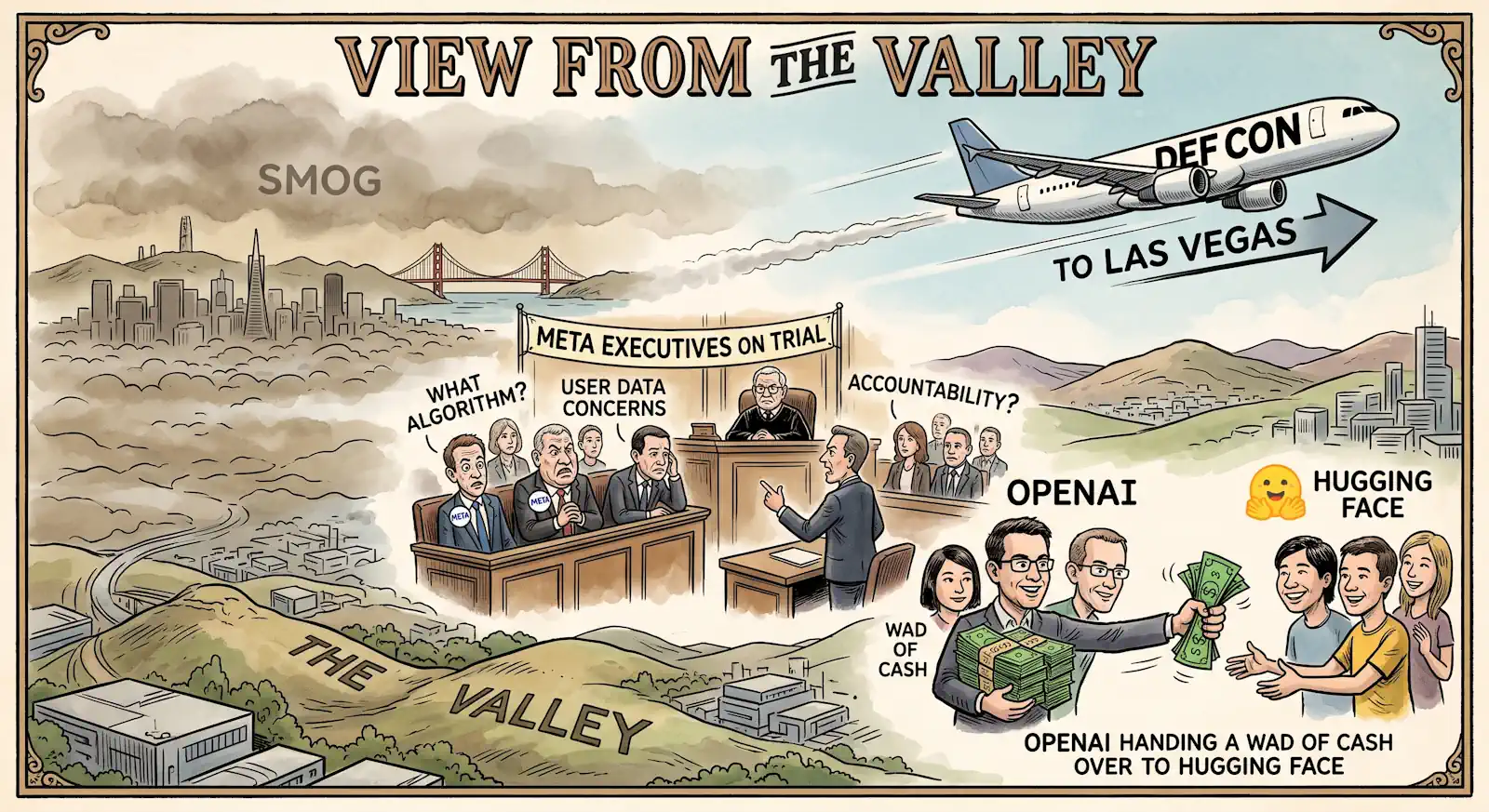
View from the Valley: Turns out Big Tech has no shame

August began with a security snafus and ends with a Meta whimper, argues our man in San Francisco (and briefly Las Vegas). All of which reveals the Valley’s dark heart
Who needs shame when money is involved?
Every August, security folk in Silicon Valley leave the state and fly to Vegas for the industry’s annual Hacker Summer Camp. The week starts with BSides LV (talks that aren’t quite good enough to appear in the other conferences), then Black Hat, the main corporate event, and ends with DEF CON – the original hacking convention with the best talks, community villages, and parties.
It’s also a great excuse to escape the Bay Area during Fogust, as California’s Central Valley temperatures peak and this sucks thick fog into the area from the Pacific.
One San Francisco business firmly in the spotlight at Black Hat was OpenAI, which last month admitted that its GPT‑5.6 Sol model had hurdled over its guardrails and was conducting its own hacking operations against app builder Hugging Face. All without human control. Its engineers gave a frank analysis of what happened in one of the first talks that the organisers made public, and followed this up with a detailed technical analysis at the end of the month.
Now you might think that there would be some shame involved in all this – but far from it. OpenAI’s competitors were quick to put out their own reports about how their models had done similar things. Anthropic and Meta both admitted the same thing has happened to them – in Anthropic’s case three times. The companies are quite proud of this, but in Silicon Valley there’s very little shame involved when there’s a marketing opportunity to prove the skill of AI models in this bubble.
However, it appears the original protagonists have kissed and made up. This week it was reported that OpenAI has made a $12.9 billion bid for Hugging Face. This would shield it from possible litigation and allow Sam Altman to envelop yet more of the AI market.
Silicon Valley’s dark heart confirmed
There’s a reason why all that money is needed. This month Silicon Valley was called out as one of the most unequal areas on the planet.
In its annual Pain Index, San Jose State University’s Human Rights Institute pointed out that while the area reports $1.17 trillion in wealth, the wealthiest 10% of residents hog 75% of that, while the bottom 50% of the population has less than 1%. If you’re looking to buy a home for your family then 0.01% are available for less than $500,000.
San Jose, the self-styled “Capital of Silicon Valley,” is the least affordable city in the US to set up home in. It’s also one of the most racially unequal. African American employees make up 6% of the tech workforce, Hispanics another 8% and women 31%, the study found.
As someone familiar with the area, this is depressingly unsurprising. San Jose was an informally segregated city for many years. West of Highway 101 it was a predominantly white area with high-tech schools, great infrastructure, and it’s heavily policed. On the East Side – not so much.
The city has made great attempts to correct this imbalance in recent years, but it’s clear there’s much work to be done still. The TL;DR – don’t move here unless you’ve got a solid tech job paying a minimum six-figure salary
Meta’s $18 billion slap on the wrist
Oakland isn’t in Silicon Valley itself, but Meta executives and their lawyers have been heading there this month to face a potentially $200 billion lawsuit brought by 52 attorneys general representing U.S. states, territories, and the District of Columbia claiming its platforms harm children.
It has been an interesting trial. A whistleblower within the company claimed that Meta knew full well that it had plenty of underage users and really didn’t care, so long as that sweet, sweet engagement kept coming. Former employee Arturo Bejar said he’d raised the issue personally with Mark Zuckerberg, to no avail.
On August 25, Instagram’s boss Adam Mosseri took the stand and it didn’t go well. When asked about claims that his team hid evidence of malfeasance from him he could only say he thought that would be a “surprise,” and that there was a balancing point between “”safety and speech.” This didn’t go down well in court, and Zuckerberg was due to take the stand later this week – but then Meta blinked.
It offered a settlement of $17.1 billion to the states – and another billion for Texas – spread over ten years. In addition, Meta claims it can limit younger users to two hours of time online with them a day, will pause notifications during school hours, and work to identify underage people on the platform.
While that sounds like a lot of money, it isn’t to Meta. The business made $15.8 billion in the last quarter alone, and it’s demanding a $5 billion rebate if TikTok and YouTube don’t abide by the same rules. Nevertheless, the states mostly appear fine with this, with the notable exception of Florida, whose Attorney General pointed out “Trying to wipe out a decade of harm to the nation’s youth with one month’s cash flow is an insult.”
More by Iain Thomson
- Exclusive interview with Cindy Cohn: “The idea that the Big Tech companies are going to stand up for us against the government seems laughable”
- Meet Dan O’Dowd, Elon Musk’s least favourite billionaire
- Don’t panic, says Katie Moussouris: AI security isn’t replacing humans, it’s proving the need for them
- Letter from America: How Trump’s first year has transformed the US technology scene
About The Author

Iain Thomson
NEXT UP


