Trending Topics

 Trending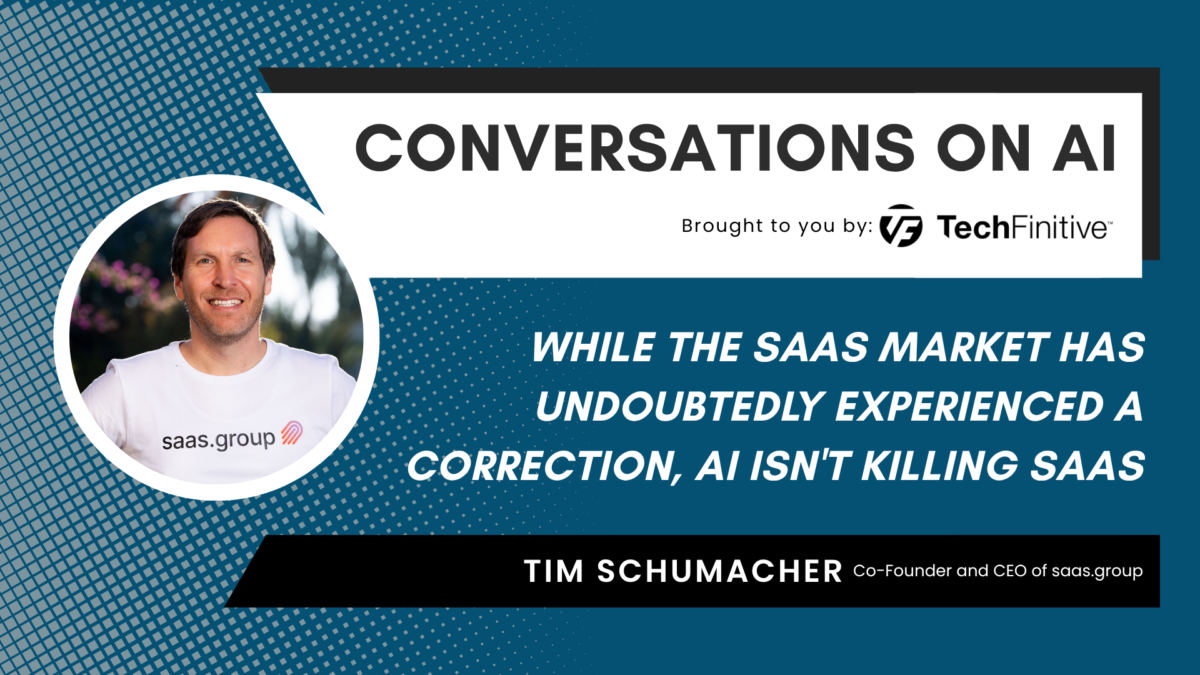
Tim Schumacher, Co-Founder and CEO of saas.group: “While the SaaS market has undoubtedly experienced a correction, AI isn’t killing SaaS”

There are very few people better placed to assess how AI is reshaping SaaS than Tim Schumacher. Indeed, you may well have used one of his products: he co-founded and then led Sedo into being the world’s largest domain marketplace, before exiting with the brand exceeding €100 million in revenue.
Having spent more than 20 years building and scaling technology companies, the German entrepreneur is now lending his expertise to others who need it. As Co-Founder of saas.group, he is helping fellow founders expand their own SaaS businesses. Yet Tim still finds time to be Chairman of Eyeo – creators of Adblock Plus – and was an early investor in Ecosia.
It should be no surprise that Tim has a clear view of where AI is genuinely changing software, and where the industry might be over-using it. These are subjects we explore in depth in our interview, as part of our series Conversations on AI.
The greatest misconception around AI? The rise of the “SaaSpocalypse” narrative, he believes. Instead, as he sees things, “the industry has overestimated AI’s ability to replace software and underestimated its ability to transform it”. In particular, AI exposes weaknesses while creating fresh opportunities for those businesses willing to adapt.
This is where Tim sees the distinction between companies that are adapting, and those simply following a trend. AI shouldn’t exist as a feature for its own sake, he argues. It should improve the delivered product. “Competitive advantage won’t come from having AI,” he told us, “but will come from rethinking the value proposition and creating outcomes that weren’t previously possible.”
As Tim sees it, real change happens when AI stops being something users must actively interact with, and instead becomes an integrated part of the systems they already use. He points to the clunky current way of working, where you must complete a generative AI task in one window and then move the result into your workflow. In his view “the unit of value changes” when AI becomes part of the workflow itself. Output alone isn’t enough.
Tim’s view is largely shaped by seeing AI as a force in the industry rather than a full replacement for software. With this thinking in mind, we started by asking where he believes the industry is overestimating AI, and where yet it still may be under-utilised.
Everyone says AI is transforming software, but where do you believe the industry is still overestimating its impact and where is it underestimating it?
For the past year or so, predictions of SaaS’s demise have dominated the tech conversation, with headlines suggesting that AI agents would replace traditional software and a widespread narrative about the SaaSpocalypse. Reality has proved far less dramatic, though. I think the industry has overestimated AI’s ability to replace software and underestimated its ability to transform it.
While the SaaS market has undoubtedly experienced a correction, AI isn’t killing SaaS – it’s exposing longstanding weaknesses in how software companies create, manage and monetise their products. It’s acting as a filter, revealing which businesses have genuine operational efficiency, product differentiation and true customer value, and the biggest winners will be those agile enough to reshape and adapt.
The companies best positioned for AI transformation are often established SaaS businesses with proprietary customer data, deeply embedded workflows and years of domain expertise, which already have something meaningful to transform.
Many SaaS vendors now describe themselves as AI-powered. What actually separates companies creating real customer value from those simply adding AI features?
Transitioning to an AI-native product isn’t just about adding a chatbot, but about a total rethink of the value proposition. One of the biggest changes we’ve seen across our portfolio is the evolution from traditional software towards AI-native outcomes.
AddSearch is a good example of this – it didn’t simply add AI functionality but evolved from a classic website search tool into an AI-powered answer engine. Likewise, Keyword.com recognised that customers no longer just wanted to know where they ranked on Google. The metric that now matters is whether an AI platform like ChatGPT is actually citing their brand as a trusted source.
That’s the difference between adding AI as a feature and using AI to solve a new customer problem. As AI capabilities become increasingly accessible, competitive advantage won’t come from having AI, but will come from rethinking the value proposition and creating outcomes that weren’t previously possible.
There’s growing discussion around AI agents replacing traditional software workflows. Do you see the future as applications becoming collections of intelligent agents, or will conventional interfaces remain central?
I don’t believe the future is AI replacing software, but instead I think AI is moving inside software. Most AI adoption has followed the same pattern for the past few years: open a separate window, paste in some context, generate an output and copy it back into your workflow. This feels productive, but it still creates friction through manual handoffs and context switching.
It is changing as AI increasingly moves inside the systems companies already depend on. Instead of generating isolated outputs, embedded systems are handling repeatable execution automatically.
The structural shift is that the unit of value changes. When AI lives outside your systems, the value is the output. When AI is embedded into workflows, the value becomes the workflow itself. AI stops being an assistant sitting beside the business and becomes part of the business.
Looking ahead three to five years, what part of today’s SaaS experience do you think will disappear because AI makes it obsolete?
I don’t think software disappears, but expect that manual execution will. Over the next few years, we’ll spend far less time manually moving information between systems, triggering repetitive workflows or repeatedly instructing software what to do. AI will increasingly retain context, automate routine execution and complete workflows automatically.
Using AI is no longer the competitive edge on its own – embedding AI directly into business systems is. That’s where I think the SaaS experience fundamentally changes. The products creating the deepest value aren’t always the ones with the most visible interfaces, but the ones embedded deeply enough into operational workflows that removing them would break the system itself.
If you could give one piece of advice to another SaaS executive planning their AI strategy today, what would it be?
It would be to treat AI as a core architectural shift, not a feature set. The founders who thrive won’t be those who treat AI as a decorative feature, but those who view it as a foundational structural upgrade for their entire business.
At the same time, don’t assume the most powerful model is always the right one. Increasingly, businesses are asking not Which is the smartest model? but Which is the best model for this task at this price? Economics, resilience and flexibility are becoming just as important as raw capability.
Finally, don’t underestimate the advantages you already have. Established SaaS companies possess proprietary customer data, trusted workflows and deep domain expertise. AI should amplify those strengths, not distract you from them.
What is the biggest misconception enterprise customers still have about adopting AI within business-critical software?
I think one of the biggest misconceptions is that AI transformation is about adding AI features. In reality, the businesses seeing the greatest returns are treating AI as a structural shift rather than a product enhancement.
We’ve seen this across our portfolio. Transitioning to an AI-native product isn’t just about adding a chatbot; it’s about a total rethink of the value proposition. Companies need to ask how AI changes the way customers solve problems, not simply how it changes the interface.
Another misconception is that AI will replace existing software overnight, when the opposite is often true. Established SaaS businesses already have powerful advantages, including proprietary customer data, deeply embedded workflows and long-term customer relationships. AI allows them to build on those strengths rather than start again.
Ultimately, the winners won’t be the companies with the most AI features. They’ll be the ones that use AI to deliver better business outcomes. Whether it’s repositioning products around AI visibility, embedding AI into operational workflows or creating entirely new customer experiences, the companies succeeding are those treating AI as a foundational architectural shift rather than something they simply bolt onto existing software.
More interviews
- Marc Churchouse, CEO of Mercator Digital: “SMEs are going to be able to reskill their workforces at a quicker pace than large corporates”
- Andrew Lawson, EVP of Sales for EMEA at Zendesk: “We are underestimating how much AI can change the way service teams work”
- Greg Nelson, CEO of RSA: “Moving to passwordless, phishing-resistant authentication should be every organisation’s top priority”
About The Author

Rowan Campbell
NEXT UP