Trending Topics

 Trending
Intel CEO Lip-Bu Tan declares that Intel has “overdelivered” for 18A platform at CES 2026

Intel CEO Lip-Bu Tan took to the stage at CES, Las Vegas, to declare that the company has overdelivered for its 18A platform. It’s an important statement, as 18A is the foundation on which Intel’s new Intel Core Ultra Gen 3 chips and Xeon 6+ processors are built.
“Over the last year, our team have pushed the limits of architecture, fabrication and core optimisation across hardware and software,” said Tan.
“I’m pleased to share that we have delivered our commitment on shipping our first 18A products by the end of 2025. In fact,” he added, “we over delivered. I’m delighted to announce that we are ramping all three Core Ultra Series 3 die package as we speak.”
It certainly seems a long year since Intel appeared at CES 2025 with two interim co-CEOs, one of whom has now left the company.
“What you will see and hear later today [during the keynote] are breakthroughs that can only be enabled by a tight integration of silicon design, advanced silicon process and packaging technology,” said Tan.
Over to you, Jim
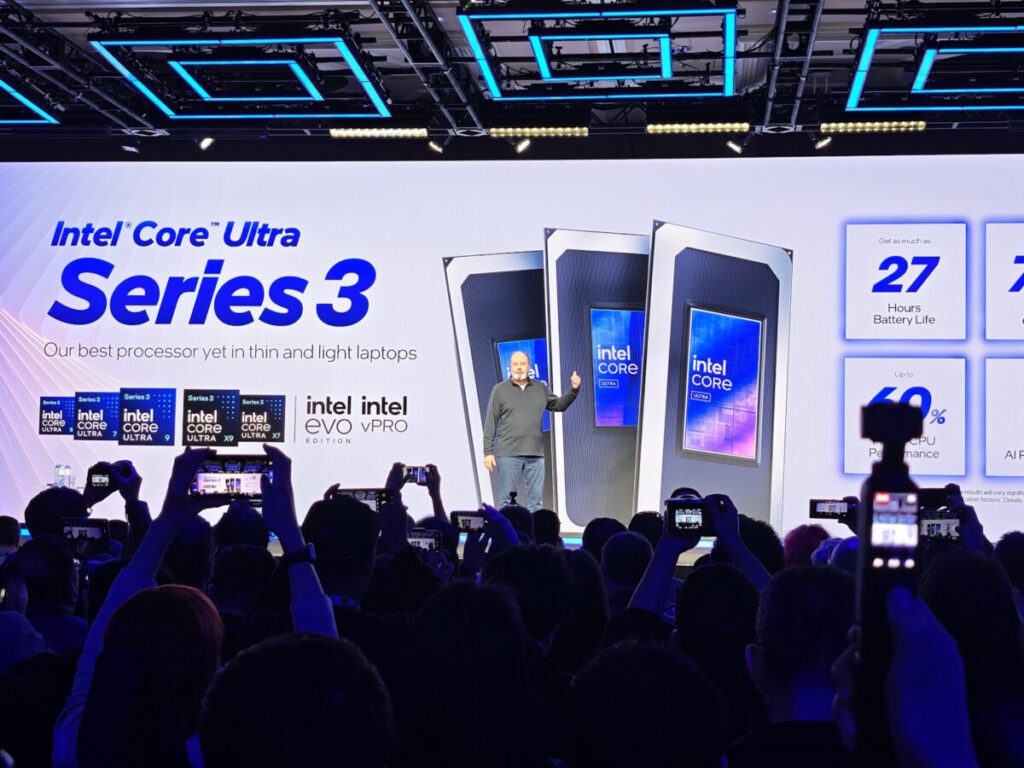
Lip-Bu Tan didn’t spend long on stage. Within two minutes, he passed the baton to Jim Johnson, Vice President and General Manager of Intel’s Client Computing Group.
Describing the industry as being at an inflexion point, he claimed that Intel is “delivering leadership products on a leadership process node”, which he certainly couldn’t have said last year.
“Leadership manufacturing has again become the strategic anchor of Intel alongside delivering x86 solutions at unmatched scale,” Johnson claimed.
“This is where our multi-gen effort to drive power efficient performance, hybrid core architectures and a multi-engine, local AI are coming to life. We build for what’s needed today, but work really hard with our partners to anticipate what’s required next. And right now, as we know, that next wave is AI.”
But most business buyers care more about battery life than AI, which is why Johnson mentioned the “maniacal focus our design teams have on power efficiency”. The Core Ultra Series 3 “dramatically improves a range of applications we use every day”, he added.

“A simple example would be streaming 4K video on Series 3 draws one third the power than prior generations, a massive reduction that allows us to be talking about battery life in days, not in hours.
“It, once again puts the myth to bed that x86 can’t be power efficient even at higher performance levels. And this is the last time I’m going say that,” he said.
Welcome to the Intel Arc B390
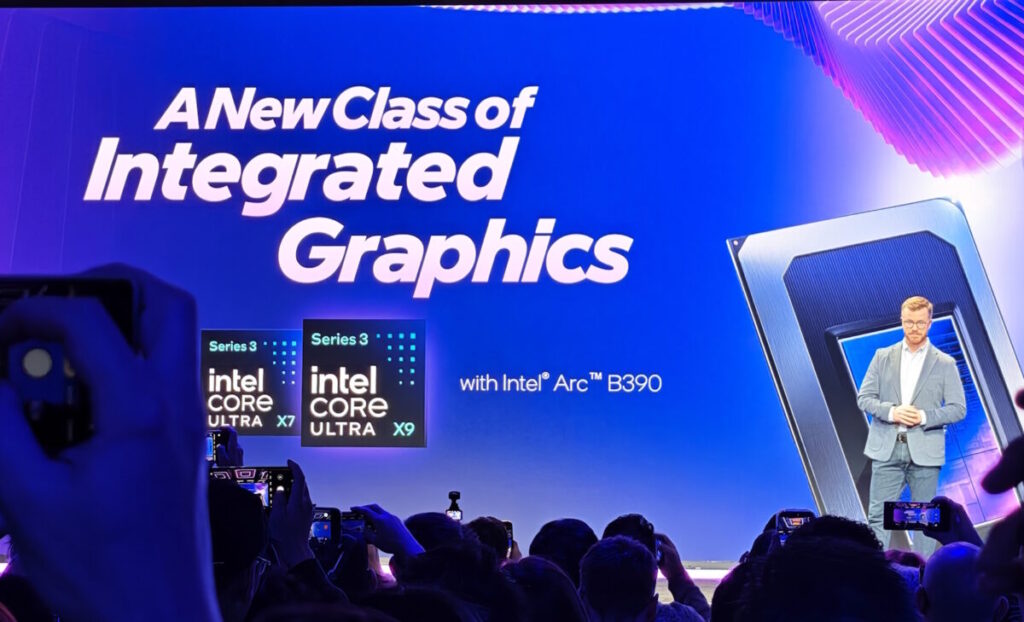
Intel also announced the official arrival of the Intel Arc B390 graphics, previously known as the Arc with 12 Xe cores.
“Five years ago, graphics and Intel had an interesting history,” said Dan Rogers, VP and General Manger of PC Products at Intel. “[They were] ubiquitously deployed with a massive install base, but previously lacking in key features, driver support and, frankly, performance.
“Five years ago, we started a mission to change that with the announcement of our Intel Arc graphics.”
This, he explained, was “more than a hardware plan” as it also encompassed a “brand commitment to deliver world class, discrete class software across a range of graphics products, including integrated”.
“Today, we are very proud to announce the next generation integrated GPU,” said Rogers. “We’ve been referring to as 12 Xe, but the world will know as Intel Arc B390 graphics.”
He promised 70% more gaming performance and 50% more AI inferencing performance than the previous generation integrated graphics.
Early signs from the demos we’ve seen suggest that Intel has reason to be confident in this top-end chip, but you will still need to activate AI frame generation to hit 60+ frames per second in tough games.
More Intel news
About The Author