Trending Topics

 Trending
Intel in 2025: the insiders’ view

I’ve just spent a week in Las Vegas for CES 2025, where I squeezed in so many meetings and briefings Outlook started whimpering. But the one meeting that stood out is with Intel, where I took part in a group interview with Jennifer Larson, David Feng, Carla Rodriguez and HP’s Cory McElroy.
There is context. Intel had a rough ride in 2024, and while it deservedly won praise for its “Lunar Lake” mobile chips this was arguably its sole big silicon hit. Its Arrow Lake desktop processors received a lukewarm reception while Nvidia continued to dominate in the data centre. Meanwhile, both AMD and Qualcomm ate away at Intel’s market share.
Perhaps more importantly, Intel’s strategy of investing in US-based foundries so it could also build chips for other companies was knocked sideways once Donald Trump won the US Election in November 2024. Trump didn’t want to invest billions in US foundries when he could reap billions through tariffs on overseas manufacturers.
Trump’s win is surely the main reason for Pat Gelsinger’s so-called “resignation”, as I explained in an article entitled “Pat Gelsinger steps down: what happens next for Intel“. What rapidly became clear as I stepped into the room is that the people before me wanted to provide an answer to the question that article posed: exactly what was going to happen next for Intel?
Introducing the panel




It had already been a busy day for Intel. A few hours earlier, David was quoted when Intel announced it was extending vPro to its 200V chips while Jennifer was the Intel spokesperson in a press release entitled “CES 2025: Intel to Power Large PC Refresh with New Silicon-Based Security“.
Meanwhile, HP had launched three commercial laptops at CES that used Intel silicon, while Carla was due to deliver a conference session entitled “AI PCs: Discover a New World of Experiences“.
To boil it down to the point of oversimplicity, David was there to give the big Intel picture. Jennifer would go deep on Intel’s commercial segment. Carla could talk about the partnerships with ISVs, such as Adobe, Microsoft and the new breed of AI developers. And Cory was there to talk about the partnership between HP and Intel.
With the stage thus set, it’s time to talk Intel in 2025.
What does a good year look like for Intel?
Before the interview started, I knew there was little point dwelling on 2024. First, because what happened is well documented; second, because I only had half an hour with the panel and I wanted to talk about the immediate future.
So I asked: what does a successful year look like for 2025?
David Feng: AI PCs to sell in massive quantities
Before answering, David pointed out that Intel had been selling AI PCs for a year and that he believed 2025 would be the year that commercial buyers embraced the technology.
“First of all, you saw our portfolio launched today. For the most part, it’s all out there. So absolutely we just want to deploy in massive quantity, and we think we’ve got a winning hand with winning partners like HP and Microsoft.” Before adding that Intel is “closer with Microsoft [for] strategic alignment than the recent few years, or, say, ever”.
But David pointed out that commercial customers have more choice than before, whether through AMD or Qualcomm. However, he believes that the work Intel has done with HP and others on defining “key personas” is crucial. “It used to be one size fits all, or two sizes fits all. It doesn’t work that way, it shouldn’t work that way, but a lot of [IT and decision makers in organisations] aren’t quite there yet.”
He added: “So that’s why we have these beautiful devices coming from HP and others. How do we really make sure the right devices, right technologies, hardware, software, ecosystem, the entire packet, is delivered to the right personas inside enterprise? So, of course, success is business results, but how together is through this work.”
Jennifer Larson: Intel to deliver enhanced security
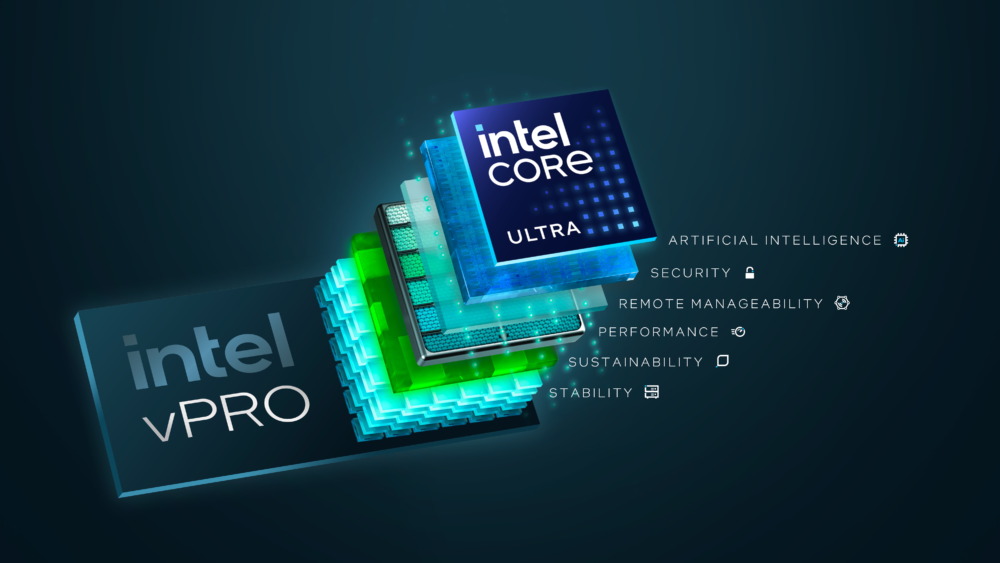
“I think it’s all about workflows and outcomes too,” said Jennifer, after agreeing that personas would be a key aspect of Intel’s success in 2025. “
“I think the other piece too, for vPro and commercial, is AI PCs are not just for business end users. There are a lot of tangible kind of outcomes, but there are elevated outcomes for it as well. So what does that look like and how can we really showcase that value?”
One key area is security, where Intel’s ecosystem team is working with security vendors to deliver products that simply offer better protection. Or, as Jennifer put it, elevated outcomes.
“You know, 24% higher threat detection efficacy and some of the other benefits that you can start to see — predictable, proactive, self healing, manageability capabilities. And so I think that’s kind of what we’re looking to 2025 is really to kind of move to the next level.”
In particular, as I wrote last week, Intel is simplifying vPro to make it easier to activate so that if a Windows outage such as CrowdStrike happens then its customers will have tools (such as out of band management) to respond.
Cory McElroy: Make AI benefits tangible and applicable at scale
“I think making AI real is the key opportunity for us, collectively, in 2025,” said Cory, speaking for HP. “I think in 2024 there was a lot of talk about what it could do and I think there was maybe some sitting on the sidelines from a commercial or end user or maybe just even a broader perspective.”
Although, as I covered in November, HP is at least attempting to create useful – and confidential – AI tools for its new range of OmniBook Ultra AI laptops.
“I think now we’re seeing some really good, tangible proof points [for AI] that Jen talked about. And there’s some demos here to highlight why it makes your life better. We just all collectively need to land that message to help [end users] understand, what can this do for you?”
Cory added that Intel and HP need to make it clearer for organisations what AI looks like at scale, even if they’re “large corporate enterprise customers with hundreds of thousands of users. How do you get the right policies in place, even once you’re clear on the value you want to provide? How do you even do that in a secure and manageable way?”
Those two prongs – show the value of AI, then show how to deploy it at scale – are what Intel, and HP, need to deliver on for 2025 to be declared a success.
Carla Rodriguez: We’ve got the AI hardware, now let’s deliver the software
For Carla Rodriguez, who works with Intel’s software partners, it’s a matter of doubling down on what’s already happening. First, to deliver great AI applications at speed; second, for users to take advantage.
“I think we’re [already] sitting on an incredible amount of features and applications that are leveraging [AI] technology,” she said. Now she wants it “start to click” with users. For them to think: “This is truly making my productivity go up. This is truly making me feel more secure. This is truly making me collaborate better, right?”
“We started with a lot [of AI-enhanced software] in 2024 and a little bit in 23 and I’m excited to see an acceleration of that so that it’s prolific, and it’s in the mainstream.”
But, as Carla points out, some of the problem is awareness. “It’s already there, and they don’t even realise it. I think if you take a lot of your average security applications that are in the background, quietly keeping users protected, whether it’s deepfake detection, anti-phishing scanning… it’s already there. They don’t have to do anything about it. It’s already there, working for them.”
New year, new Intel?
Let’s take a moment to summarise these themes. First, Intel believes that it now has the right family of products to deliver AI-enhanced hardware to businesses. Second, that partners such as HP are delivering great hardware that takes advantage. Third, that software is already on the market to enhance business workers’ lives, both by making people more productive and keeping them safe.
And, naturally, that Intel is better placed than AMD or Qualcomm due to its long-term history of delivering commercial PCs.
But what, I wanted to know, was the feeling within Intel? Your CEO has just resigned, market share is falling, your rivals have upped their game. It’s safe to say that David Feng preferred to focus on Intel’s technology rather than the company mood.
“A lot is hinged on making sure we’re delivering 18A [Intel’s next-generation process node, based on 1.8-nanometer technology], Panther Lake [processors] and the data centre products are leveraging 18A as well,” he said.
“That will enable the foundry services to go broader over time beyond what we announced publicly in the past few quarters. Video tracking as well. Right? So it’s just a pivotal year in so many ways, and in the PC business we think… a lot of things are primed to really come to fruition in the PC space this year.”
Perfect storm… for success?
In particular, David Feng believes that Intel is delivering products that we have always “dreamt of in the past 20 years”.
Such as? “You have the best productivity. You still have the real full-day battery life, not the marketing for all-day better life, real all-day battery life. You have… enhanced security manageability. And then you have AI ecosystem between what we’re working on, what HP is delivering uniquely… and then what Microsoft is working with us across the industry as well.”
Looking back, he added, “I’m not seeing another year that looks like this year”.
I’ll give the final word to Jen Larson. “Our partnerships are stronger than ever with Microsoft, with HP and internally, I mean, it’s pedal to the metal.”
About The Author

Tim Danton
NEXT UP


