Trending Topics

 Trending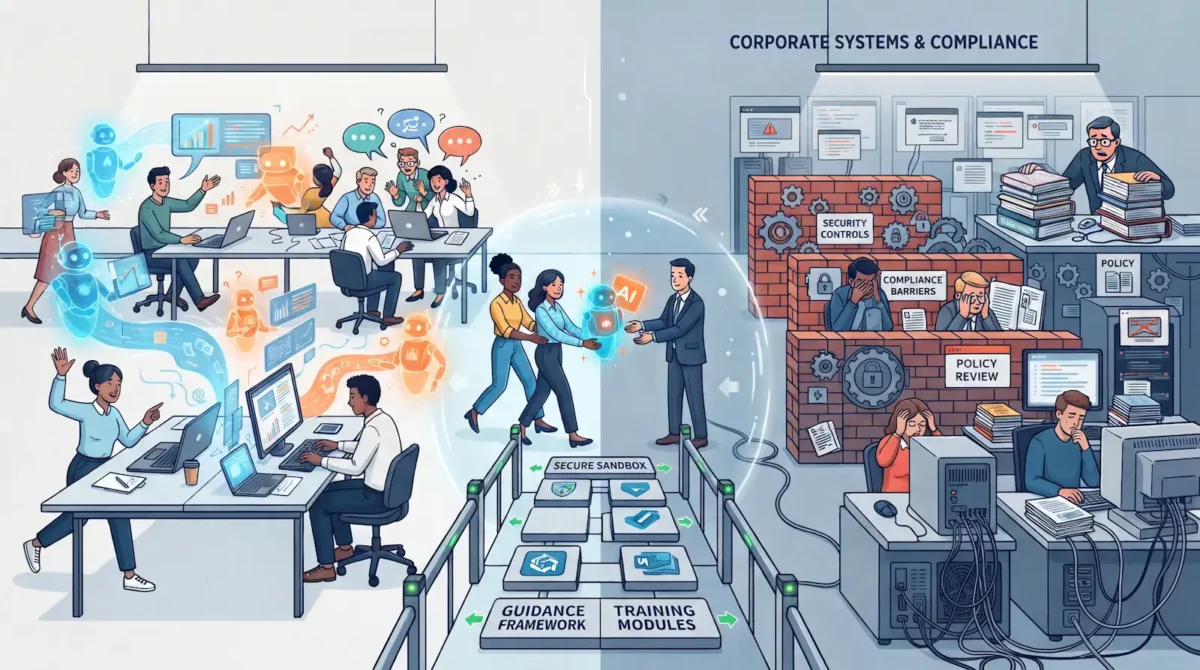
Employees are bringing AI to work – companies must catch up

Employees are using AI to work faster – often beyond corporate control. We interview NTT Data Business Solutions’ Chris Gabriel, who argues the answer isn’t a ban or a moonshot, but small steps and smart governance

The best way to get started with AI is to use the AI you’ve already got – because that’s what your employees are already doing.
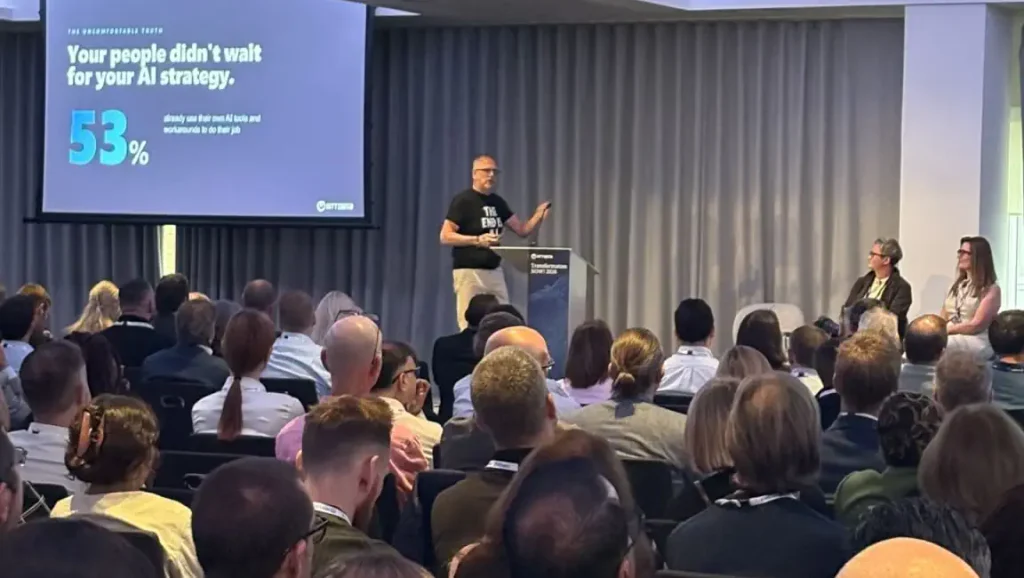
That’s one key message from NTT Data Business Solutions, as shared at its recent Transformation NOW! conference. It pulls together two challenges with AI: working out how to get started with a potentially risky technology while your staff are already using even riskier personal chatbots to do their work.
Chris Gabriel, Head of Marketing & Innovation at NTT Data Business Solutions UK&I, told TechFinitive that only a handful of conference attendees put their hands up when asked if they were confident in AI at the moment – and no wonder given the headlines about rogue agents hacking their way around the web. “I think that’s where a lot of organisations are struggling, it’s with confidence,” he says.
But their staff don’t have the same concerns – and it could be making AI even riskier for companies.
Bring your own AI
More than half of people are bringing their own AI to work on a semi-regular basis to their jobs, according to an NTT Data Business Solutions survey from earlier this year. This found that 53% of UK workers were using personal AI tools and informal workarounds to improve their work. A figure that climbed to 75% among younger workers.
“People are hacking their own jobs with AI, which is positive in one sense because people want to be productive, they want to produce better outcomes,” Gabriel says.
But that informal adoption raises problems. “It’s outside of corporate control, it’s outside of any risk profile.”
While companies may not trust AI to manage their finances, plenty of people are confident handing their personal finances over to ChatGPT or Claude. Of course, individuals merely risk their own pensions or savings, while CFOs face much more serious consequences if inaccuracies are found in financial reports.
Employees are also seeing personal benefits at work. “Every presentation I see now has a ChatGPT chart or one created in Claude,” Gabriel says.
AI work hacks bring happiness and risks
He points to research out of Finland that shows AI at work can make people happier because it lets them find their own way. “People like to hack things to make them easier to do,” says Gabriel. “Businesses try and stop you doing that in the main because you are given systems to use and processes to use.”
But as any employee can tell you, those systems never work perfectly. Workarounds are always found. “If you let people hack their own work, within reason, to make it easier and better, they will be more fulfilled than if you say no to them, that they can’t improve the thing they asked to. That’s what causes people stress,” argues Gabriel.
Indeed, that NTT Data Business Solutions’ survey found that 73% of UK workers said their well being and productivity suffered due to broken systems and processes. Perhaps the only surprise is that this figure isn’t higher.
And AI is really good at hacking together a workaround, hence the rise in BYO-AI. The survey suggested employees most wanted AI to help with unpicking unfamiliar tasks, improving communications and digging out policy answers more quickly.
So set aside ROI: if all your AI rollout manages is to send someone home at night feeling less stressed, that’s not a bad result, says Gabriel.
Losing the AI learnings
There’s another downside to this shadow AI, beyond risks and security and compliance. Companies are missing out on learning how AI can work for their employees. “You can’t bank that as a business because you don’t know what’s happening,” says Gabriel.
Employees are finding ways to get work done more quickly, but businesses aren’t capturing that knowledge. “How do you measure and monetise that as a business?” Gabriel asks.
While there are security risks to AI, it’s worth considering the economic risks of missing out on how employees are benefiting from these tools.
“If you don’t know what’s going on, you can’t bank it,” says Gabriel. “You can’t transform your business, and you might be stuck in stasis between you haven’t got it but you have got it, but you don’t know what it’s delivering.”
Easing into AI
That brings us back to that first concern: how to start with AI when the headlines make it sound like a terrifying gamble?
It may be tempting to sit this one out, but that comes with its own risks. On one hand, offering approved tools can help avoid the security risks of shadow AI; on the other, the business is missing out on learning how the technology could benefit the bottom line.
Gabriel says to keep it simple: start small with software you’re already using. “Don’t go gung-ho into AI, but use the AI that’s built into the tools your people already use,” he advises. “It’s probably what they want and probably what’s best for you, as you can control and govern it.”
He adds: “AI that’s not necessarily groundbreaking but inside a system you trust, is a great place to allow AI to do something – as long as you trust the data it’s got.” That’s better than trying to build “spectacular AI” that never quite gets into production, he says.
Many companies attempt to roll out major AI programs, only to find they drag on and exceed budgets – and are disappointing when finally complete. “The more protracted it gets, the bigger it gets, if it’s not a game-changing use case, AI will disappoint in the corporate landscape,” Gabriel argues.
Bridge the gap
Don’t stress about finding an immediate return on investment (ROI). Employees will explore the tools and find ways they personally benefit, helping to reduce frustration and burnout from repetitive or dull tasks – if that’s the only win, it’s still significant. Plus, they might discover unexpected use cases.
“My message was: don’t rush, and try to build… give them some tools you can trust, that you can roll out reasonably quickly, so they can just use them,” Gabriel says.
But waiting to build the perfect native-AI system, or banning it for fear of risks, could mean “people just break the rules even more,” says Gabriel. “So try and bridge that gap.”
Related articles
About The Author