Trending Topics

 Trending
GPT-5 for business: how can it help?

Exactly a week ago, OpenAI introduced GPT-5. It described GPT-5 as its “smartest, fastest, most useful model yet, with built-in thinking that puts expert-level intelligence in everyone’s hands”. But what we care about is how GPT-5 can help your business. What’s different, are there any pitfalls, how can it make people more productive?
To find out, we asked a cross-section of academics and business leaders for their thoughts. First, though, we need to cover exactly what GPT-5 offers compared to GPT-4 and GPT-4o. Here’s what GPT-5 itself says about how it compares:
| Feature/Model | GPT‑5 | GPT‑4o | GPT‑4 |
|---|---|---|---|
| Release date | August 2025 | May 2024 | March 2023 |
| Primary focus | Advanced multimodal reasoning, higher factual accuracy, better long‑term context handling | Real‑time multimodal (text, image, audio, video) with very low latency | High‑quality text generation, reasoning, and coding across a broad range of tasks |
| Modalities | Text, image, audio (input/output), richer video understanding | Text, image, audio (input/output), live conversation mode | Primarily text (with some image input via GPT‑4 Vision variant) |
| Latency & speed | Faster than GPT‑4o for complex reasoning, improved throughput for enterprise‑scale use | Extremely fast — near‑instant responses in live voice/video demos | Slower than GPT‑4o, optimized for accuracy over speed |
| Context window | Larger than GPT‑4o (reportedly in the 256k+ token range for some tiers) | 128k tokens | 8k & 32k token variants |
| Reasoning improvements | Better factual grounding, long‑chain reasoning, reduced hallucination rate | Strong reasoning but tuned for interactive, real‑time settings | Solid reasoning for static tasks, but more prone to “losing track” in long contexts |
| Use cases | Complex research, high‑stakes decision support, enterprise workflows | Conversational AI, instant multimodal assistants, creative media generation | Writing, coding help, Q&A, tutoring |
| Notable strengths | Scales well in both accuracy and speed, excels in sustained, context‑rich sessions | Lightning‑fast multimodal interaction, natural voice conversation | Strong and consistent text quality, wide adoption in apps/products |
Is GPT-5 good value for money for businesses?
Initially, things didn’t look great. You may have read headlines about ChatGPT Plus subscribers – who pay $20/£20 per month – quickly hitting their limits. That’s because with the move from GPT-4o to GPT-5 came a switch to modes.
You now have a choice between Auto, Fast, Thinking-mini and Thinking, where Fast provides instant answers, Thinking-mini has a quick think and Thinking will take up to 30 seconds to provide a reasoned-through answer. Altman reckoned most people should stick with Auto, which allows GPT-5 to decide how long to take, but paid-for subscribers wanted more control.
At launch, Plus subscribers were limited to 200 Thinking messages per week, fewer than with GPT-4o. OpenAI quickly responded to the complaints, raising the limit to 3,000. Which arguably is terrific value for money for businesses and individuals alike.
“GPT-5 is a smart strategic play from OpenAI in a fiercely competitive market,” said Shanti Greene, Head of Data Science and AI Innovation at AnswerRocket.
“The upgrades matter: a 400,000-token context window, a set of models that can route work internally for efficiency, and pricing around $1.25 per million input tokens. I have been using it since the Horizon beta. It is fast, consistent, and priced in a way that changes how many teams can justify running larger workloads.”
Shanti says that the “real shift” is in how companies think about models. “This is not about finding the single ‘best’ option anymore,” he said. “It is about building a toolkit where each model has a defined role. GPT-5 might handle the bulk of general-purpose work. Claude 4.1 Opus is still the safer choice when flawless code matters. Gemini 2.5 Pro is unmatched for processing huge datasets in one shot.”
And don’t forget regional players like MiniMax M1 and Zhipu’s GLM-4.5 he added, especially for complex, multi-step workflows. “The companies that get the most out of AI are matching the right tool to the right job and watching both quality and cost.
“That is the new economics in AI. Keep your options open, route work where it makes sense, and use models like GPT-5 to free up budget for the specialized tools that actually move the needle. The winners will be the ones who treat AI like a portfolio to manage, not a single bet to place.”
Now let’s take a look at a few sectors that could be particularly affected.
GPT-5 for healthcare
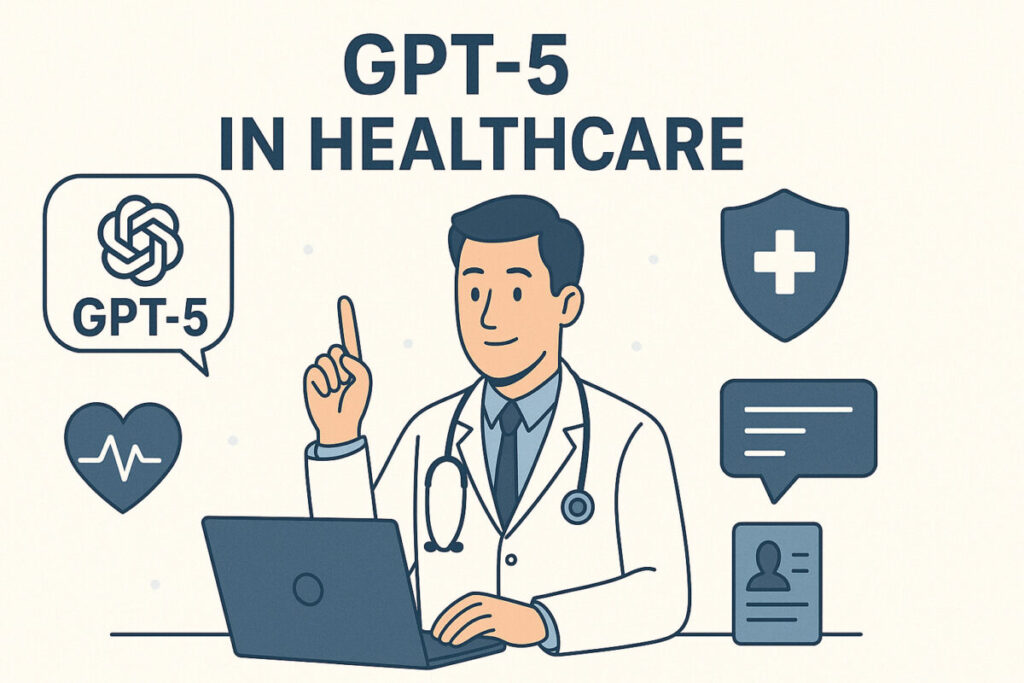
“Healthcare organizations will see the most immediate impact,” said Brady Lewis, Senior Director of AI Innovation at Marketri. “With GPT-5 scoring 46.2% on advanced health benchmarks and hallucinating only 1.6% of the time on medical queries, we’re crossing the reliability threshold that healthcare systems demand.”
Martin Neale, CEO and Founder of ICS.AI, is also worth listening to. ICS.AI claims that Derby City Council in the UK has saved around £7.5 million through its AI transformation programme. And that was with the old version of GPT.
“GPT-5 marks a real step-change in how the public sector can safely apply AI at scale,” said Neale. “For sectors like government, healthcare and education, the big story isn’t just that it’s smarter – it’s that its improved reasoning and context handling can be embedded into everyday processes without sacrificing governance or public trust.
“And with some versions now up to 40 times cheaper to run than earlier models, the impact on operational costs will be significant – opening the door to far broader deployment without blowing budgets.”
GPT-5 for education

One of the biggest claimed benefits of GPT-5 is its increased trustworthiness. Fewer hallucinations in particular. This means that “educational institutions can finally deploy AI for student support, curriculum development and administrative processes without worrying about accuracy issues that plagued earlier models,” said Marketri’s Brady Lewis.
“The difference between 15% hallucination rates and 1.6% is the difference between a research tool and a production system,” he added.
Mark Roman, Managing Partner, Education at Info-Tech Research Group, believes that GPT-5 could have a huge impact on education. “Its ability to process images, sound, video, and text could change the nature of learning altogether,” he said.
“For example think of a history lesson with images, a brief video, and an audio description bringing the topic alive. With greater memory, it can now also monitor a student’s progress, tap into what they already understand, and tailor lessons to their speed.”
But he has words of warning. “There are also challenges to manage, and clear privacy rules must be in place within every organisation. There should be a process set up to review the content for errors or bias. Also, staff and students should be taught how to use it properly. With these safeguards in place, the new model from OpenAI could become a genuine asset to education rather than just another piece of new technology.”
Igor Trunov, Founder of AI startup Atlantix that promises to turn scientific research into scalable businesses, is also cautious. “[Hallucinations] haven’t vanished – they’ve just become more sophisticated,” he said. “The model is more confident and fluent, so when it’s wrong, it can be harder to spot without rigorous fact-checking. This is why I still see AI as an augmentation tool, not an autonomous decision-maker.”
GPT-5 for the government & the wider public sector
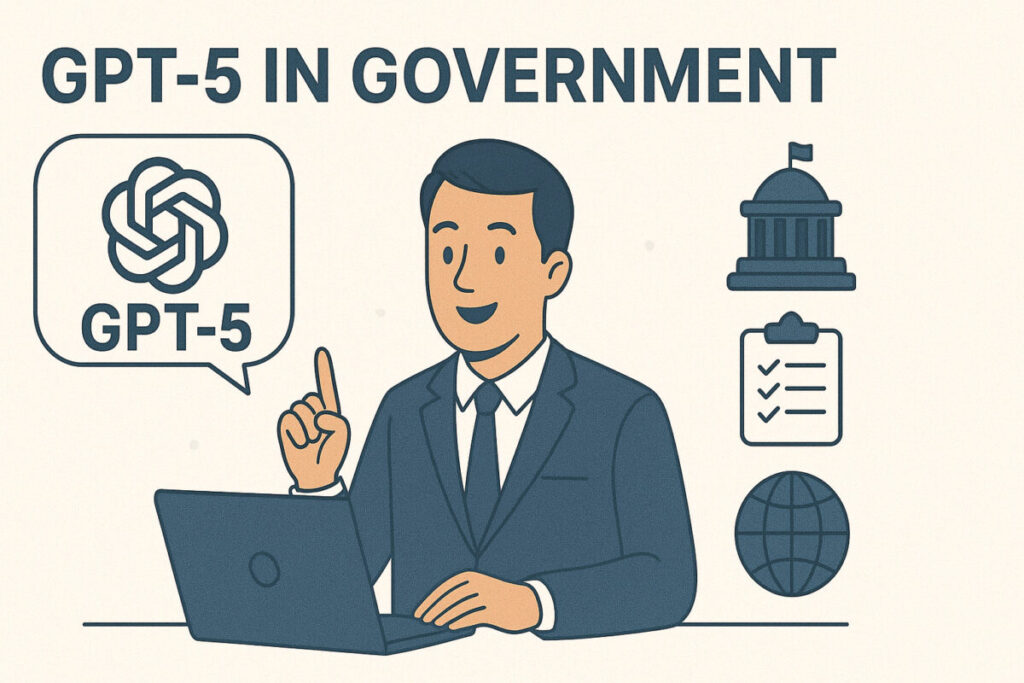
We’ve already quoted Martin Neale, CEO and Founder at ICS.AI, which works with local and central government in the UK. You may recall that he said GPT-5’s lower cost opens the door “to far broader deployment without blowing budgets”.
So what does that mean for government? “That means faster triage of citizen queries, better decision support for complex casework, and more consistent service delivery across entire organisations.”
He added: “[We’re] bringing GPT-5 into our unified AI Platform in a way that’s grounded in each customer’s own content, model-flexible, and affordable for every employee. That means UK public bodies can continue to move from isolated pilots to a single governed platform that spans front-door services and back-office processes, delivering faster outcomes, consistent quality, and resilience as AI technology evolves.”
GPT-5 for lawyers and attorneys

So we’ve covered the public sector. What about private firms? As our example of best practice, let’s think about law. Here, we turned to Chad Daniel Cummings, Chief Executive Officer at Cummings & Cummings Law. He also teaches business law at Florida Gulf Coast University.
“Where GPT-4o often required heavy human review for nuanced legal or accounting matters, GPT-5’s improved contextual retention, source integration, and ability to follow multi-step analytical chains make it operationally viable for tasks that were previously too risky to automate,” he said with confidence. Confidence borne of the fact that he has team “embarked on a crash course test of GPT-5” to see how it performed.
Here are a few highlights of how it performed:
- Better at ingesting information (“[It] can ingest an entire statutory code section alongside hundreds of case annotations, synthesize conflicts, and produce jurisdiction-specific risk assessments with pinpoint citations. GPT-4o could summarize, but often missed fact-sensitive nuances or conflicting holdings.”)
- Better at reading contracts (“GPT-5 can compare a proposed commercial lease or service agreement against multiple regulatory regimes… and flag non-compliance. GPT-4o could identify general issues but lacked the precision to detect jurisdiction-specific statutory conflicts.”)
- Improved interpretation of tax codes (“GPT-5 can process Internal Revenue Code provisions, IRS regulations, and relevant Tax Court opinions in a single query to provide immediate, context-aware interpretations for client scenarios… GPT-4o often returned generalized explanations that required significant manual supplementation.”)
- Improved anomaly detection (“GPT-5 can scan thousands of journal entries, trial balances, and supporting documentation to identify patterns inconsistent with GAAP or IFRS, such as improper revenue recognition under ASC 606. GPT-4o’s anomaly detection was narrower and prone to false positives in high-volume, heterogeneous datasets.”)
“In short,” said Cummings, “GPT-5 moves these applications from ‘assistant’ to ‘co-counsel’ or ‘senior associate’ level in terms of research and analytical rigor, provided the professional user applies appropriate validation and maintains control over final work product.”
GPT-5 for business: breaking barriers

“The breakthrough with GPT-5 is finally having an AI system that thinks before it acts,” said Marketri’s Brady Lewis.
“Its real-time routing between fast responses and deep reasoning means government analysts can get instant briefings for routine queries while triggering comprehensive analysis for complex policy decisions – all from the same interface. After two decades of watching technology implementations fail due to complexity, GPT-5’s unified approach eliminates the biggest barrier to enterprise AI adoption.”
We’ll give the final word to Bob Bilbruck, CEO at Captjur, who originally used AI to generate a response to our question. When we challenged him on this, he responded: “It’s a story about AI. Of course it is generated by AI, it’s much smarter then me. I use AI every minute of my life now.”
But it turns out that it was worth asking him to put the impact of GPT-5 into his own words, as they add welcome realism to the more positive thoughts elsewhere.
“GPT-5 is going to eliminate about 33 million jobs,” he said. “Jobs you wouldn’t even think could be eliminated by AI, but they are as good as gone. That’s going to have a huge impact not only on technology but human life. What are these people going to do to make money? They better get really good at using AI and making what ever they produce worth something to society.”
We agree, as we do when Bilbruck points out that AI “will always be a tool – just like all technology humans will evolve on the way we use the tool and how we make that valuable to society. Just like the internet was a tool and now a platform to help run our lives the same will happen with AI – at some point when the fascination wears off it will just integrate into our lives, it will be assumed – just like we assume using the internet to do our banking today. Back in 1990 we were not using the internet to do banking, its all about efficiency.”
We’ll come back to this in 35 years to see if he’s right.
More articles you might enjoy
About The Author

Tim Danton
NEXT UP