Trending Topics

 Trending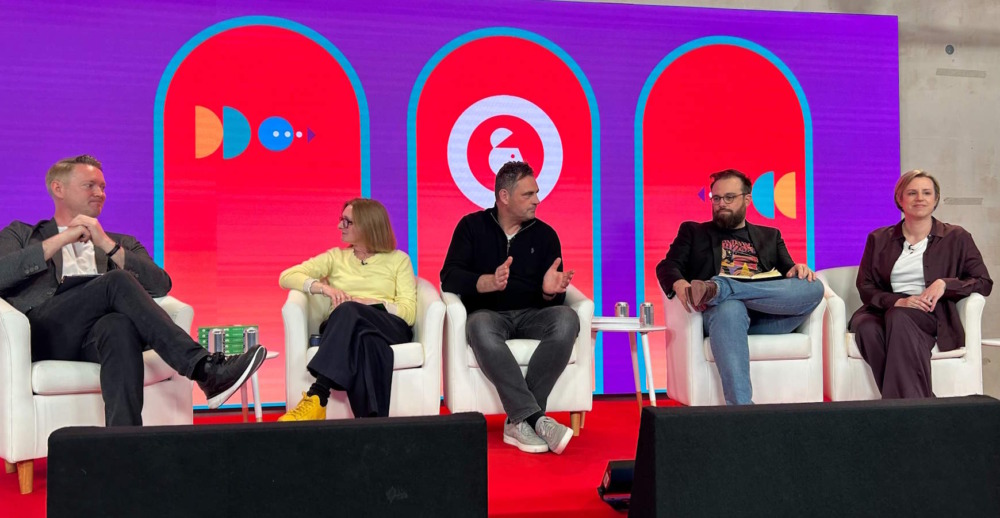
Ten ways to deliver authentic marketing in an AI world

When you can no longer tell if a photo of someone is real or fake, how can you trust the marketing produced by a company? That video may look like it’s a genuine person saying they love a product, but how do you know? Especially among the flood of similar marketing messages hitting you on social media.
So how can a brand deliver clearly authentic marketing with AI? This is the question TechFinitive’s Managing Director and Co-Founder, Chris Cannon, put to a panel of four experts at Advertising Week Europe yesterday. Here, captured in ten hopefully useful tips, is what they had to say.
About the panel
As a lot of this article concerns trust, why should you trust what these experts have to say? Well, let’s explain their credentials.

You’ll first hear from Rachel Fairley. “Rachel is an absolute expert in fixing brands to drive growth,” said Chris Cannon. “She’s contributed to over 35 brand transformations globally as both a marketing leader and an advisor. She’s former Chief Brand Officer for Hewlett Packard Enterprise. Now she’s co founder of Rebrand Right with Sarah Robb.” Rachel and Sarah have co-written a book called Rebrand Right, which goes on sale later this month.

Next up, Paul Cash. “Paul is a creative startup founder with over 25 years of experience within the B2B industry,” said Chris in his introduction. “He’s the Founder of Rooster Punk, the UK’s first B2B storytelling agency and also one of the best names, I think, for an agency I’ve come across. Paul also founded Tidal Wave, the UK’s fastest growing marketing agency, which scaled from two to 120 people in about four years.” Another author, Paul’s book Humanising B2B is available from Amazon.

“Pierre Paoli is a Media Strategy Manager at Lenovo, one of the largest technology brands in the world, constantly pushing the envelope of innovation,” said Chris. “He has expertise in audience strategies, digital media and ad tech, analytics and automation. He’s worked with global and local brands across multiple sectors: technology, FMCG, automotive and entertainment. He very much specialises in data and AI to optimise brand-to-buyer journeys and enhance marketing effectiveness.”

Izzie Rivers, CEO and Founder of award-winning global digital agency Realm B2B. “She has 20 years plus of experience leading transformative programmes for top brands in technology, finance and multiple different industry sectors,” said Chris. “Izzie is a thought leader in AI driven marketing and is actively involved in B2B AI councils and industry forums. She’s dedicated to harnessing new technology for growth, which is perfect for today’s panel.”
Put real people at the heart of your campaigns
When it comes to successful campaigns, Izzie Rivers said it’s all about real people. And one campaign immediately came to mind.
“We’re now in the third year of running [a campaign] for HPE, where they’re finding their products and service champions. So they do a lot of AI campaigns. So they’re finding their AI product lead. They’re using Antonio, their CEO, to come out and actually do campaigns now,” she said.
“He’s not just doing editorial and interviews. He’s actually in adverts… and it’s like the old school influencer at times. [Those campaigns] are outperforming by about five or six times the baseline of anything else that’s out there at the moment.”
So, if you’re a marketer, the message is clear: think about putting real people from the company at the heart of your campaigns. “I’d say that’s the top performing thing from an influence and an authenticity point of view,” said Izzie. “People want to hear from peers… and the people at an organisation.”
Don’t pump out beige campaigns just because you can
Building upon a previous session, where a panel member had said that brilliant creativity doesn’t burn out, Rachel twisted the message. “If you have rubbish creative, rubbish ads, they just burn out,” she said.
“You’ve got to be careful that just because you can produce lots of content and thousands of ad variations that we don’t end up putting out stuff that is literally beige or vanilla or doesn’t get cut through.”
And Rachel had seen that recently, where CMOs were telling CFOs that they needed bigger budgets to push creative. “[That’s] because we’re drowning ourselves out with the noise of mass produced beige content,” said Rachel. “And that is a big lesson, as well as be really careful not to pollute but to actually put out things that are relevant to your audience and have a real sense of being useful.”
Which is the problem when you put AI into the hands of marketers. “It’s very easy to do more, it’s actually harder to do less better.”hpe
Empower people at your company: put them first
“We’re humans selling to humans at the end of the day,” said Pierre. “I don’t think machines are actually making [final] decisions on B2B contracts yet. We need to empower employees. We need to make sure that these people are feeling sort of comfortable and just leverage what we can to help them.”
However, that doesn’t mean a free for all when it comes to tools. Pierre mentioned that Lenovo’s global governance council has forbidden employees from using free AI services, in particular.
“The last thing I would mention is that whatever we do to empower our humans and the customers that we have is to be those three keywords that we use internally quite a lot. Ai needs to be ethical, responsible and sustainable, and that’s what we try to do at every level.”
He added: “It would be lying to say that we’ve all figured it out,” he added. “We haven’t, but we’re in the process of testing it quite strongly.”
Measure attention, not just engagement
When it comes to authenticity and AI, you also need to measure the success – or otherwise – of your campaigns. And there’s a switch to attention.
“Even in the lead generation space at the moment, for example, the metrics are shifting to attention metrics, not just engagement metrics,” said Izzie. “So it used to be that you just try and put content in front of a B2B person and hope they left you a lead or gave you some information in return.
“Now you can actually measure how much of a web page they’re reading, dwell, if they’re engaging with different things in dynamic ads and dynamic papers, and those are providing better remarketing opportunities than programmatic campaigns and data.”
Connect emotionally
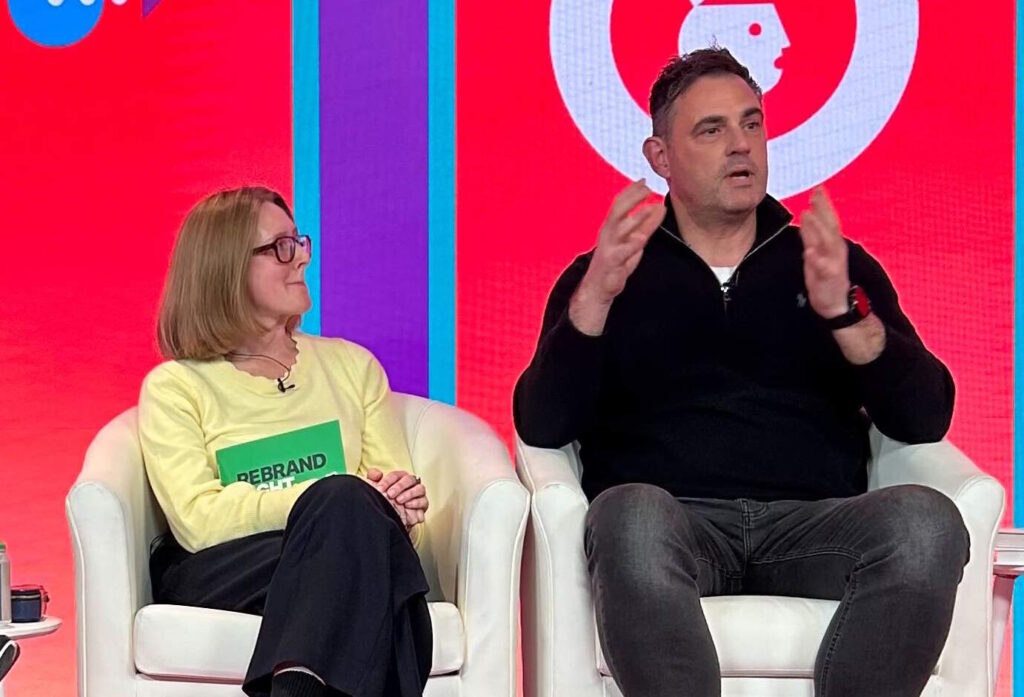
Don’t look away, but Rachel’s next point was about emotions. “In order to get attention, you have got to do something which is slightly emotional, which B2B brands hate doing, by the way,” she said.
“If you can engage with that person in a way that gives them some sense of emotion, then the associations that you’re building as a brand lodge in their mind. And that gives you predisposition. If you have predisposition, you have buyers.”
But the problem with AI is that, by its machine nature, it’s devoid of emotion. “When you’re using AI, you’ve got to make sure that you don’t you become even less emotional in how you’re communicating,” she said. “That’s really easy to do as well.”
Be true to your (strong) brand
“A strong brand, for me is sits at the heart of everything,” said Rachel, CEO of Rebrand Right. “Because it’s really hard to even think about authenticity and being real, and what that means if you don’t actually have a strong brand.”
She added: “It seems very authentic for some businesses to use bootleg IP to train the LLMs. When you hear about it, you’re like, yeah, actually, it does seem quite them, for them to have done that, right?”
But, as a general rule, Rachel says it’s important to use AI in a way that people would expect of your brand. “Sage wants to build business confidence. Cadbury’s wants to bring a spirit of generosity to you. And so when you’re thinking about how you’re executing on your brand… you have to know what you’re actually trying to be authentic at.”
You also have to think about what being authentic means to your buyers. “As a brand, you’ve got to show up knowing what that’s going to be, and you’ve got to be really cohesive with how you execute it.”
Take a leap of faith
Lenovo’s Pierre Paoli believes that brands need to be braver. “A problem that a lot of brands encounter at the moment is that sort of paralysis: you just freeze, you stop, you don’t even attempt things, you don’t iterate, you don’t try,” he said.
“And we are guilty of that sometimes on certain elements. Basically, we need to be brave enough to sometimes take a leap of faith. And certainly test and learn.”
This, he explained, applies to AI as much as any other new technology, and is an area where Lenovo has taken a leap of faith. A leap that has shown itself in results.
“In February, we had our Q3 earning calls,” he said. “Our worldwide revenue grew 20% year on year, Q3 to Q3, and that’s the third consecutive quarter of double-digit growth. AI has an impact. AI is at the core of the marketing strategy we’re implementing at every level, end to end, from product, engineering, processes, operations, brands and marketing, obviously sales as well.”
It’s reflected in products that span from AI PCs to hybrid cloud, from private customers to enterprises to the public sector. And even Lenovo’s tagline: “AI for all”.
Let AI empower B2B marketing like never before
“I think there’s a legacy challenge in B2B,” said Paul Cash, “which is this ongoing crisis of creativity. There seems to be this giant magnet of conservatism, speeds and feeds, the race to the bottom. Talk about products all the time.”
It isn’t a new problem, he explained, but one he’s been fighting for three decades. “We have these mini creative renaissance where all of a sudden, creativity seems to be on top of its game, and then markets move – older, wiser CEOs go back to what they know, which is that kind of conservatism.”
The difference today is AI. “Gen AI, which is arguably the greatest democratiser of our time, the ability to give every man and woman the ability to create great things… levels the playing field, for sure,” said Paul.
Meanwhile, agentic AI will remove the dull, mundane tasks and free up people to be more strategic and creative. “When we talk about authenticity as a species, that’s what we’re about, right? Creativity, imagination, the ability to bring that to the fore, and I think, I hope, that in B2B – small agencies, in-house creative teams – we raise the bar to a higher standard than it’s ever been before.”
While warning that we could enter a “wave of mediocrity before we get to the good stuff”, as teams get to grips with AI tools, it will be worth it. “Hopefully B2B will be on more of a par with its B2C cousins in terms of the opportunity to do great creative work, emotional, using storytelling, good production.”
You can’t build trust with a banner
We loved this quote from Izzie. “We’re constantly having client conversations,” she said. “We’re like, you’re not going to change their mind with a banner. It’s the best banner in the world, and I love it to pieces, but if that person doesn’t know who you are, you’re not going to build trust with a banner.”
Pierre went even further. “It’s not about just one ad, one display ad, one video, whatever, one event,” he said. “It’s a combination of accumulated experience with brands, with people, relatives, family, co-workers, employees, whatever, that will sort of feed into… very personal patterns that we all have about one brand versus another.”
This, he explained, is one area AI is starting to help. “[AI] is helping us to try to understand these minute details in qualifying, sort of like translating a little bit what that means for brands. We’re very much at the beginning, it’s complex but there’s hope.”
Related articles
About The Author

Tim Danton
NEXT UP


