Trending Topics

 Trending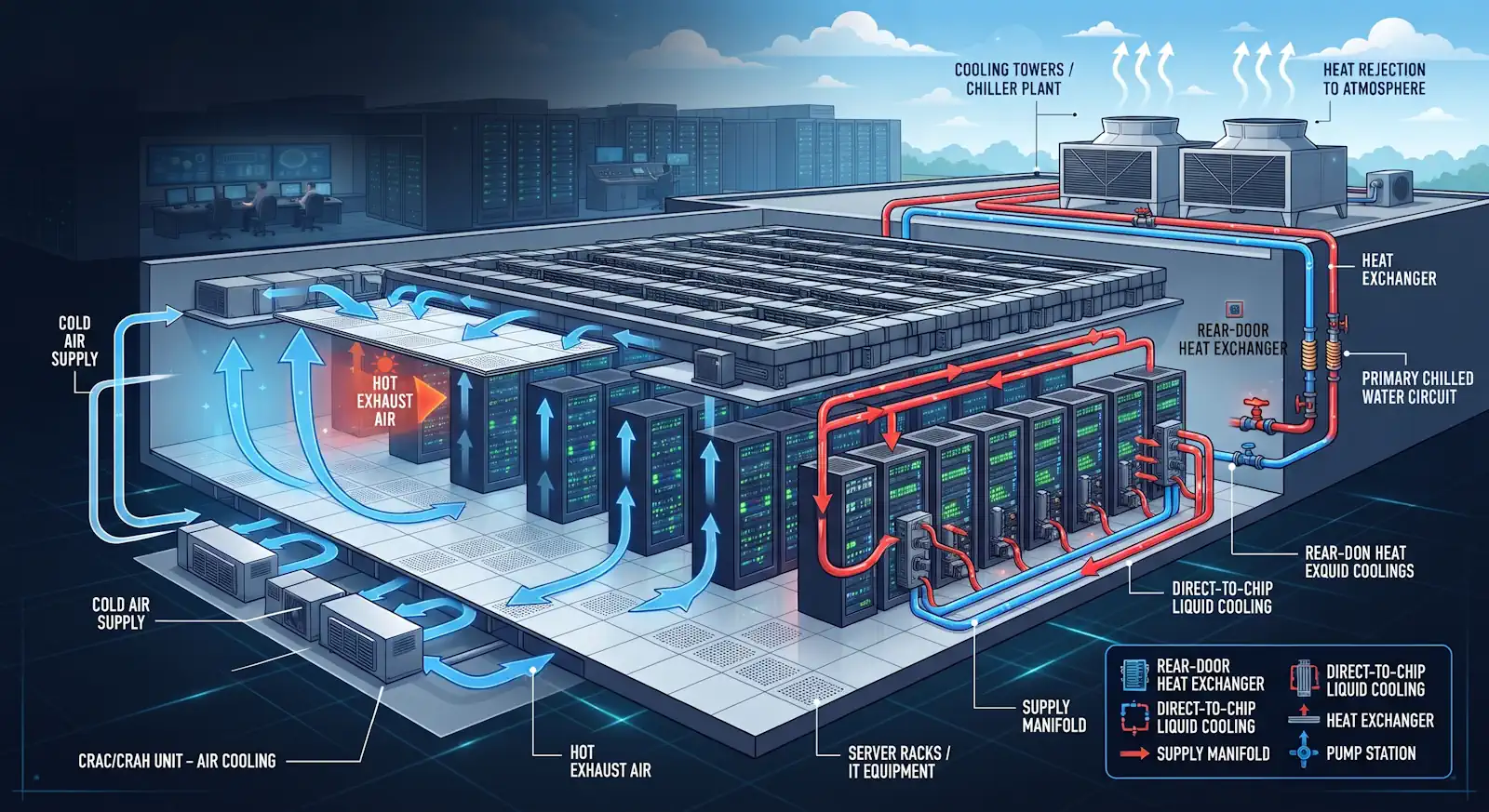
AI data-centre cooling: The harder work starts after fluid validation

We recently reported that Castrol’s ON PG25 and PG25T direct-to-chip cooling fluids have met Nvidia’s requirements for AI infrastructure. For operators choosing a coolant, that is a useful procurement signal.
The hard work will begin when the fluid enters service.
As coolant circulates through cold plates, hoses, manifolds, connectors, and coolant distribution units, its performance depends on the materials it touches and how the whole circuit is installed, monitored, and maintained.
According to Castrol, Nvidia’s technical review examined corrosion resistance, thermal stability, water quality, base-fluid purity, and compatibility with materials in contact with the coolant.
That list is revealing. It demonstrates that liquid cooling is not simply about removing heat. It is a materials-management and operations problem.
Who owns the cooling loop?
Someone must take responsibility for fluid quality throughout its working life.
Who samples the coolant?
Who investigates contamination?
How is the circuit cleaned before commissioning?
If a leak damages a server, what do the equipment vendor, cooling integrator, operator, and fluid supplier each cover?
Those responsibilities need to be settled before something fails.
With Nvidia’s Rubin architecture, the stakes become clearer. Nvidia describes it as fully liquid-cooled, with coolant entering the rack at up to 45°C. That higher inlet temperature can reduce reliance on mechanical chillers where the climate and system design allow.
The efficiency gains are compelling. They also make reliable coolant circulation central to keeping the servers running.
An engine cooling circuit offers a useful analogy. The coolant’s formulation matters, but so do the pump, seals, hoses, maintenance schedule, and response to a pressure drop. Specifying the right fluid is one part of keeping the system healthy.
Castrol appears to recognise the broader challenge. The Nvidia review also considered its business and global supply-chain resilience, suggesting that dependable supply and support are part of the proposition. That gives its expansion into data-centre cooling substance beyond the chemistry.
Operators still need a service plan that connects those assurances to their own installation: fluid handling, contamination checks, leak response, maintenance records and clear warranty responsibilities.
Suppliers that help deliver this will have a stronger case than those relying on a validation badge alone. Castrol is in a strong position in this regard. The company’s product page states that support spans start-up, maintenance, repairs, and disposal through third-party suppliers, with availability varying by location.
Related articles
About The Author