Trending Topics

 Trending
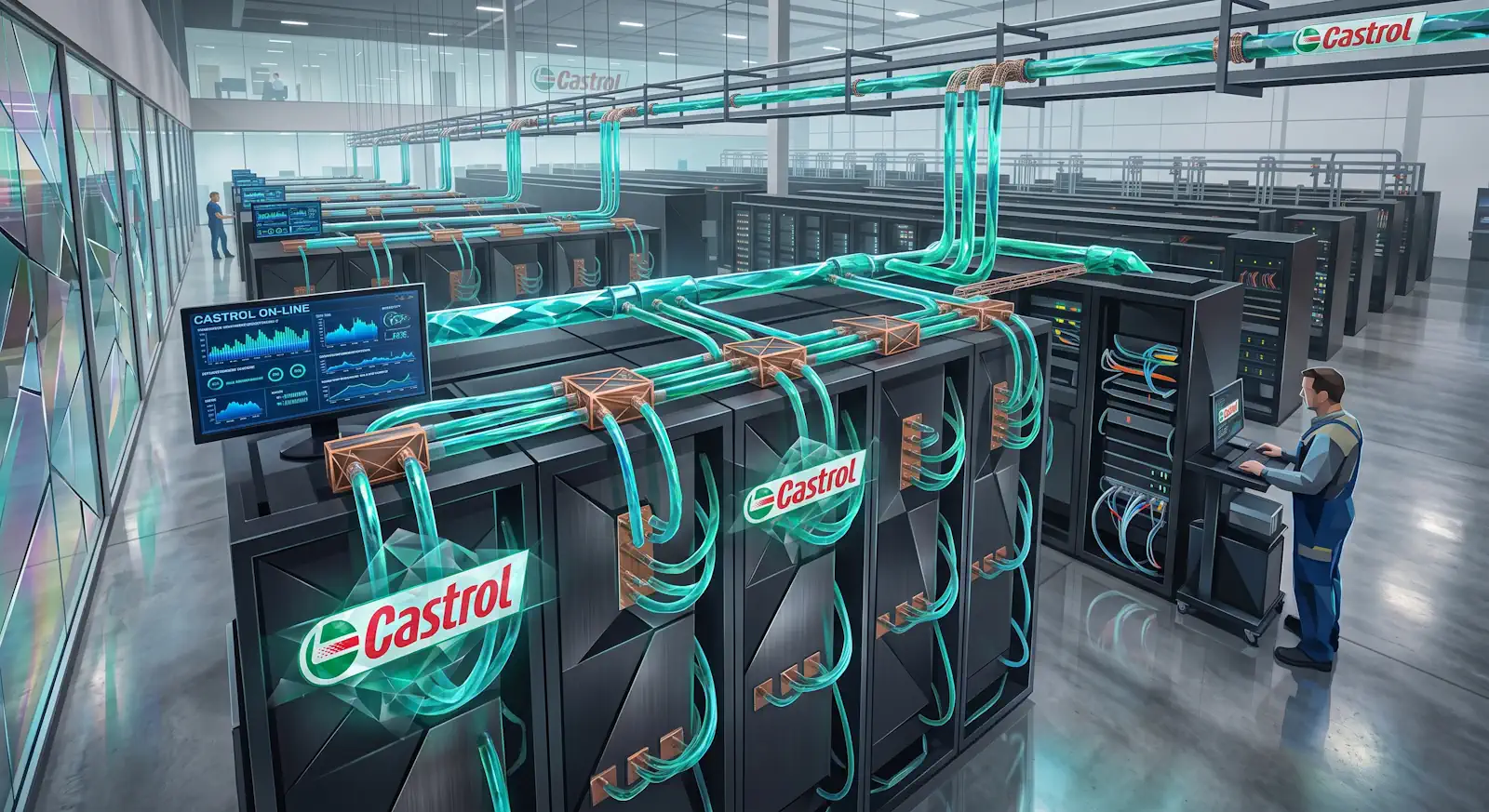
Castrol cooling fluids given green light for Nvidia AI Factories and data centre infrastructure

Two months ago we described how Castrol was bringing its 125 years of fluid expertise to help cool the world’s data centres. Today, it announced a giant step to becoming as ubiquitous in AI Factories as it is in car engines: two of its direct-to-chip cooling fluids, Castrol ON PG25 and PG25T, have been validated by Nvidia for use in its most demanding environments.
“As AI infrastructure scales, the industry needs cooling solutions that are effective, practical to deploy and reliable over the long term,” said Peter Huang, Global President of Thermal Management & Data Centres at Castrol.
“The inclusion of Castrol ON PG25 and PG25T within Nvidia-Validated AI Factory Infrastructure gives customers added confidence in both the fluids’ performance and Castrol’s ability to provide consistent global support across markets. It is an important step towards making liquid cooling a dependable part of AI factory design and operation.”
Nvidia hasn’t made any official statement, but then it never does about its data centre partners. So we must turn instead to Sung A. Kim, Data Centre Global Technology Manager at Castrol.
“We evaluate every thermal management fluid under rigorous test conditions before it reaches the market,” she said. “The validation from Nvidia confirms that PG25 (OAT) and PG25T (IAT) hold up to that standard, even at the scale and intensity of today’s AI infrastructure.”
OAT stands for Outside Air Temperature, IAT for Intake Air Temperature.
How Castrol fluids met Nvidia requirements
Becoming Nvidia-Certified is a big deal. Validation is handled through the Nvidia Partner Network (NPN) and dedicated enterprise engineering channels, as detailed on its site.
This happens in private, but we know from Castrol that PG25 and PG25T were validated after passing technical reviews that covered:
- corrosion resistance
- thermal stability
- dilution-water quality
- propylene glycol base-fluid purity
- and compatibility with wetted materials (“the metals, plastics, seals and other components that come into contact with fluid inside a liquid-cooling system”, explained Castrol in a statment.
In addition, Nvidia needed to have confidence in Castrol’s business and global supply-chain resilience.
About The Author

Tim Danton
NEXT UP