Trending Topics

 Trending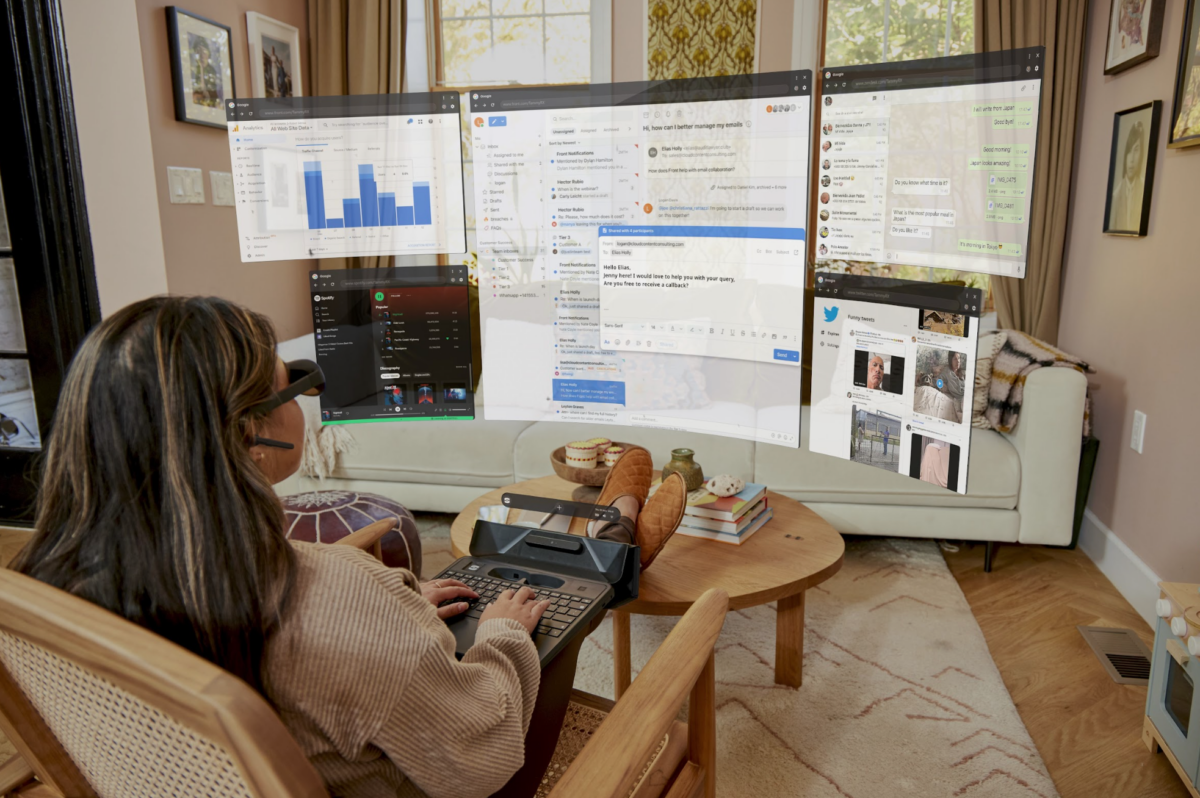
Can these AR glasses replace screens?

How many screens do you have on your desktop? Two, three, more? If the purveyors of augmented reality (AR) technology are right, that number might soon be zero.
Sightful is the latest company to demo AR glasses. But instead of popping up helpful information as you walk down the street or letting you play with 3D models of sports cars, the company’s Spacetop product aims to replace your physical computer screens with a 100in virtual display.
The Spacetop is effectively a laptop without a screen. That’s replaced by a pair of AR glasses that provide a swathe of virtual desktops, letting you switch focus from one app to another by moving your head, just as you might with your email on one physical screen and your web browser on another.
Now whether you’re sitting at your office desk or with your Spacetop in a cramped economy cabin, you can theoretically enjoy the benefits of multitasking across a huge display. Theoretically.
Related reading: the business case for Vision Pro.
Tomorrow’s technnology?
Don’t put your desktop monitors on eBay just yet. The Spacetop is only a prototype that’s been showcased to a handful of journalists. Full disclosure, I wasn’t one of them.
I was, however, one of the first journalists in the world to get a demonstration of similar next-generation AR glasses from an Israeli firm called Lumus at CES in January, so I know what the technology’s capable of. Sightful, perhaps not coincidentally, is also based in Israel.
Are these glasses capable of displaying enough detail to comfortably replace your computer screens? Yes, AR glasses have come a long way in a short space of time, and the 2K x 2K display demonstrated by Lumus definitely wasn’t short on detail. The Spaceport glasses are slightly lower resolution, with 1080p in each eye.
Practical solution?
The difficulty comes with the practicality. Even though that “100in display” looks impressive in photos and the video demos above, with lots of app windows tiled over one another, there’s a limit to how much anyone can focus on at one time.
As The Verge’s Monica Chin – one of the journalists to get a Spacetop demo – writes: “I don’t feel that the 100-inch screen accolade is quite accurate — the Spacetop gives you no peripheral vision. Everything outside of your immediate view is dark. Sure, the Spacetop can technically display many, many more windows than you might be able to cram onto a 13-incher, but you can still only see a few at a time (also the case on a 13-incher).”
Then there’s the far from the rudimentary task of making it compatible with Windows or macOS. The Spacetop is built on its own custom OS and will initially be pitched at workers who spend most of their time in a web browser. But if these products are to have any real future in the workplace, they’re going to need to work with the mainstream operating systems running everyday apps. Making Windows or macOS scale to work effectively on today’s large physical screens isn’t always easy, let alone on a 100in virtual display.
This is stunning technology that has barely reached infancy. It will inevitably improve and nobody can be sure what the future holds. The Spacetop might not replace your MacBook and bank of screens this year, but is there a future in which your massive black mirrors are replaced by a pair of slip-on spectacles? I wouldn’t bet against it.
Read next: “The office of 2033 will become a more social, healthier, more sentient, elastic, digital, personalised, shared and purposeful space” – exclusive interview with author and futurist Philip Ross.
More on smart glasses
About The Author

Barry Collins
NEXT UP