Trending Topics

 Trending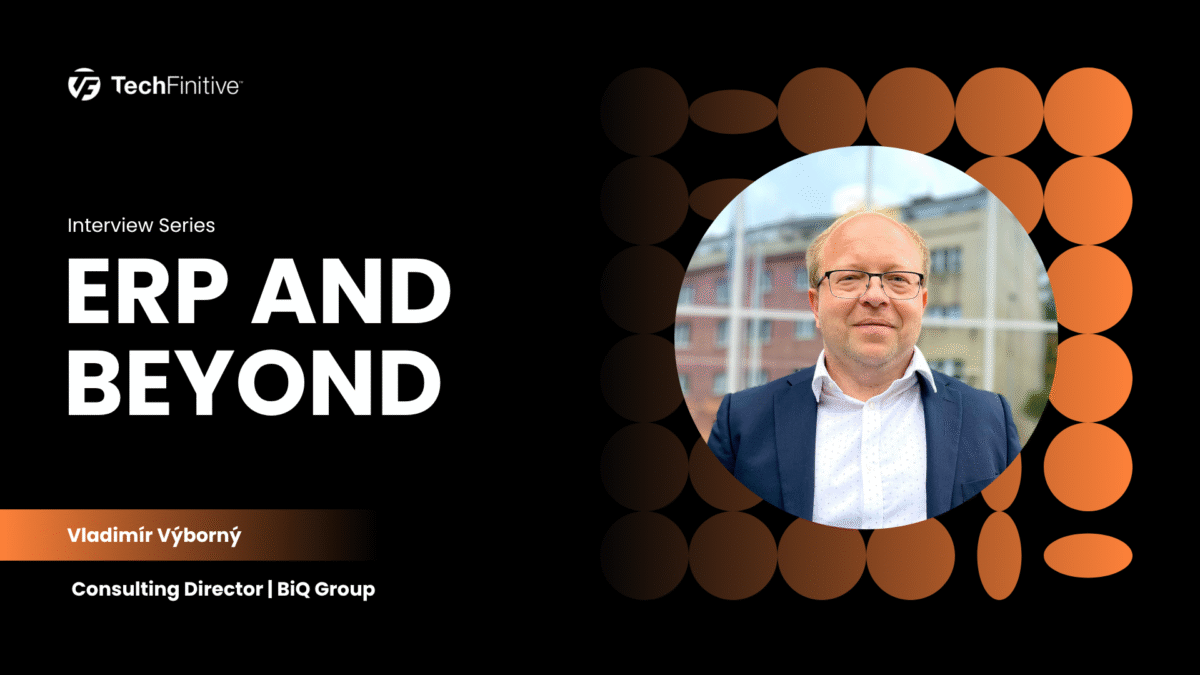
Vladimír Výborný, Consulting Director at BiQ Group: “We’re at the start of a new era”

In this second interview of our new series, ERP and Beyond, we speak to a someone with a long-standing reputation reputation as a digital transformation expert. Vladimír Výborný’s career bridges startups, enterprise consulting and national infrastructure, and as Consulting Director at BiQ Group, he not only leads business strategy and consulting services but also helps organisations modernise through ERP, CMS and ECM solutions.
For Vladimír, ERP is much more than a technical platform, it’s the very core of modern business operations. “I perceive ERP as the heart of a company,” he explains, but the technology is just the start: only with high-quality data does the company have solid foundations for growth.
That sense of patience and craft is a common theme throughout Vladimír’s career. “Just like good whiskey takes time to mature, my journey to ERP was gradual,” he says. Starting in infrastructure and networking, Vladimír moved through document management and e-commerce before finally arriving at ERP. The experience across these solutions has shaped his belief to this day, leading him to the conclusion that lasting digital transformation can’t be rushed, it’s built steadily with a clear vision.
Of course, getting to that point takes discipline. Vladimír has seen plenty of ERP rollouts stumble, and it’s rarely the software’s fault. “ERP is first and foremost a business project, with IT secondary,” he explains. Too often, though, companies rush in without a shared vision, which is why to Vladimír, “the starting point must be the needs of the business and company leadership; only then should you tackle the technical side”.
All of the lessons that Vladimír shares here come with copious amounts of experience in industry. At companies such as Tieto, Pontech, Itelligence and ČD – Informační Systémy. To set the stage, we began by asking about his role now and his journey with ERP systems along the way.
Can you tell us about your role and your experience with ERP systems?
I perceive ERP as the heart of a company. Just like good whiskey takes time to mature, my journey to ERP was gradual. I started out in infrastructure and networking, moved into document management systems and e-commerce, and subsequently arrived at ERP. Most of my experience is mainly with SAP, starting from the older versions to current cloud-based SAP S/4HANA.
From an IT architecture perspective, ERP should be the central hub where all business processes converge, a single source of truth. When ERP is built on quality data, the company has solid foundations for growth. At the same time, users must feel comfortable. ERP should be a place where people can easily find what they need without friction. That’s why it’s essential to have a connected ecosystem, with ERP as the foundation for all associated systems.
What first drew you to working with ERP solutions?
My first experience came through integrations, back when there were no standard interfaces. Connecting to local or global systems took months; it was laborious, costly, and required tedious analysis. I realised if I wanted to really help, I had to go to the core of ERP itself.
By coincidence, ERP systems and their development gradually came under my responsibility. That’s when I saw how fast this area was evolving. Both SAP and Microsoft shifted their focus to user comfort – the beginnings of UX.
I started my career at PilsFree, working in the networking department. Then came Reengine and Tieto, followed by Pontech (today NTT Data), where my work with ERP deepened. However, the most formative period was my eight years at ČD Informační systémy, where I was also responsible for ERP development and gained the most valuable experience.
In your view, what’s the biggest advantage a well-implemented ERP system can bring to an organisation?
The biggest benefit isn’t obvious at first glance. When the entire company works with the same data and unified processes, it leads to efficiency. That improves reporting, speeds up decision-making, and ultimately strengthens the business.
But ERP implementation isn’t just about software. It brings best practices, know-how, and methodology from the partner you work with. Often, the company goes through a cultural shift as people adopt new ways of working and start thinking differently about processes. A well-implemented ERP allows long-term growth without creating bottlenecks, and it opens access to the latest innovations.
ERP shouldn’t be a burden on the business; it should support it. The best ERP is the one users barely notice because it fits seamlessly into their daily work.
How do ERP systems help businesses become more agile and data-driven?
This is a crucial question. Modern ERP brings not only comfort but also a high degree of agility. With embedded AI and reporting, users can now create outputs that previously took months. In the past, you had to submit a request to IT, wait weeks for a report, which might still contain errors, and then start the whole cycle again. Today, it’s a matter of defining the request and filtering correctly, and you get results in minutes, without heavy effort. The demands on users are modest and, importantly, it’s cheaper. They can generate what they need on the spot.
I often compare it to plumbing: in the old days, you had to cut and thread metal pipes, seal them, and hope they held. Now you just snap plastic pipes together. It’s quicker, simpler, and more reliable. ERP today simplifies work in the same way. Agility and user experience are critical, and those who don’t embrace this will fall behind in ERP.
On top of that, companies need systems that can handle international standards and legislation. If you choose a purely local tool, you’ll hit a wall when expanding abroad, such as Slovakia, Poland, or further, and face a costly migration. That’s why you need to think about growth from the very beginning, and just as importantly, choose partners who can support you over the long term.
Are there specific industries or business functions where ERP creates the most impact?
I believe the impact is universal. Yes, in some industries, ERP already comes with a wider product portfolio, sometimes extending into production. But in most cases, ERP is complemented by specialized solutions tailored to the segment. The real benefits can be seen across manufacturing, logistics, e-commerce, healthcare, and even education.
Take DPD SK, Arriva CZ, or BeLenka as examples: their move to SAP S/4HANA consolidated tools, cut costs by around 10%, and brought best practices into play. And this was achieved in a short timeframe. Implementations were completed in just nine months. At Arriva, a SAP Fiori app for service brought immediate savings. At ČD Cargo, introducing AI cut development time and costs by about 50%.
My advice: use best practices wherever they don’t clash with your core business, and only customize where absolutely necessary. Long term, ERP provides stability, transparency, fewer errors, and even supports company valuation. From a CIO perspective, it reduces costs by consolidating tools and licenses and eliminating unnecessary integrations. Cloud operations are more efficient, safer, and scalable, and you no longer need to maintain servers in the basement or manage physical access.
What are the most common reasons ERP implementations fail or fall short?
Most failures can be traced back to the very beginning, even before the system is chosen. If ERP is treated purely as a technology project, it’s destined to struggle. ERP is first and foremost a business project, with IT secondary. The starting point must be the needs of the business and company leadership; only then should you tackle the technical side.
Other critical factors are project management and change management. The project must be run with discipline and clear methodology, and users must be engaged early. If you don’t win them over, they will never truly adopt the system.
What lessons have you learned from challenging ERP rollouts?
Every tough rollout has pushed us forward. We learned that standard methodology alone isn’t enough. You also need your own approach. One role I’ve found invaluable is what I call the “guardian of standards”. Someone who constantly checks whether customisations are really necessary and makes sure best practices are followed. In every project, there will be hundreds of customization requests, but you have to keep them to a minimum.
Another lesson is about timing: don’t try to do everything at once. If you overwhelm users with changes, they’ll push back. Give them time to adjust, and roll out extras gradually. The only exceptions are legislative or regulatory requirements, which must be addressed immediately.
One highlight for me was deploying SAP Joule at ČD Cargo, our first real example of AI directly embedded in ERP. We also led some of the very first public cloud ERP migrations in the Czech Republic and Slovakia, moving to SAP S/4HANA.
How do you balance the complexity of ERP systems with the need for usability?
ERP systems are inherently complex because they cover everything from finance and logistics to manufacturing and HR. But the biggest mistake is making them even more complex than they need to be. Some teams try to polish every detail, add features users never asked for, and end up with a system so heavy that nobody wants to use it.
My experience: stick to standards, forget about flashy “wow factors” in the first step, and focus on total experience. By that I mean the overall feel – speed, consistency of data, logical processes. The simpler and more natural the environment, the more likely people are to embrace it. Balancing complexity and usability is about letting ERP do what it was designed to do, without layering on unnecessary extras.
Is it better to change your processes to fit in with your chosen ERP solution or go down the route of customisation?
This is the classic dilemma of every ERP project. My rule is straightforward: follow the standard wherever possible, and only customise when adopting the standard would hurt your core business. ERP systems already embody best practices from tens of thousands of companies worldwide. Why not use them? Every customisation brings risk, cost, and future migration pains.
Yes, there are unique processes worth preserving, but they should be the exception, not the rule. In practice, I’ve seen the value of having leadership review every customization request and ask: Do we really need this, or can we adapt? The closer you stay to the standard, the more sustainable and future-proof your ERP will be.
When migrating, do organisations tend to under-estimate the challenge of data migration? If so, how can you mitigate against that?
Companies almost always underestimate data migration. The most common mistake is trying to move the entire history. In cloud migrations, this usually makes no sense. We archive the old data so it’s available if needed, but keep only a “starting set” in the live system. That way, the new environment launches smoothly without being overloaded.
The key is to capture business needs early, map your data sources, and clean the data well in advance. And remember: data migration is not just a technical exercise. It’s a business process, and you need to involve the people who actually use the data every day.
How do you think ERP systems will evolve over the next 5–10 years?
We’re at the start of a new era. Cloud will become the standard. Infrastructure sits with the vendor, and the customer can focus on business, not servers. Speaking about AI and machine learning, I see three levels where ERP is already changing.
First, AI is embedded in processes and scenarios, saving time and costs. Second, support for users who can now generate outputs themselves instead of waiting months for developers. And third, AI agents that can autonomously perform certain tasks within the ERP ecosystem. This means ERP is no longer just a system of record; it’s an active assistant that suggests and guides decisions.
In the next five to ten years, I expect ERP to become more modular and personalised, with the lines between ERP, CRM, and SCM continuing to blur. The end state is one intuitive ecosystem where users work naturally and technology actively supports them.
How should companies think about integrating ERP with other key systems, like CRM or supply chain tools?
ERP is the heart of the entire company, and everything else is connected to it. Make the most of native integrations and ensure that data flows between systems as it should. In the age of AI agents, it is extremely important to have a single source of truth in order to get the most relevant output.
What’s the most exciting ERP innovation you’ve come across recently?
From my point of view, it is undoubtedly the recent project for ČD Cargo to use the SAP Joule AI assistant to develop Fiori applications. The motivation was slow development and, consequently, high development costs. The tool will help the company, for example, to design a data model and application logic based on input via text prompts. This saves developers time and helps prevent frequent errors. Instead of an entire team, a single developer worked on the project. ČD Cargo was the first company in the Czech Republic to implement SAP Joule for application development. So generative AI is a big deal that already speeds up development and saves companies significant financial resources.
If you could give one piece of advice to a CIO about to embark on an ERP project, what would it be?
There is no point in reinventing the wheel. Try to fit to standards and proven processes as much as possible, and avoid customisations.
If there was one single pitfall you would warn people of, what would it be?
Systems tend to grow into enormous complexity. Try to keep it under control. This will help you avoid mistakes and future problems.
Other interviews
- Adi Krysler, VP Marketing at Oktopost: “Don’t fall for the AI polish”
- Costanza Ghelfi, Chief Product Officer at Making Science: “You can’t get personalisation right without getting privacy right first”
- Áine Dundas, Head of EMEA Marketing at Notion: “As a marketing leader, I’m living in an unprecedented era of martech transformation”
About The Author

Rowan Campbell
NEXT UP


