Trending Topics

 Trending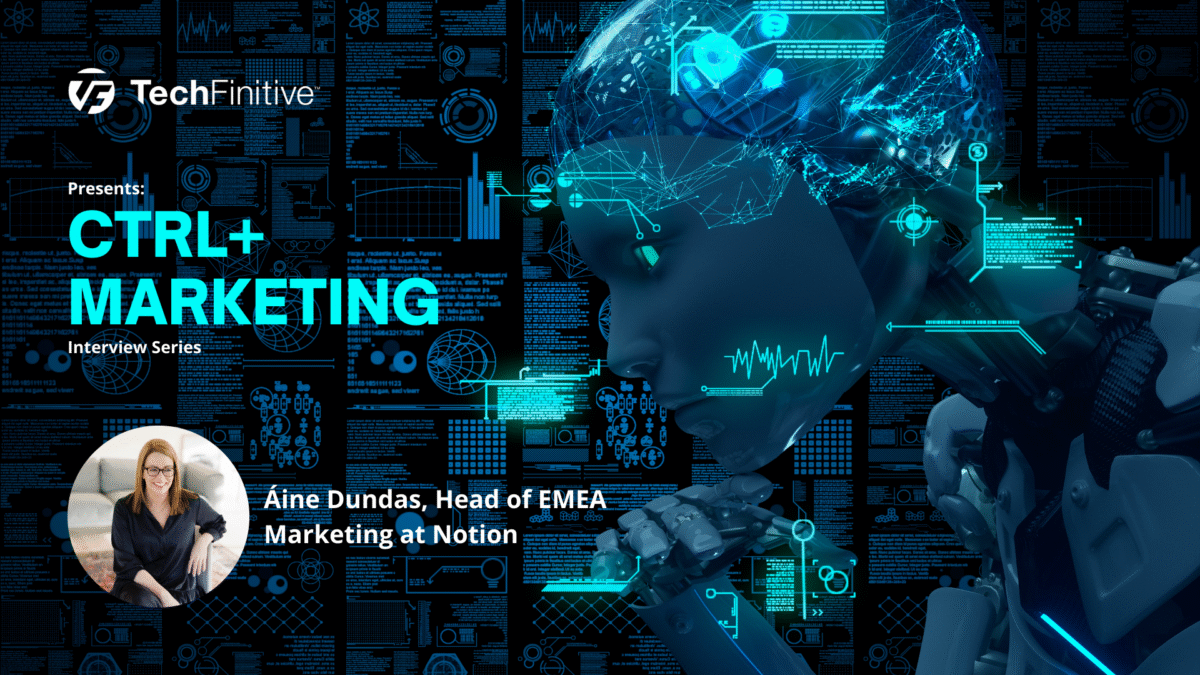
Áine Dundas, Head of EMEA Marketing at Notion: “As a marketing leader, I’m living in an unprecedented era of martech transformation”

It’s hard not to be wowed by Áine Dundas’ CV. With a career spanning marketing leadership roles at Google, Looker and Marketo, she is now leading Marketing at Notion – a company that’s often cited by other interviewees. Where better to exploit her experiences of taking full advantage of AI as a tool to help her team execute smarter.
“AI has had a huge impact on my creative process,” she explains, “particularly when it comes to getting ideas off the ground, faster.” While Áine’s best ideas still come naturally when out in nature, AI has made capturing and communicating those ideas easier than ever. For Áine, writer’s block is no longer a barrier, with AI ensuring that every fresh idea starts with extra momentum.
Beyond momentum, Áine sees the potential in this new AI world to deliver empathy at scales previously impossible. “The principle of personalisation is and has always been important,” Áine explains, “but the mechanisms to deliver it are more advanced than ever.”
As for return on investment, Áine sees the strongest results when AI supports, not replaces, traditional campaigns. “It’s not about replacing people,” she explains, rather “it’s about accelerating progress and maximising impact.” That approach powered Notion’s ‘Make with Notion’ series, which hosted over a thousand attendees across three countries – and it was managed by only four marketers. A feat she says wouldn’t have been possible just ten years ago.
With results like that under her belt, it’s no surprise Áine is eager to explore the AI tools that make such an impact possible. Which led to a very natural first question for us to ask…
What are the most exciting AI tools or technologies you’re currently using in your marketing campaigns?
As a marketing leader, I’m living in an unprecedented era of martech transformation that’s both thrilling and daunting all at once. AI tools are evolving at lightning speed and allowing us to rapidly execute campaigns that would have been incredibly time-consuming just a few years ago.
For me, the most exciting developments are around using AI as a tool to transform content creation. That doesn’t mean outsourcing creativity, but AI-driven content generation and optimisation tools have revolutionised how we produce copy and adapt it for creative variations at scale – all in a fraction of the time it used to take. There is also huge potential in predictive AI platforms, automatically identifying audience segments and helping us make smarter, faster decisions around ad spend.
Keeping up with the pace of change can feel like a full-time job in itself. There are now more than 15,000 martech solutions, with AI native tools driving the surge in recent years – but no single tool offers a complete solution. Even if some AI-powered tools are exciting in isolation, many remain siloed, which limits their effectiveness in supporting the full customer journey. The real value goes beyond the innovation of a single tool and is best extracted by connecting them with other systems to give them access to shared knowledge across workflows. That’s how you capitalise on the AI opportunity.
Personalisation has become a key marketing trend. How has AI helped you deliver more personalised experiences at scale?
Personalisation isn’t a new trend. In fact, it’s been at the heart of data-driven marketing for over a decade. What’s changed isn’t the what, but the how. We’ve gone way beyond tailoring communications to a customer’s first name, where the extent of audience segmentation was limited to targeting clustered audiences.
AI has taken this to new heights, evolving basic personalisation to meaningful, one-to-one conversations. It can rapidly analyse behavioural patterns, customer preferences, even CRM and call data, to build highly tailored experiences — whether that’s in product recommendations, dynamic pricing, or targeted messaging.
One of the most powerful advantages is the speed at which AI can synthesise data. In a matter of minutes, it can gather insight from internal tools and public sources, then build campaigns that feel genuinely personalised. For example, we’ve used AI to analyse call transcripts alongside CRM data to spot emerging themes, shape our messaging strategy and build content hubs we can scale across blog, social and sales outreach. The key is feeding all that data into a centralised hub to paint the full picture.
The principle of personalisation is and has always been important, but the mechanisms to deliver it are more advanced than ever.
What does “authentic marketing” mean to you in an era of AI-generated content? Is true authenticity still possible at scale?
Marketing is about driving growth — raising brand awareness, supporting revenue, and building lasting advocacy. But first and foremost, marketers must be the voice of the customer. That means understanding their needs and challenges to genuinely support them. AI is enabling a shift towards increasingly local and contextual marketing that meets people where they are. It helps us gather insights such as tone preferences, intent signals, and past behaviour, and saves time on execution.
But people indeed remember how you make them feel. As marketers, we can’t afford to lose focus on that customer-first mindset or allow it to be diluted by AI. True authenticity comes from relevance and empathy, which can rarely be achieved through automation alone. That’s why we always blend AI outputs with human storytelling or risk communication that feels robotic.
We are very proud of our Notion community, which thrives because it’s built on real, human connections. Members show up to events to share their Notion creations out of genuine interest — that’s something you can’t automate. If you lose customer centricity, you lose authenticity, which is what ultimately earns trust and converts users into advocates.
Has AI impacted your creative process — for example, in content creation, ad design or campaign ideation? If so, how?
AI has had a huge impact on my creative process, particularly when it comes to getting ideas off the ground faster. I often find my best thinking happens while out walking my dog, whether I’m in the park, by the sea, or up in the mountains. But AI makes capturing these thoughts (which I do in a private Notion page) — and making sense of them — a seamless process.
For example, AI can accelerate the transformation of those scattered ideas into something structured. Rather than having to explain a concept or spend time creating something visual, it’s far easier to spin up ‘prototypes’ of ideas, which can make things much clearer for everyone to understand. For example, in planning our upcoming Make with Notion event series, I used AI to collate last year’s feedback, current themes and our early event plans and within minutes, we had a full framework to work from. Similarly, working with our Learning & Development team, we’ve built AI-driven tools to support content planning for use cases.
In short, writer’s block is a thing of the past. AI accelerates the ideation phase and ensures every campaign starts with momentum. The key is using it to clarify, not replace, your creative thinking.
How do you measure the ROI of AI-powered marketing initiatives compared to more traditional campaigns?
The notion that there will be AI-powered marketing initiatives versus traditional campaigns is flawed. I see an AI infusion into all marketing campaigns. For example, I’ve seen the greatest ROI when AI is woven into classic campaigns such as events. These resource-intensive programmes require cross-functional alignment and fast timelines.
Delivering a roadshow across multiple countries would take months of meticulous planning with endless layers of documentation, scattered across tools and colleagues’ brains. But today, the ‘heavy lift’ is dramatically lighter. For our Make with Notion event series, we hosted over 1,000 attendees in three countries within four weeks, with just four marketers. That just wouldn’t have been possible ten years ago.
We use AI to support detailed timelines, speaker outreach and content planning, all built in shared databases for everyone to access. It’s not about replacing people; it’s about accelerating progress and maximising impact. In fact, at Notion, we’ve seen a 300% year-on-year growth in bottom-line impact from regional campaigns.
In addition to the business impact, we’re thinking about the cultural impact of AI. As a company, we are dedicated to fostering a culture of AI curiosity, encouraging the whole team to engage with AI and report wins and learnings. If you want to be an AI-first marketing team, it has to be a collective venture that is woven into the everyday, not the exception.
If you could give one piece of advice to marketing teams just starting to explore AI, what would it be?
AI is best viewed as an extended team member that enhances human creativity. You often hear that all businesses should “have an AI champion.” But I think every employee should be an AI champion, using the technology to their advantage and feeding back to their broader teams.
Elsewhere, consider how AI can reduce time-consuming admin, streamline ideation and scale campaigns. Automating everyday tasks like summarising notes and organising ideas can help make significant downstream time savings and allow marketers to re-anchor efforts on human-centric messaging. Humans still bring the human nuance.
As a team leader, building a high-performing team means hiring people with diverse talents and perspectives. Now imagine every one of them in their zone of genius, supported by AI and with even more time to think, create, and connect.
More interviews
- Michelle Boockoff-Bajdek (BB), Chief Marketing Officer at Sitecore: “AI can deliver answers. But only you can decide which ones are worth acting on”
- Nathaniel Stich, Director of Growth Marketing at Scope3: “AI has fundamentally changed my creative process”
- Evanna Kearins, CMO at UiPath: “Embrace AI – but don’t forget the craft behind great marketing”
About The Author

Rowan Campbell
NEXT UP


