Trending Topics

 Trending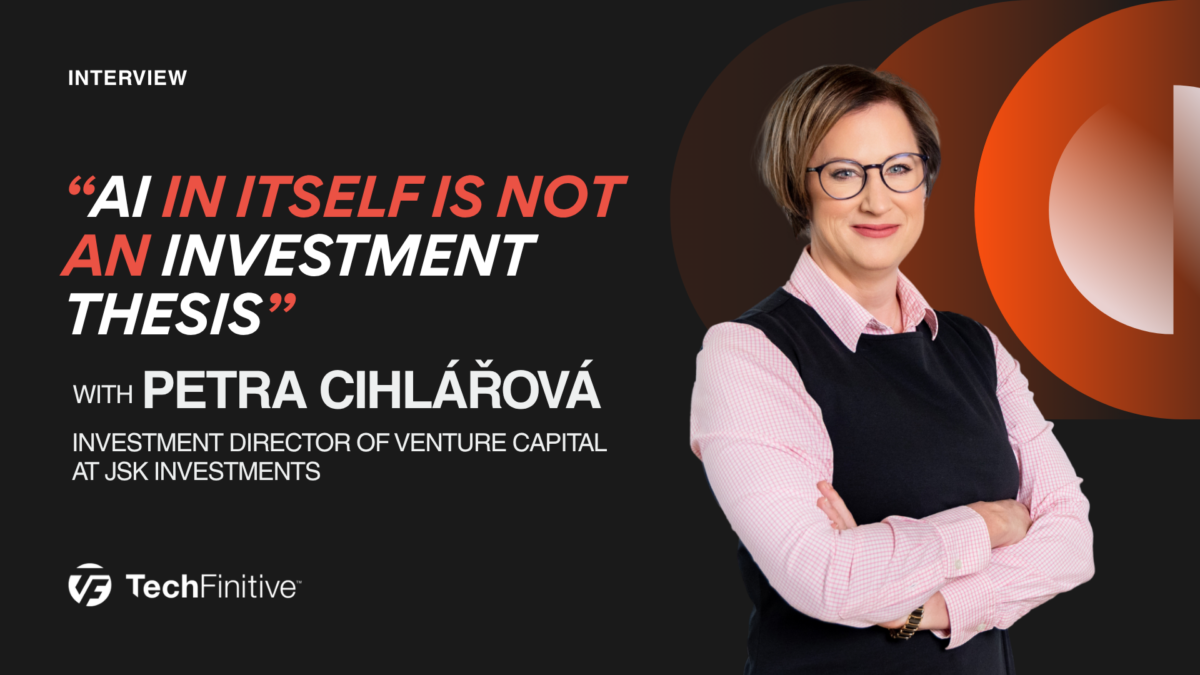
Petra Cihlářová, Investment Director of Venture Capital at JSK Investments: “AI in itself is not an investment thesis”

For JSK Investments, the appeal of autonomous surgery is not really about autonomy for its own sake. Petra Cihlářová, Investment Director of Venture Capital at JSK Investments, is unusually blunt about the point: “AI in itself is not an investment thesis.” What matters is whether the technology addresses a specific clinical problem, whether the team can bring it into real-world practice, and whether there is evidence that it works beyond the pitch deck.
That thinking sits behind JSK’s investment in Andromeda Surgical, a US medtech startup developing an autonomous surgical platform initially focused on HoLEP, a complex procedure for treating an enlarged prostate. For Cihlářová, the opportunity is rooted in a problem that extends beyond the technology itself: a shortage of surgeons trained to perform the procedure and a long learning curve that limits its availability.
The investment also reflects an unusual combination of expertise in Andromeda’s founding team. Co-founder Nick Damiano brings experience developing medical technologies, while Kartik Tiwari has a background in autonomous systems. Cihlářová says that combination was important because autonomous surgery sits at the intersection of medicine, AI, robotics, regulation and clinical adoption.
In this interview, Cihlářová discusses what JSK looks for when assessing AI healthcare companies, the milestones she will be watching as Andromeda moves into commercial deployment, and why she sees the bigger opportunity in autonomous surgery not as replacing doctors, but as extending specialist expertise to more patients and more places. She also explains why clinical evidence, human oversight, regulation and accountability will be just as important as the underlying technology as autonomous capabilities develop.
What specifically convinced JSK Investments that Andromeda Surgical was the right company to back, and how did you assess the opportunity against the many other companies developing AI and robotic technologies for healthcare?
We are fairly sceptical about AI in healthcare. We see plenty of companies with AI in their pitch decks, but AI in itself is not an investment thesis for us. We need to see a specific clinical problem, a team capable of bringing the technology into real-world practice, and evidence that it works beyond the pitch deck.
With Andromeda, the problem was clearly defined. HoLEP is one of the most effective treatments for an enlarged prostate, but also one of the most difficult to learn. Its availability is therefore constrained not by the procedure itself, but by the shortage of surgeons trained to perform it. Andromeda is targeting precisely that barrier. HoLEP is also the entry point: the company intends to gradually apply the same approach to other procedures in urology.
We then wanted to make sure this was more than a compelling story. We assessed the clinical need ourselves and spoke with physicians. We also met Nick, Kartik and the team in person in San Francisco, where we saw both the product and the environment in which it is being developed. With hardware and medtech, there are things you simply cannot assess from a presentation or a video call.
We were initially introduced to Andromeda by Neda Razavi, founder of iSono Health, one of our portfolio companies. A recommendation never replaces due diligence, but a founder whose judgement you trust can be a very good filter.
Another positive signal was how quickly they were able to close the Series A. Fast fundraising does not automatically make a company a good investment – that would be a dangerous shortcut. But once you have done your own work, seeing a number of experienced investors independently reach a similar conclusion is another useful piece of the puzzle.
Ultimately, it was not one single thing that convinced us. It was the fact that several independent signals reinforced one another.
You describe Andromeda’s combination of an experienced founding team, clinical validation and a clearly defined global problem as particularly compelling. Which of those factors carried the most weight in your investment decision, and why?
If I had to pick one, it would be the team. But not in the obligatory “we invest in great founders” sense. What is unusual is the combination of Nick and Kartik.
Nick has been working on the problem of an enlarged prostate for more than ten years. His earlier company, Zenflow, developed a treatment for the same condition, and he also co-founded Avail MedSystems, whose technology reached hundreds of hospitals. He therefore knows what it takes to bring medical technology into real clinical practice.
Kartik brings a very different background in autonomous systems. At Starsky Robotics, he led the team that was the first in the world to put a driverless truck on a public road.
That matters to me. There is a difference between someone who can talk convincingly about autonomy and someone who has already demonstrated that they can take an extremely complex technology from concept into the real world.
Autonomous surgery is not purely a medical problem, nor is it simply an AI or robotics problem. You need to master both, while navigating regulation, earning the trust of physicians and ultimately getting the product into hospitals. Nick and Kartik complement each other naturally in that respect.
And then there is something that is difficult to capture in an Excel spreadsheet. Nick is a very convincing advocate for Andromeda, but in person both he and Kartik are remarkably unassuming, open and humble given what they have already achieved. They communicate openly with us, make themselves available when we need them and genuinely try to help. They have even introduced us to other promising founders, with whom we are now discussing potential investments.
For us, that is not simply a nice-to-have. When you invest in founders, you are entering a relationship that may last many years, and there will inevitably be difficult moments. That is when the kind of people you chose to partner with really matters.
JSK identifies healthcare and cutting-edge technology as two of its long-term investment priorities. What does Andromeda tell you about where those two areas are increasingly converging, and what other opportunities are you looking for in this space?
We do not approach healthcare through the lens of a particular technology. We start with the problem. Two challenges are only going to become more significant over the coming decades: access to quality healthcare and an ageing population.
Andromeda fits directly into that thesis. An enlarged prostate is a condition that affects a large proportion of men as they age. As the population gets older, the number of patients increases, while the number of specialists able to perform HoLEP is not growing at the same pace. A technology that can help close that gap is addressing a problem that will still be relevant twenty years from now.
We apply the same lens to diagnostics, monitoring, primary care and women’s health. We are looking for technologies that can help deliver high-quality care to more people, more efficiently and at an earlier stage.
As a group, we are also active in healthcare beyond venture capital. Through our private equity sub-fund, for example, we have invested in the Prague-based women’s health clinic EVALON and the primary care provider Primaria, and we intend to gradually add further medical specialities to the portfolio. This gives us a perspective on healthcare as an operator as well as an investor. Over time, it may also create a broader clinical environment where there could be meaningful synergies with some of the technologies in our venture portfolio.
Andromeda is entering its commercial phase, with the Series A funding being used for regulatory processes, manufacturing and deployment. From an investor’s perspective, what are the key milestones you will be watching to determine whether the technology can successfully make the transition from clinical validation to a scalable commercial business?
The harder part starts now. In startups, technological milestones tend to get celebrated, but in medtech, good technology and good clinical data do not automatically translate into a good business.
Andromeda has ISO 13485 certification for its quality management system and MDSAP certification, as well as authorisation for commercial launch in Canada and New Zealand. That demonstrates that the team is executing on its regulatory strategy. I also like the fact that the company’s future does not depend solely on waiting for FDA clearance. The US is obviously a critical market, but in parallel they are opening other markets and gaining experience from clinical use.
We will be watching the first commercial deployments particularly closely. Does the system perform equally well in another hospital and with another clinical team? How quickly can a new surgeon learn to use it? How demanding is the implementation? What does actual utilisation look like? And, crucially, can Andromeda demonstrate an economic case for hospitals alongside the clinical one, including how the procedure fits within reimbursement systems?
In the longer term, we will also be watching whether the platform can expand beyond HoLEP into other procedures. That is the difference between building a successful product and building a company that defines a new category.
Scalability in medtech is not simply about how many devices you can manufacture. It is about whether you can repeatedly get them into hospitals – and whether clinicians actually use them once they are there.
One of the company’s stated goals is to address the shortage of specialists by making complex procedures more accessible to hospitals. How important is that real-world healthcare problem to the investment case, and what needs to happen for autonomous surgery to have a meaningful impact on access to care?
It is at the heart of the investment case.
If autonomous surgery simply made an excellent surgeon at a leading hospital somewhat more efficient, that would still be useful. But from both an investment and a broader impact perspective, it is far more interesting if you can bring some of that expertise to places where it is not available today.
HoLEP illustrates this well. The procedure can deliver significant benefits for patients, but it is offered by a relatively limited number of centres because the learning curve is long and demanding.
At the same time, I would be cautious about the idea that technology alone can solve the problem. A robot without trained staff, servicing, funding and an appropriate regulatory framework will not improve access to care. The real impact comes when the technology works as part of the wider healthcare system around it.
JSK has invested in a company developing technology that could fundamentally change the role of the surgeon. What do you think investors and the healthcare industry most often misunderstand about the opportunities – and the risks – associated with autonomous medical technology?
We too often ask whether robots will replace doctors. I think that is the wrong question.
Many medical specialities already face shortages of physicians, and as populations age, the pressure on their capacity will continue to grow. So the challenge is not primarily how to replace human work, but how to enable a limited number of specialists to treat more patients to a high standard and how to make their expertise available in places where it does not exist today.
The more interesting question is what happens when an excellent specialist can transfer part of their expertise into a system that can apply it consistently and in many more places. It is not about replacing people; it is about multiplying their capabilities.
At the same time, we can get carried away by what AI can do under ideal conditions. In medicine, what matters just as much is what happens when conditions are not ideal. That is why clinical evidence, safety, human oversight, regulation and clear accountability are every bit as important as the algorithm itself.
Nor do I believe we will jump from today’s surgery straight to fully autonomous surgery. A gradual path is much more likely, with individual autonomous capabilities being introduced over time and each one having to prove its clinical and economic value.
That is where I see Andromeda’s greatest opportunity: not in a future of surgery without people, but in bringing autonomy progressively into real clinical practice to solve a very specific problem.
You might also be interested
About The Author