Trending Topics

 Trending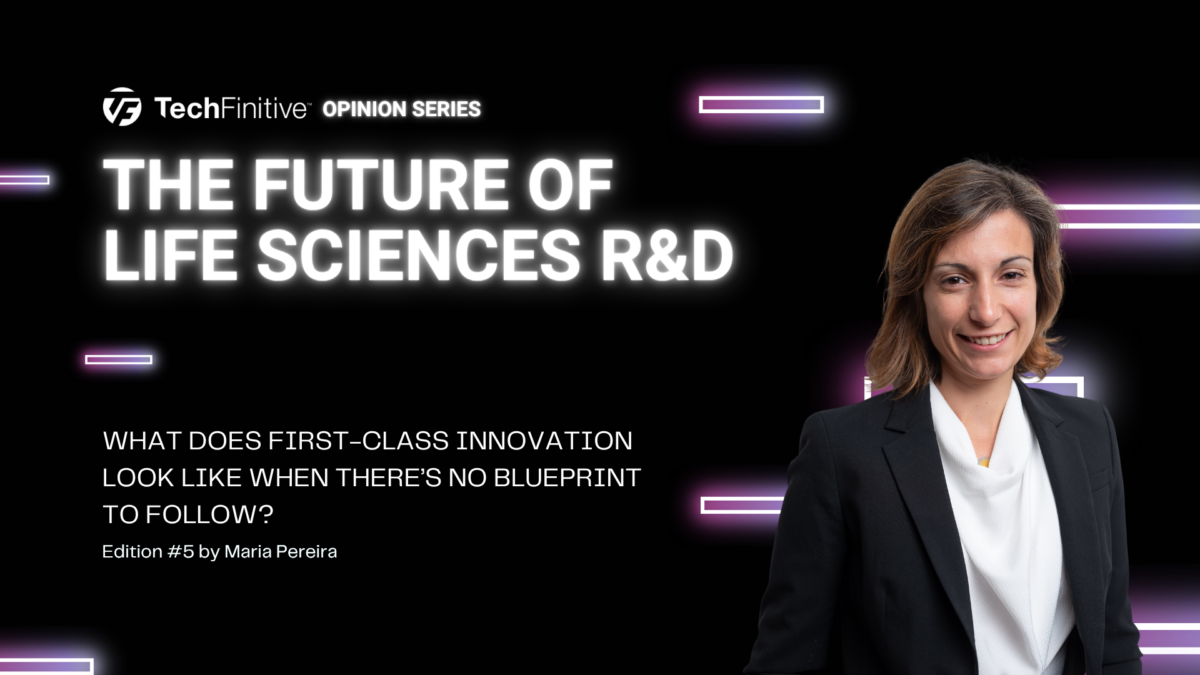
What does first-class innovation look like when there’s no blueprint to follow?

As part of our new “The future of life sciences R&D” series, exploring how emerging technologies – from AI and digital trials to synthetic biology and advanced data platforms – are reshaping the future of drug discovery, clinical research, and scientific innovation, we invited Maria Pereira, Chief Innovation Officer and Co-Founder of TISSIUM, to share her views.
Here, Maria explores what it takes to develop first-class innovation in medtech when existing frameworks are no longer sufficient. Examining the intersection of clinical need, material science, product design, and artificial intelligence, Maria argues that pioneering medical technologies require organisations to rethink not only how products are developed, but also how success is defined, validated, and ultimately adopted by clinicians.
Medtech innovation is often incremental, leveraging established paths, whether from existing regulatory precedents or the historical methods used by surgeons. Building on something that already exists offers a structured evolution course based on long-standing techniques, frameworks, and research. When innovation outpaces legacy, a new R&D programme must be designed from the ground up to forge new benchmarks for success.
The challenge (and opportunity) with first-class innovation
The potential impact of medtech innovations cannot be overstated. Advancements in modern healthcare have the capacity to extend specialist expertise across a broader network of medical professionals, reach more patients and deliver more consistent clinical outcomes.
Revolutionising pre-existing areas of medicine offers an element of predictability, supported by clinical evidence that explicitly outlines progress and offers a clear definition for success based on prior technological innovation or clinical developments. When developing a product that has limited precedent, the framework for evaluation has to be designed alongside the technology.
What is considered successful must be established across different dimensions, including research and development, clinical validation, and regulatory strategy through testing and continuous iteration. Having no template introduces a set of unique challenges and opportunities, requiring multiple priorities to be balanced across each discipline while viability is demonstrated within a surgical setting.
Balancing the pipeline across disciplines
The development of any new product must be grounded in the clinical need. Where there is no clinical need, there is no basis for innovation of a new product or the evolution of an existing one.
To ensure that the product is both practical and relevant in a clinical setting, two additional areas must be considered at the start of development: the challenge that the technology is addressing and the capability of the technology itself. The solutions with the most potential lie somewhere in the middle, where the technology provides a meaningful advantage but also satisfies the clinical demands of a broader strategy.
A balanced pipeline must consider and reflect the clinical need, technology capability, and relevancy to the broader healthcare industry. These areas don’t always align, and balancing them becomes a core part of the development process as they shape and influence decisions within the other elements.
Educating the curve and mitigating friction
Historical technologies have long shaped both how surgeons are trained and the methods they employ in the operating theatre. Encouraging a change in this behaviour requires evidence and a structured system to support adoption into current clinical workflows.
Early learnings and sustained engagement are essential to address any gaps between clinical efficacy and clinical uptake and to ensure that the product can be effectively integrated as a foundational tool. In addition, a diverse group of surgeons should be involved from the initial design process through to launch, to facilitate learnings on adoption and education.
Like any profession, some surgeons act as early adopters of this technology, they recognise the potential of new technology and are eager to learn and leverage it in their work. Involving this group early on captures a diverse range of perspectives and insights from surgeons before transitioning to late-stage commercialisation, mitigating any potential friction or barrier to entry.
A meaningful place for material science
Surgical innovation over the decades has evolved toward minimally invasive approaches, but at the fundamental level, the tools used to carry out these procedures have seen very minimal change or evolution.
Material science and product design can change the profession, both by making surgery less invasive and changing the way that operations are performed and by whom. The programmable nature of the field lends itself to wider translation across different areas of expertise and networks of surgeons through the development of new materials.
Integrating AI as a tool for innovation
The building block nature of material science is almost a direct parallel to machine learning. Integrating AI into the R&D process offers an opportunity to shorten development timelines and drive more consistent outcomes for medtech companies. However, AI integration must be an intentional choice that not only complements existing processes and technology within a company but also demonstrates true value in product development or technical innovation.
Purposeful AI integration has the potential to detect new patterns and apply these across decades of academic research and clinical data, enabling a company to design and implement a dynamic growth trajectory that stands to benefit surgeons, patients, and the wider healthcare industry.
Pioneering without precedent
Designing a new product without a blueprint can be intimidating, but it can also widen the scope of what is possible in medicine. When global health leaders develop new technology to address a persistent challenge, it establishes a new precedent of care that redefines how complex procedures are approached, how treatment is delivered, and to whom by a global community of surgeons.
About The Author

Ricardo Oliveira
NEXT UP


