Trending Topics

 Trending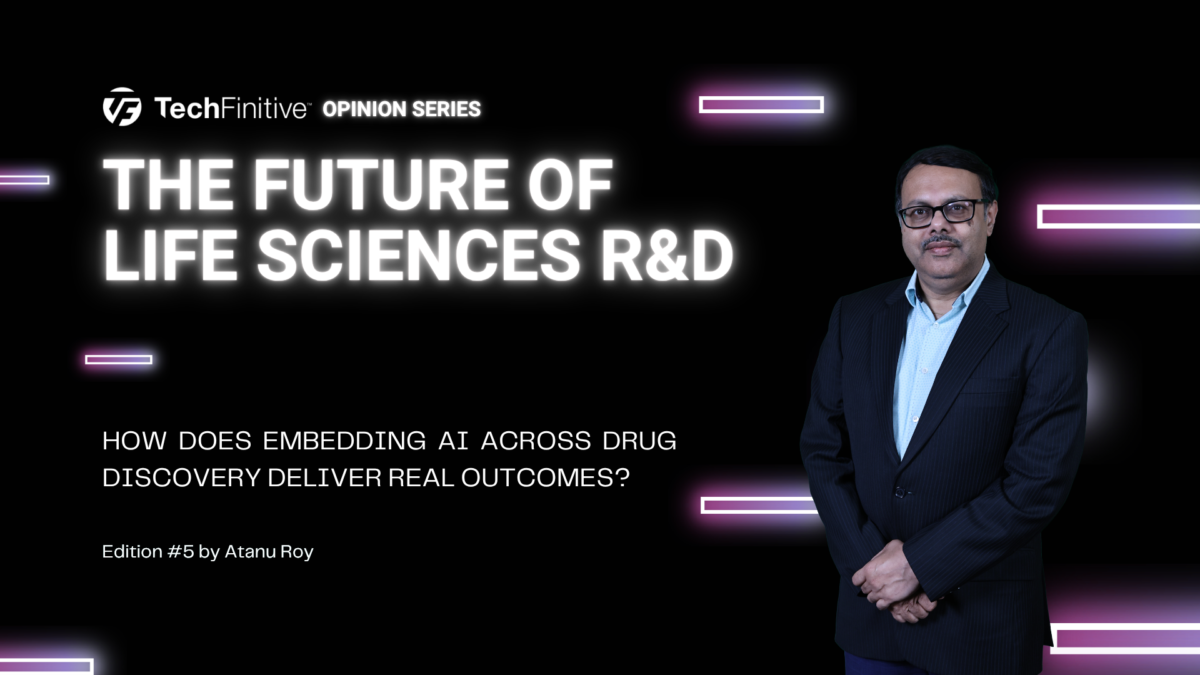
How does embedding AI across drug discovery deliver real outcomes?

As part of our new “The future of life sciences R&D” series, exploring how emerging technologies – from AI and digital trials to synthetic biology and advanced data platforms – are reshaping the future of drug discovery, clinical research, and scientific innovation, we invited Atanu Roy, President & Group CIO, PI Industries Ltd. & PI Health Sciences, to share his views.
Here, Atanu explores how artificial intelligence is moving beyond isolated use cases to become embedded across the entire drug discovery and development lifecycle. Drawing on PI Health Sciences’ experience building integrated AI-driven discovery capabilities, Roy discusses how organisations can combine advanced technologies, scientific expertise, and manufacturing scale to accelerate innovation and create competitive advantage in an increasingly data-driven pharmaceutical landscape.
Artificial Intelligence is reshaping drug discovery, not as a distant promise but as a present competitive reality. Therefore, the question for life sciences organisations today is how deeply and how quickly to embed it across the discovery-to-development continuum to drive meaningful outcomes.
Developing a new drug takes 10 to 15 years and costs upwards of USD 2 billion, with fewer than 10% of clinical candidates reaching patients (source). AI is shifting these odds meaningfully. McKinsey estimates a 30 to 50% reduction in early-stage discovery timelines, while generative models are already designing novel molecular structures that would previously have taken years to synthesise and test.
What has changed is the depth and breadth of deployment. Early AI applications were confined to computational chemistry. Today, AI operates across the full continuum, from molecular design and biomarker discovery to clinical optimisation and post-market surveillance. The shift from point-in-time tools to integrated, end-to-end platforms is where real competitive differentiation is now emerging.
Integrated drug discovery: where AI creates the most value
The greatest impact of AI lies in integrated drug discovery, the ability to connect target identification, molecular design, screening and optimisation into a single, intelligence-driven workflow. AI-powered platforms can analyse vast chemical and biological datasets to identify promising candidates faster, reduce synthesis cycles, and predict efficacy and toxicity profiles with far greater precision than traditional methods.
For PI Health Sciences, this integrated approach, combining Computer-Aided Drug Design (CADD), machine learning, and expanding Global Manufacturing Practice (GMP) capabilities including our site in Hyderabad and Lodi, Italy, is part of a deliberate strategy to serve customers across the full Contract Research, Development and Manufacturing Organisation (CRDMO) spectrum, from early discovery through to commercial manufacturing.
In PI’s Hyderabad facility, a dedicated Centre of Excellence for drug discovery has been set up where we have been able to deepen strategic partnerships with global pharma and biotech customers. It has been observed that with the compounding effect of embedding AI into the integrated discovery-to-development workflow, CRDMO enquiries have grown from 69 to 295, and pharma revenues increased 40% year-on-year in FY26.
India’s structural advantage
The opportunity for India is structural. With 752 United States Food and Drug Administration (US FDA)-approved manufacturing sites — more than any other country — and 2,050 World Health Organisation Good Manufacturing Practice (WHO-GMP) certified facilities (source), India has the manufacturing credibility global partners demand. AI adds the critical innovation layer: enabling a move from generics-led volume to research-driven value.
Beyond discovery, AI is also strengthening India’s manufacturing and supply chain capabilities. Leading Indian facilities are achieving 99.9%+ right-first-time performance through AI-enabled quality systems, while predictive analytics are improving on-time-in-full delivery by over 40% against a global industry average of just 1%.
India already supplies nearly 20% of global generic medicines to over 200 countries. The next frontier is value, not volume. The organisations and nations that recognise this transition is already underway, and act with urgency, will determine who leads global pharmaceutical innovation in the decade ahead. For India, and for organisations like PI Health Sciences building at the intersection of science, technology, and manufacturing excellence, the moment to lead is now.
Also in this series: Why a closed-loop approach is the only way AI can deliver true value to life sciences R&D
About The Author

Ricardo Oliveira
NEXT UP


