Trending Topics

 Trending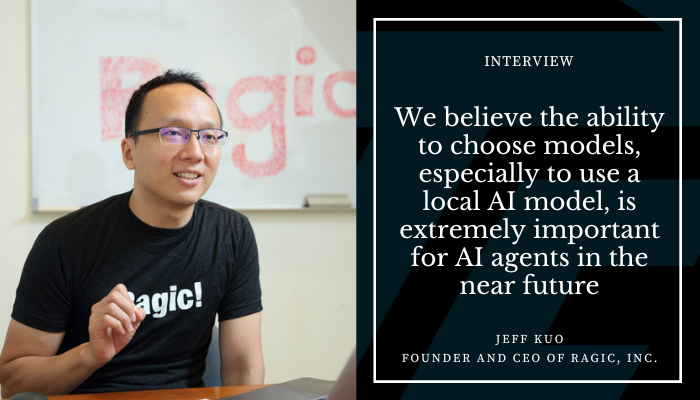
“We believe the ability to choose models, especially to use a local AI model, is extremely important for AI agents in the near future”

Digital transformation has entered a new phase, where organisations are no longer simply experimenting with AI but trying to embed it into everyday business operations. Yet for many companies, the challenge is no longer access to AI itself, it’s figuring out how to make these tools practical, maintainable and usable by non-technical teams without creating new layers of complexity.
For Jeff Kuo, founder and CEO of Ragic, the answer lies in bringing AI directly into the systems where business data already lives. Having worked in enterprise software and ERP development since the early 2000s before founding Ragic in 2008, Kuo has long focused on simplifying how organisations build and manage internal applications. His vision for Ragic – a spreadsheet-style no-code platform designed for non-technical users – is rooted in the idea that the people closest to day-to-day operations should be able to shape and automate workflows themselves, without depending on developers or costly implementation projects.
In our interview, Kuo explains why he believes no-code platforms offer a safer and more sustainable alternative to “vibe coding,” how embedded AI agents can help organisations avoid the integration headaches that often derail AI initiatives, and why the next generation of enterprise productivity may depend less on technical expertise and more on every employee learning how to work effectively alongside AI. But before we get ahead of ourselves, let’s start with a very simple question.
What is Ragic, and what is the benefit of a no-code application?
Ragic is a no-code AI tool that can help your everyday sales, marketing, and project managers build database applications, digitalizing your business processes.
We believe no-code application building is a far more maintainable approach for non-technical business users to build business applications, in comparison to vibe coding. If you are not able to read and understand the code that AI generated for you, it’s inherently unsafe and has a high risk of growing into something that’s unmaintainable by your team.
We believe a no-code tool that supports AI and can build an application is the best long-term solution for non-coders. No code platforms work like vibe coding, except that it does not generate any code; all of the business logic of the application is represented in the design interface in a way that all business users can understand. This way, users can know what the application that the AI created is actually doing, making the development process much safer and maintainable.
Explain why AI agents are so helpful in no-code applications such as Ragic?
While no-code applications do not require any coding experience to learn and use, real-life business processes are inherently complex, and a sophisticated no-code tool needs to have all the functionalities to support business process challenges of all kinds. The no-code tool may look a little intimidating at first for non-technical users, and possibly scare some people off, which would be a shame, as these users are not giving themselves a chance to take an hour to learn how the tool works – a tool that can be so very helpful for years to come.
This is where AI agents can help; AI agents can listen to your requirements and build the prototypes of your application; this is similar to asking an IT consultant to build the application for you. Once you have the scaffold that’s completely based on how your company works, it becomes a lot easier to understand and modify, compared with starting with a blank canvas.
Moreover, AI agents not only help you build the application, but they can also help you run the application. Once the business process is digitalized on the no-code application, one can simply use plain English to assign jobs to AI, creating an army of AI agents that can help automate routine work for the team. Anything from validating if a quotation follows company pricing policy, to auto answering customer inquiry emails and keeping track of the support cases in a database, agents can become a part of your team, catching errors and providing faster and more reliable customer responses based on your no-code application design.
Many companies are excited about AI but intimidated by the complexity of implementation. What specific barriers did you see in the market that led Ragic to develop an embedded AI Agent rather than a standalone AI solution?
The biggest obstacle for a successful business AI agent implementation is providing enough context and tools for the agent to work properly. No matter how smart the agent is, AI will never work without a complete, reliable source of data that’s properly formatted, and with a suitable set of tools, it can call and execute the work. If the AI tool lives outside of your data application, it’s up to the organization, or the implementation team, to create the right harness for all the data and tools that the AI agent needs to perform its task. This is definitely not easy. For years, many software companies have created middleware, data buses, and integration platforms to consolidate all the data silos scattered in the organization, and AI can only work accurately once all the data and tools are ready.
Ragic itself is a flexible tool that can help consolidate scattered data because of its no-code and flexible nature. If a lot of your data is already on Ragic, then perfect, AI is built in, and AI agents are ready to go on day. If there are some other data sources needed for the AI agent, the organization can simply use one of the Ragic sync tools, sync up the data, and then run the built-in AI agent on Ragic. The best part is, there is no need to design how AI agents use your data. Once your data is in Ragic, you can take advantage of the data harness that’s already designed specifically for customized Ragic applications and not worry about different types of data harnesses for different data sources.
You describe the Ragic AI Agent as operating directly within the database where the data already lives. How does that change the user experience compared to traditional AI tools that rely on integrations, APIs, and external workflows?
Ragic AI agents can read very detailed data application design metadata, all the raw data, and reports, including change history, directly if you allow it to. It has access to all the right data and tools to perform their jobs right without a separate AI implementation project.
Not only is a separate costly AI project not needed, because AI agents have access to data and tools not only limited to the existing APIs that this application has, it can make more accurate decisions and do so much more. Your AI agents are only as good as the data and tools that you provide them with.
Security and governance are major concerns for organizations adopting AI. How does keeping the AI Agent inside the Ragic environment help address concerns around data privacy, compliance, and control?
Ragic provides flexible choices of AI models that organizations can choose from. They can choose from any AI vendor they trust; they can even run Ragic and AI completely on-premises without any of their data leaving their network. Organizations can run a local LLM model for an on-premises version of Ragic to consume, satisfying the most rigid data privacy requirements that the data never leaves their local network.
The AI Agent supports models from OpenAI, Anthropic, and Google. How important is model flexibility for customers, and how do you see businesses deciding which AI models are best suited for different workflows?
We believe the ability to choose models, especially to use a local AI model, is extremely important for AI agents in the near future. Even though local models tend to be a few generations behind frontier models, the trend is that they will evolve and catch up with time. Open source local models will eventually become “good enough” for enterprise use, and the cost and privacy advantages are something that frontier cloud models can never match.
Ragic is positioning this as a tool for non-technical teams such as HR, operations, finance, and sales. What are some real-world use cases where you’ve seen organizations achieve meaningful productivity gains without needing developers or consultants?
The overwhelming majority of Ragic adoption in organizations is implemented without needing developers or consultants. We constantly ask organizations to consider spending a little time learning the tool before requesting developer or consultant help, since the tool is actually very easy to learn, especially with the help of AI. The major benefit of Ragic adoption without developer or consultant help, is that end users will be able to make changes to improve the system as they use it every day. End users almost always think of newer and better ways to improve their system flow, and the most productivity gain usually comes from continuous enhancements over real-world use over the years.
The IHG hotel chain is a great example of this. Many major IHG hotels not only adopted Ragic across all teams, but by making Ragic part of their employee culture, when staff review their operation and service, they think about whether they can solve this with Ragic.
Ragic provided them with a digital backbone so that all processes are centralized on Ragic, and all of their important data is on Ragic. This proves to be a great strategy, as they cannot only adapt quickly to process changes by updating the database system themselves on Ragic without asking for the vendor’s help. They are AI agent-ready. Any data or tools that are needed to create the required harness for AI agents are already there, and they can test out AI agents without any extra integration.
As AI agents become more common in the workplace, what do you think separates practical, business-ready AI from the hype? How do you envision AI Agents changing the way organizations operate over the next few years?
AI agents require a lot of contextual data and tools that they can call to achieve meaningful results, and almost no agent works perfectly out of the box. AI agents require real-world use and constant tuning to make sure edge cases and AI hallucinations are handled thoughtfully. A one-size-fits-all solution will almost always have its limit; it may work pretty well in 80% of the cases, but generates tons of frustration with the 20% of the cases. On the other hand, a custom AI project may pass the bar in the beginning, but as businesses grow and change, its maintenance quickly becomes a problem.
Organizations will need an AI solution that all teams have the ability to help them improve. Prompt engineering for AI agents will become a key skill that all business users need to master, similar to how they mastered the spreadsheet. I believe that writing good, productive agent prompts will be a key skill for everyone, and business applications that support this type of end-user development, or citizen developer for AI will help organizations achieve real, practical benefits from AI automation.
About The Author

Ricardo Oliveira
NEXT UP