Trending Topics

 Trending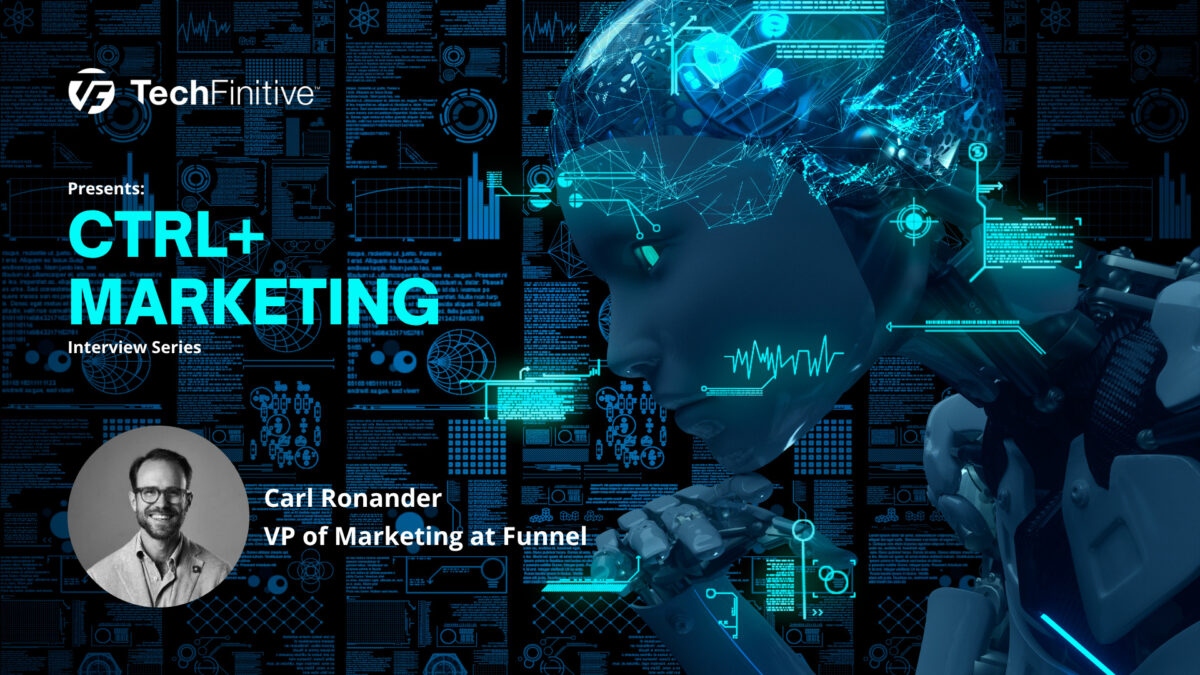
Carl Ronander, VP of Marketing at Funnel: “Authenticity is a tricky term in marketing, even before AI”

What Carl Ronander doesn’t know about brand building can fit on a postage stamp. With more than 15 years of experience, he’s worked alongside some of the world’s largest brands and had a hand in shaping two of Sweden’s most successful SaaS companies: first Mentimeter and now Funnel, where he is VP of Marketing.
Carl’s work has also earned him numerous awards, including Sweden’s prestigious Guld Ägget and 100Wattaren. Now, he’s putting his skills into practice by helping companies optimise their performance at scale.
Having worked in agencies and in-house, Carl knows the realities of building brands – and managing expectations. With that experience, he understands both the creative ambition and discipline needed to scale a business successfully, and the dangers of putting AI solely at the wheel. “AI is great as a creative partner and tool for scale,” he explains, “but where it lacks ability is to create that authenticity and human connection.”
For Carl, human connection starts with brand clarity, something that AI has trouble recreating. While he still believes AI to be a powerful tool, he says “we are far from having a fully automated process”. This belief extends to how he uses AI at Funnel: not as a replacement, but as a supplement.
With this careful approach to AI, we wanted to know how the technology has reshaped Carl’s approach to digital marketing in the past few years – and what he thinks that means for the future of the industry.
How has AI changed the way you approach digital marketing over the past few years?
AI is now an integrated part of how we work with marketing. From insight generation to building custom GPTs that have been trained in our brand’s tone of voice and our content library, we use it for creative development and in lead identification. But perhaps most importantly, we use AI in our Advanced Marketing Measurement solution for triangulation between MMM, MTA and Incrementality testing.
The advent of AI in marketing has had a seismic effect, as I’m sure is being experienced across so many industries. What emerges in the first half of a year may well be outdated by the end of the same year. In that kind of environment, I think digital marketing has really evolved into a learning environment again, which is positive because the use of AI is challenging people to stay ahead of the curve and put aside time for professional development. Adapt or die is very much the mindset marketers need to have now in the midst of this kind of rapid change.
What are the most exciting AI tools or technologies you’re currently using in your marketing campaigns?
A tool we recently introduced is otterly.ai, where we are working to establish and improve our visibility in GTPs. The new SEO for the AI era.
We are also big fans of higgsfield.ai/ as we continually hear from the advertising platforms how video will continue to grow in importance and effect.
And we leverage our own Advanced Measurement solutions AI capabilities to evaluate and optimise our campaigns.
How can AI-enhanced marketing create a connection that feels authentic to the humans who receive the communications?
I believe that AI is great as a creative partner and tool for scale, but where it lacks ability is to create that authenticity and human connection. You still need to rely on human creativity to create that connection. But to make the AI-generated marketing as “good” as possible, I think it starts with having a clearly defined brand. If you have a well-defined brand that will lead to more authentic marketing, but I still believe we are far from having a fully automated process. With AI, we risk just getting more of the same, and that is definitely not how brands create more effective marketing. As more brands will try to leverage AI, there is a possibility to differentiate by leveraging human creativity.
I think there’s a key difference between “AI-generated” and “AI-enhanced” too, and that needs to be emphasised. If I’m using AI to deploy my time in a more efficient way and can cover more ground faster, then that doesn’t necessarily impede my creativity. If anything, I think there’s a world in which time-saving from AI creates more time for marketers to be creative and commit time to focusing on originality.
What does “authentic marketing” mean to you in an era of AI-generated content? Is true authenticity still possible at scale?
Authenticity is a tricky term in marketing, even before AI. I think we have moved beyond the discussion of authenticity; it was very much part of the whole purpose of the brainwashing of marketing. Marketers should focus on building emotional reactions from their marketing; that’s how we embed our brand in the minds of consumers. That something feels authentic can be of achieving this, but I think you can also get that from something that is whatever the opposite of authentic is.
Where do you think AI enhances brand trust, and where does it risk undermining it?
Brand trust is not a product of marketing, but the full experience we have of our brand interaction. That’s why you need to make sure brand experience is part of every conversation you have internally, from product development to support. I don’t think AI specifically will impact brand trust.
Where AI impacts trust generally for consumers is where it’s deployed without proper rigour and in ways that detract from the overall value of a product or service, simply for the sake of cost efficiency. I think we’re starting to see that creep into advertising, but for the overall brand picture, it’s more complex as people measure trust based on so many factors.
Has AI impacted your creative process — for example, in content creation, ad design or campaign ideation? If so, how?
Yes, for sure, I would say we use it in more or less everything we produce. AI tools should be seen as a great creative partner throughout the whole creative process. But as I said before, it can still not replace human creativity, skill or craft. For example AI AI-generated content will not be as effective in a post SEO reality when we find our information and recommendations in different ways.
I think AI can play a very important role in ensuring that your marketing leverages your distinctive brand assets. Again, this has been proven to be the key factor in marketing effectiveness, especially as we see an increasing move to short-format ads on platforms such as TikTok. If people do not understand that you are the sender, it is a waste of resources.
How do you see the role of human marketers evolving alongside increasingly sophisticated AI systems?
I believe marketers will have to be better trained in understanding the principles of effective marketing and hopefully also become braver in what they create to stand out from a sea of AI-created marketing. AI has the possibility to automate the boring work and allow us to focus more on creative thinking.
I think senior talent and experience will also be a majorly sought-after thing in this industry in the years to come, because that experiential knowledge is something that can never be outsourced to AI. Marketing is, at its core, a person-to-person industry, no matter how many layers of digital interface we put between us. In this sense, I think really investing in leaders who understand the relational element of marketers and consumers, brands and partners will be really critical. We’re already seeing a lot of entry-level work being chewed up by AI, and that means that senior, strategic thinking higher up the chain becomes more valuable and more competitive, too.
What’s one thing marketers get wrong about AI, and what should they focus on instead?
With AI, I think it is very easy to fall into a trap of constantly putting out new messages. New ads and content have also been boosted by the digital platforms’ algorithms. But as Andrew Tindal of System1 has proven with his research, Compound Creativity is perhaps the most important factor for marketing effectiveness. Marketing benefits greatly from consistency over time; you should do fewer things for longer. With AI, I think the temptation to constantly change will be one of the biggest struggles for marketing teams.
If you could give one piece of advice to marketing teams just starting to explore AI, what would it be?
Fully understand the principles of marketing and the latest research on creativity (laid out by people like Byron Sharp, Jenni Roumaniak, Les Binet and Peter Fields, Dr Karen Nelson-Fields, Tom Roach, Dr Grace Kite, Andrew Tinadal, Mark Ritson, Orlando Bloom amongst others) before you start playing around with AI. What makes great marketing has not changed with the introduction of AI. When you understand the principles of marketing, use AI to help you become better at working according to these principles. As mentioned before, this could be to make your ads more distinctive or identify Category Entry Points.
More interviews
- Sharon Yates Harrison, CMO of Gravyty: “AI is forcing us to redefine what personalisation actually means”
- Ada Mockute Jaime, CMO at Nordcurrent: “Do not be scared or sleep on the opportunities AI presents”
- Deema Tamimi, VP of Marketing at Creatopy: “The real magic happens when you treat AI like a creative partner, not just a productivity hack”
- Rachel Fairley, Marketer: “Please don’t outsource your thinking”
- Milind Pathak, CMO at Proximus Global: “AI isn’t always the right tool for the job”
About The Author

Rowan Campbell
NEXT UP