Trending Topics

 Trending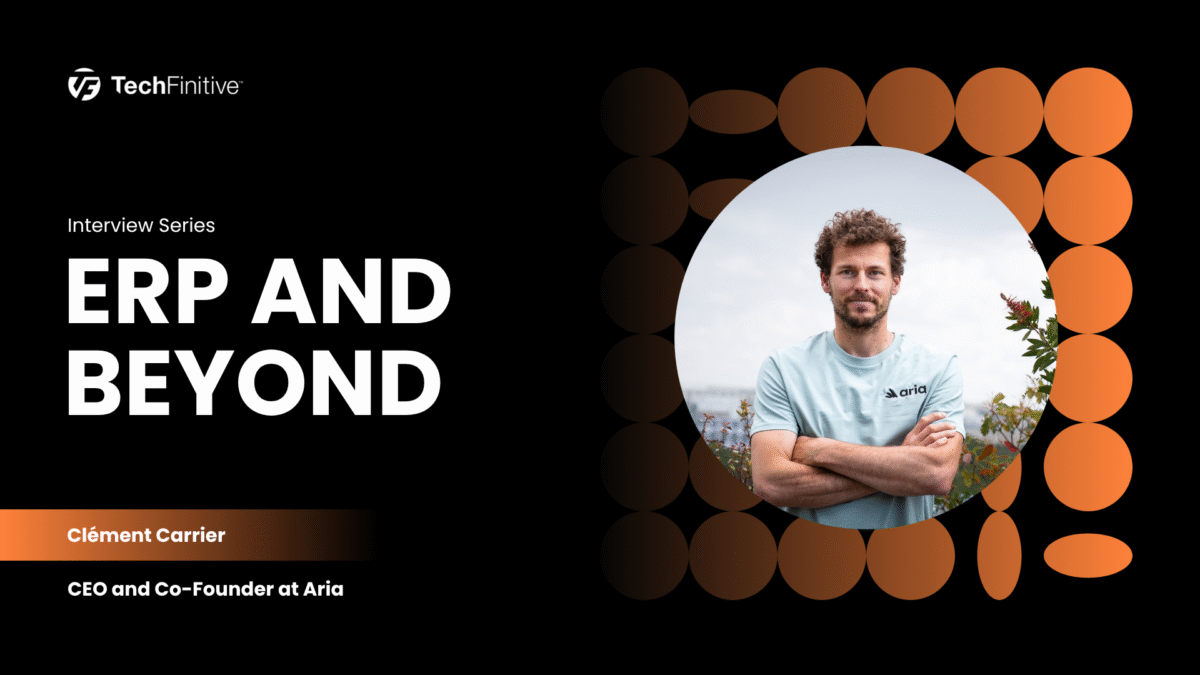
Clément Carrier, CEO and Co-Founder at Aria: “Too many ERP projects begin with a list of technical requirements”

With a history working at HSBC and France’s Ministry of Economy, Clément Carrier understands better than most how to bridge the gap between data science and finance. Today, Clément is applying his expertise as CEO of Aria, a company he co-founded in 2020 after experiencing first-hand the cashflow challenges faced by SMEs and freelancers due to late payments.
Aria’s embedded finance platform integrates into procurement software and ERP systems to solve these problems. This enables instant payments to suppliers, plus a laundry list of financial services – onboarding, credit scoring, fraud protection and more.
For Clément, ERP is far more than just a tool: it’s the nervous system of the company. Without it, Clément explains, “companies are operating blind; they’ve got data in five different places, and no one can tell you what’s actually happening”. With a well-implemented ERP system, those fragments of data can be reassembled into one unified picture, allowing businesses to make informed and live decisions.
Of course achieving that clarity isn’t always straightforward. There are plenty of pitfalls standing in the way of a strong ERP system. And Clément is quick to point out that ERP systems can just as easily amplify a company’s problems if they’re not implemented thoughtfully. “A lot of companies can act fast now,” he explains, “but speed without clarity just means you’re making mistakes faster.”
When it comes to getting it right, Clément’s advice is simple: “start with clarity on the business outcomes you want to achieve, not the software features”. For him, a successful ERP rollout isn’t as much about technical prowess as it is a leadership challenge. The most effective projects, he explains, are those where operations, finance and technology are connected from day one, ensuring that the system is built to support and reflect how the business truly functions in the day to day.
That belief isn’t one Clément came to overnight, but through years of seeing systems succeed and, perhaps more crucially, fail. To get a better sense of that lived experience, we started by asking about his history with ERP systems over the years.
Can you tell us about your role and your experience with ERP systems?
I’m the CEO and co-founder of Aria. We help platforms and businesses tackle the late payment culture that is costing the UK economy almost £11 billion per year and closing down 38 British companies every day, according to the latest government figures.
Our deferred-payment API for B2B platforms ensures suppliers get paid instantly while buyers have flexible payment timelines. In other words, we help businesses handle the messy side of finance: paying suppliers, reconciling transactions, and embedding financial services where they’re needed.
I first dealt with ERP systems when I was working with large organisations that had data scattered everywhere. But I quickly realised that finance had one system, operations had another, and procurement had a third. Nothing spoke to each other properly. I got interested in how the right setup could cut through that mess and actually make things work.
That’s what we’re doing at Aria. We’re simplifying how money and information move through a company, not by adding another layer, but by building something that actually fits how businesses operate.
What first drew you to working with ERP solutions?
For me, it’s about seeing the full picture. Most companies are operating blind; they’ve got data in five different places, and no one can tell you what’s actually happening with cash flow or where money is getting stuck. A good ERP changes that. It gives you one clear view of what’s going on.
Once you have that, everything shifts. You stop firefighting to fix problems and start making decisions based on what the numbers are telling you. You can see where capital is tied up, where processes are breaking down, and where the real opportunities are.
We see it at Aria all the time. When companies get their ERP and financial infrastructure properly connected, it unlocks huge operational leverage.
In your view, what’s the biggest advantage a well-implemented ERP system can bring to an organisation?
The biggest advantage is that ERP systems allow companies to move fast while simultaneously eliminating the guesswork. A lot of companies can act fast now; the tools are there, and AI makes certain things easier. But speed without clarity just means you’re making mistakes faster.
A good ERP connects finance data, supply chain, and customer information in one place. This means businesses are not waiting until the end of the month to find out what happened. When you layer in something like Aria to automate payments and the reconciliation side, businesses are getting signals in real time. They can see a problem forming and deal with it before it becomes a crisis. It’s the difference between steering with a map and steering with a live GPS.
What role do you see AI and machine learning playing in ERP in the near future?
AI is already changing how organisations interact with their systems. Instead of static dashboards, we’re moving towards predictive, conversational interface tools that tell you what needs attention before you even ask.
In Aria’s world, we’re using similar technology to detect anomalies in payment flows, forecast liquidity needs, and automate approvals. The same principles apply to ERP: less manual checking, more intelligent insights surfaced automatically. I think within a few years, we’ll stop talking about “using ERP” and start talking about ERP that actually collaborates with us.
What’s the most exciting ERP innovation you’ve come across recently?
What excites me most isn’t a single feature, but the convergence we’re starting to see between ERP and financial infrastructure. Historically, ERPs have been great at tracking what should happen, such as invoices raised, goods received, and payments scheduled, but less effective at managing what actually happens in real time.
Now we’re seeing ERPs becoming connected to live payment rails and embedded finance platforms like Aria. That means reconciliation, supplier payments, and working capital management are becoming fully automated and visible within the ERP itself. It’s a massive step towards closing the gap between accounting and action, and it’s where we see enormous value being unlocked for our customers.
If you could give one piece of advice to a CIO about to embark on an ERP project, what would it be?
Start with clarity on the business outcomes you want to achieve, not the software features. Too many ERP projects begin with a list of technical requirements, when the real goal should be to improve how people work and how money moves through the business. From Aria’s experience integrating with ERPs, the most successful projects have a strong link between operations, finance, and technology from day one. The CIO’s role isn’t just to deploy software, it’s to create alignment across departments and make sure the system supports the company’s real-world processes, not the other way around.
Other interviews
- Adi Krysler, VP Marketing at Oktopost: “Don’t fall for the AI polish”
- Costanza Ghelfi, Chief Product Officer at Making Science: “You can’t get personalisation right without getting privacy right first”
- Áine Dundas, Head of EMEA Marketing at Notion: “As a marketing leader, I’m living in an unprecedented era of martech transformation”
About The Author