Trending Topics

 Trending
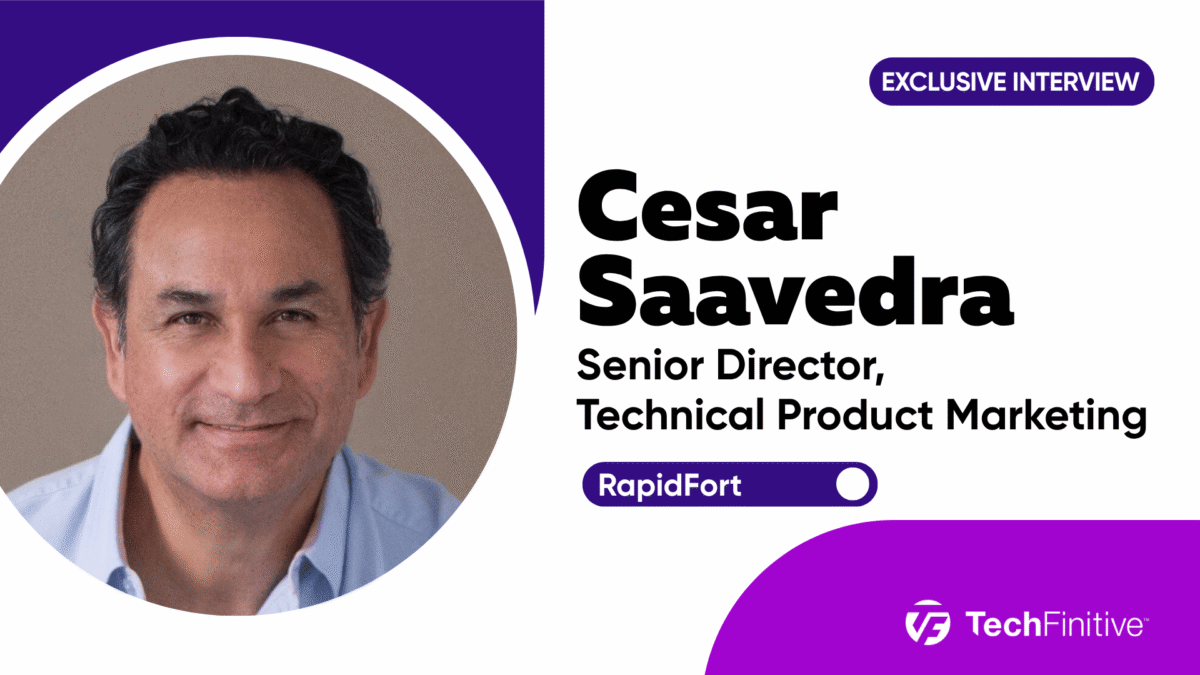
Cesar Saavedra, Senior Director, Technical Product Marketing at RapidFort: “The boundary is moving toward the point where a finding arrives with its resolution.”
Vulnerability scanners are supposed to help security teams understand where their software is exposed. But when they flag issues that have already been patched, or cannot distinguish between a genuine vulnerability and a fix applied outside the scanner’s advisory database, they can create as much work as they save. Development and security teams are left investigating findings that may no longer represent a real risk.
For Cesar Saavedra, Senior Director of Technical Product Marketing at RapidFort, the problem is partly one of visibility: the tools reporting vulnerabilities do not always have access to the information about how those vulnerabilities were fixed. RapidFort is addressing this through curated container images and detailed security advisories, including a partnership with Aqua Security that brings its remediation data into Trivy, allowing the scanner to recognise fixes that conventional advisory sources may miss.
In this interview, Saavedra explains why vulnerability management needs to move beyond generating ever-longer lists of CVEs. He discusses the case for starting with near-zero-CVE container images, how remediation responsibilities can be taken away from application developers, and the importance of making security claims independently verifiable through open-source foundations, software bills of materials and signed provenance. He also considers how the relationship between vulnerability detection and remediation could change what organisations expect from security scanners.
Vulnerability scanners can generate a lot of noise, particularly when they flag CVEs that have already been mitigated or patched in ways they don’t recognize. Why is this still such a difficult problem for development and security teams?
A scanner is only as accurate as the advisory data behind it. Most scanners work by identifying the packages in an image and matching them against vulnerability advisories, usually the ones published by the base operating system vendor. If a package has been fixed in a way that data source doesn’t describe, for example with a patch taken from another distribution or adapted from a newer upstream version, the scanner still sees what looks like a vulnerable package and reports the CVE. The fix is real, but the scanner has no way of knowing about it.
The cost of that gap falls on people. Every finding has to be investigated before anyone can safely dismiss it, and “we think it’s already fixed” is not an answer an auditor or a CISO will accept without evidence. So teams spend hours chasing vulnerabilities in base images, dependencies, libraries and OS packages, many of which turn out to be false positives or already mitigated. The alternative, suppressing findings without supporting evidence, just trades noise for a different kind of risk. The problem persists because the people applying fixes and the tools reporting on them have historically not shared the same information.
RapidFort is providing Trivy with detailed advisory data, including cases where fixes have been extracted from other distributions or adapted from otherwise incompatible versions. Why is that level of remediation context important for accurately assessing the security of a container image?
Because without it, the scanner is assessing the image against the wrong source of truth. When Trivy detects a RapidFort Images, which it identifies by a marker file in the image filesystem, it uses the RapidFort security advisories feed for that image instead of the base OS vendor’s advisories. The base OS vendor has no record of a fix that RapidFort sourced from another distribution or adapted from an otherwise incompatible version, so a standard scan would keep reporting that CVE as open. With RapidFort’s advisory data, Trivy recognizes each fix and reports the image’s actual status.
Accuracy works in both directions. Under a standard base OS scan, Trivy skips packages it classifies as third-party. Because RapidFort curates advisories for everything it ships, including RapidFort-built rebuilds and third-party packages in the image, Trivy scans all of them against the RapidFort feed. RapidFort also curates advisories for end-of-life releases, so those images are still scanned rather than flagged as unsupported. And our advisory determinations are backed by primary sources, including the National Vulnerability Database, distribution trackers and upstream code commits, so each “fixed” or “not affected” status comes with a documented reason rather than a black-box suppression.
The partnership is designed to let teams start with near-zero CVE images rather than discovering and fixing vulnerabilities later in the development process. How does that change the way developers and security teams should approach vulnerability management?
It moves the starting line. Most vulnerabilities originate in the operating system layer, and CVEs inherited from a base image propagate into every service built on top of it. If you start from a community image, you inherit that debt and then spend the rest of the lifecycle scanning, triaging, patching and rebuilding to pay it down. Starting from a near-zero CVE foundation removes most of that work before it begins.
Adoption is designed to be low-friction. RapidFort Images are built on the same LTS distributions and keep the same version tags teams already use, so in most cases it’s a matter of swapping the image tag and building with existing pipelines, with no code changes. From there, RapidFort continuously rebuilds and patches the images. Once an applicable upstream patch is available, our SLA is 1 day for CISA KEV CVEs, 7 calendar days for Critical and High CVEs, 21 for Medium and 28 for Low.
That changes the role of the scanner and of the security team. Instead of a backlog generator, Trivy becomes a verification step that confirms the foundation is clean, and attention can go to the findings that genuinely need a decision: vulnerabilities in the team’s own code and dependencies, and issues where no upstream fix exists yet.
You describe the goal as reducing the operational burden of vulnerability management without shifting more work onto developers. Where do you see the biggest disconnect today between security teams identifying vulnerabilities and developers actually being able to remediate them?
The biggest disconnect is ownership. Security teams identify vulnerabilities, but most of what scanners report lives in base images, OS packages and third-party libraries that developers didn’t write and can’t easily patch themselves. Handing a developer a ticket for a CVE in a system library asks them to become a distribution maintainer, which would include researching whether the finding applies, finding or backporting a fix, rebuilding, and retesting, all while trying to ship features.
The second disconnect is context. A raw finding rarely says whether the CVE is already fixed, whether it’s applicable, or whether the vulnerable code is ever executed. Traditional remediation produces too many findings with too little applicability validation, and teams end up spending time on CVEs that aren’t exploitable.
Our approach is to close both gaps without adding to developers’ workload. RapidFort takes on the patching of the foundation through RapidFort Images, which are curated, and our advisories put the evidence for each determination inside the scanner teams already use, so the security team and the developer are looking at the same, accurate answer. For workloads where teams want to go further, our runtime profiling and hardening focus remediation on what actually executes and remove unused components, again without changing application code. In addition, for running applications, RapidFort Runtime knows exactly what is running live in production, detects what changes, and identifies and addresses new risks before they become incidents.
RapidFort says its curated images can be up to 99.9% CVE-free while remaining genuinely open-source. How do you curate and remediate those images without introducing another layer of opacity into the software supply chain?
Transparency is built into how we work, starting with the foundation. RapidFort Images are built on the open-source LTS distributions customers already use, including Ubuntu, Debian, Red Hat UBI, Alpine, Oracle Linux, Amazon Linux, Rocky Linux, and Alma Linux, rather than a proprietary distribution, so customers can always go back to the source. We patch those images with minimal code changes under a controlled software change management process, and we keep the original image version tags.
Second, our remediation data is open to independent verification. Our security advisories are published as a feed that third-party scanners consume, which is exactly what Trivy does under this partnership and what Wiz does through its integration. Each determination is backed by primary sources such as NVD entries, distribution trackers and upstream commits, and applies consistently regardless of which scanner reports the finding. The near-zero CVE result isn’t something customers have to take our word for; they can check it with an independent tool.
Third, every image comes with verifiable provenance. We generate an SBOM for every image build, in SPDX and CycloneDX formats. All curated images are digitally signed, signatures are recorded in a transparency log, and customers can verify them with cosign using our published public key, including offline. Signed attestations include SLSA provenance, an SPDX SBOM and a verification summary, and we publish the SLSA verification policy those attestations are checked against.
With Trivy scanning and RapidFort providing curated images and remediation intelligence, where do you see the boundary between vulnerability detection and vulnerability elimination moving? Could this eventually change what organizations expect from a security scanner?
The boundary is moving toward the point where a finding arrives with its resolution. Historically, a scanner told you a CVE existed and everything after that, from investigation to fix to proof, was your problem. With RapidFort advisories in Trivy, the scanner can report whether a vulnerability has already been fixed and on what evidence. In our Wiz integration, when a finding touches a RapidFort-curated image, the near-zero CVE equivalent is available as a direct, typically one-line remediation. Detection and elimination are converging into a single workflow.
We think that will change what organizations expect from scanners. The measure of a good scan is shifting from how many CVEs it finds to how accurately it reports real risk, and whether every determination is backed by evidence an auditor can follow. That favors open, evidence-backed advisory data that works across scanners, rather than vendor-specific suppressions.
Importantly, it also keeps detection and remediation honest. RapidFort fixes the images, and an independent scanner like Trivy verifies the result against our published advisories. Partnering with Aqua Security gives developers confidence that they are working with up to 99.9 percent CVE-free code before applications are ever deployed into production, and gives security teams an independent check on that claim.
Related reading
About The Author