Trending Topics

 Trending
IBM debuts artificial intelligence tools for green causes – but businesses cautious on sustainable AI

IBM has unveiled AI tools to help with energy and urban planning at this year’s COP summit.
The two tools, developed in partnership with Sustainable Energy for All (SEforALL), a UN not-for-profit that promotes the use of green energy in developing economies, were launched at the summit in the Azerbaijani capital of Baku last week.
The first tool, Open Building Insights (OBI), creates visual representations of urban planning data that can be used to inform decision-making around energy and urban development.
The OBI platform AI models to generate data about buildings – including location, height, whether a building is residential or not, and its expected energy efficiency and consumption – and displays it as overlays on maps of the area.
According to SEforALL, OBI can “support the evaluation of electricity consumption and environmental impact of a specific area, the possibilities for optimizing energy efficiency, or planning for future infrastructure developments”.
The platform was built using IBM’s watsonx AI, and is available through IBM Cloud. According to Big Blue, OBI already has data for all of Kenya, where it’s currently being used for energy planning projects in Makueni County, in the country’s south.
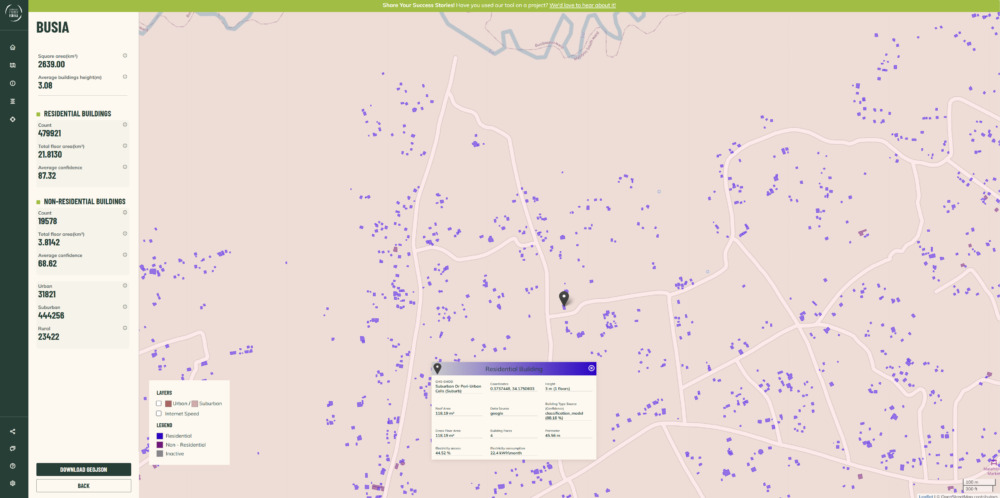
IBM sustainable AI tool: Modelling Urban Growth
IBM also debuted Modelling Urban Growth (MUG) at COP, a model which uses a variety of datasets to predict the growth of cities.
IBM said MUG uses data including satellite images and information on the existing structure and geography of cities – for example, its slope and existing roads – to predict where they will spread in the future. The resulting predictions can be used by government officials to decide which areas might need extra resources, such as power infrastructure, in future.
The open-source model is trained on a number of countries in Africa, including Nigeria and Uganda, but can be retrained using data from other geographies. MUG can be accessed via GitHub.
Prior to the COP summit, IBM published research into the use of AI for sustainability.
The State of Sustainability Readiness Report found a gap between business leaders’ enthusiasm for the potential of AI for sustainability, and their willingness to use it: 90 per cent of the decision-makers surveyed for the report said they believed AI could be used to achieve their companies’ sustainability goals, while only 44 per cent said the organisations were already using it for that purpose.
However, that figure could be on the up before too long: the report said 32 per cent of survey respondents plan to deploy AI for sustainability “soon”, while 88 per cent said they were increasing their investment in IT as a way of improving sustainability.
More on sustainability
About The Author

Jo Best
NEXT UP


