Trending Topics

 Trending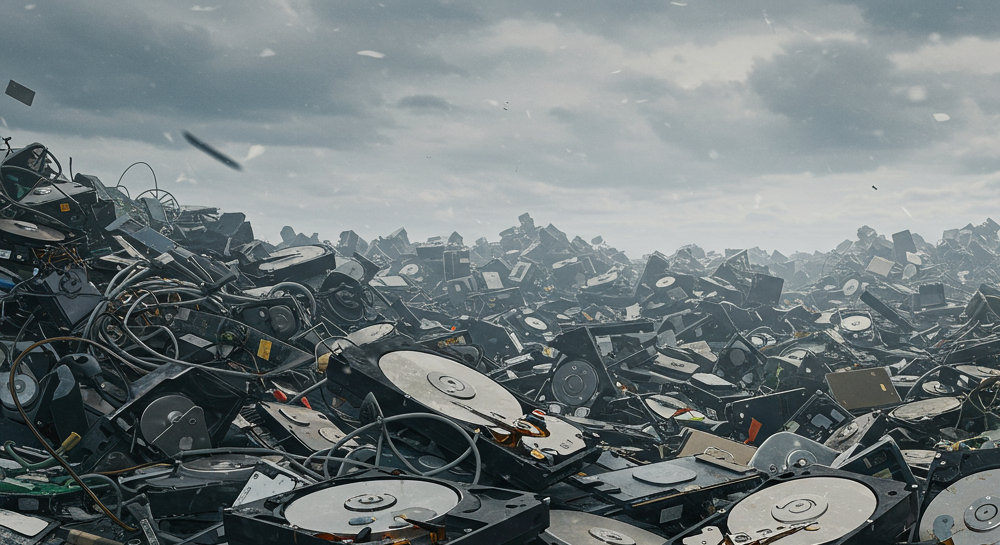
Rare Earth reboot: Western Digital and Microsoft transform old hard drives into REEs to beat tariffs and save the planet

The recent introduction of trade tariffs by Donald Trump has caused additional ripples in the sea of technology. Despite the tub-thumping calls to re-nationalise US tech manufacturing, the geographical reality is that many vital elements inside core components are imported into North America from overseas.
Without elements such as neodymium, terbium and many of the 15 other rare earth elements (REEs), our laptops, phones and EVs simply can’t be made. At least, not using the current system.
Although many REEs are relatively abundant, they’re seldom found in concentrated forms (hence, rare) and are difficult to extract. What’s worse is that we lose these precious REEs when we dump products at the end of their life.
Thankfully, some of the largest technology firms have collaborated to find a way to reclaim REEs from e-waste. This innovation has the potential to revolutionise supply chains, radically improve circularity whilst reducing e-waste. There is much more at stake here than Trump’s tariffs and trade wars.
What has Western Digital done with Microsoft’s hard drives?
They’ve crushed them up. But on purpose and for a very good reason.
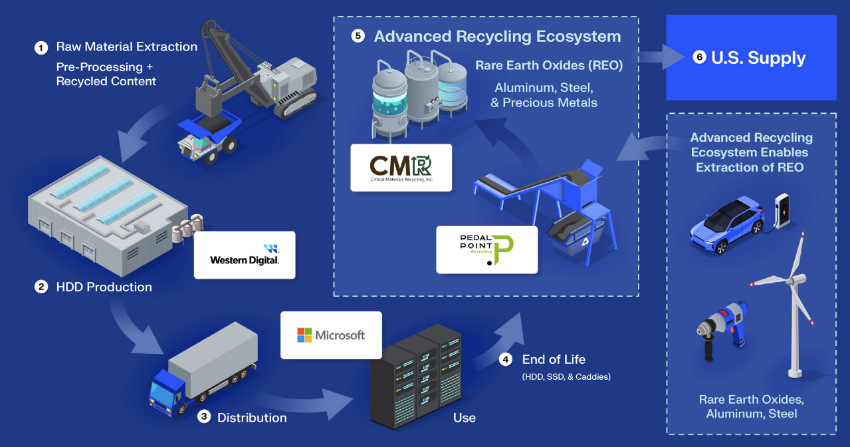
Advanced Recycling and Rare Earth Recovery at Scale is a new whitepaper published by Western Digital. It explores WD’s recent collaboration with Microsoft, Critical Materials Recycling and PedalPoint Recycling in converting around 47,000 pounds of end-of-life hard drives into critical and valuable metals including REEs.
The project began in 2023 with Microsoft supplying shredded EOL drives from two of its data centres. These were processed and separated into printed circuit boards (PCBs), aluminium and ferrous to allow for further recycling. Much of the process was kept within the USA, with the PCB fragments being shipped to South Korea to extract the gold, copper, silver and palladium.
How to extract REEs from a shredded hard drive?
Critical Material’s Recycling used an innovative method of recovering REEs called ADR–Acid-Free Dissolution. This process uses copper-salt solution to recover over 90% of REEs from the shredded drive feedstock. From this, rare earth oxides are harvested with a purity of over 99.5%.
These numbers are incredibly impressive, especially as there is good potential to scale the process. The ability to recover REEs from shredded drives also dismantles many of the security and data protection barriers that prevent hard drives being sent for recycling instead of incineration.
Environmental benefits of recycling hard drives
As part of this process, a Life Cycle Assessment was applied to collect data to measure its environmental impact. The results seem startling.
For every 1,000kg of shredded drives that arrive, the process extracts 985kg of useable material: 318.6kg of ferrous, 641.7kg of aluminium and 24.7kg of REEs. Incredibly, only 15kg was wasted.
The aluminium smelting process captured 75% of the metal, using around 96% less CO2e than the production of virgin aluminium. The process to produce the REOs also used 80% less CO2e than equivalent primary production, and those figures include a return trip to South Korea. Equally, steel reclamation also cut CO2e emissions by 95% compared to virgin production.
The aggregated results all seem incredibly promising. The headline figure states that this type of recycling and reduce CO2 emissions by around 95% compared to virgin production. In addition, the process greatly reduces energy consumption, acid leaching, ecotoxicity and the environmental desecration caused by the mining process. The last point alone also eradicates risks to workers, local communities and wildlife.

Reclamation of REEs from products discarded as e-waste is phenomenally complicated to achieve and therefore virtually non-existent at scale. The linear use of REEs can only ever be wastefully finite. Neodymium, for example, has been formed over tens of millions of years and is found in parts of the world we now call China, Brazil and Greenland. Technology manufacturers extract this resource to build products which stay in use for less than a decade.
It is little wonder that the current political climate has focused the spotlight on the importance of REEs, highlighting the wasteful way in which the technology industry uses them.
Pass it on: Recycling is better for the bottom line
Though the whitepaper focuses on the environmental impact of reclaiming REEs, some of the citations also look at the financials.
A report published in the American Chemical Societies’ (ACS) journal focussed on didymium oxide. The report suggests that the recycling process could reduce the minimum selling price of didymium from $130/kg to $73/kg, a decrease of over 43%.
Why is the price of didymium oxide significant? Because it’s used in the construction of super-magnets. These are used in EVs, wind turbines, hard drives and virtually any other high-demand piece of electrification equipment. That’s a useful piece of information, especially during a trade war.
The Western Digital whitepaper shows that a circular economy reduces waste and costs. It must be hoped that as the recycling technology improves, so will the environmental and fiscal benefits. Hopefully leading to scaling-up, adoption and availability.
Apple’s closed loop continues to bear fruit (sorry)
In 2019, Apple released its Material Impact Profiles as part of its drive to utilising more recycled elements within its supply chain. Its latest environmental progress report states it hit 99% for recycled gold, tin, cobalt and some REEs against its 2025 100% goal. Apple mentions that is requires recycled materials to conform with ISO 14021 which defines how companies substantiate their environmental claims.

Additionally, Apple continues to focus on closed loop recycling, which allows it to control its own recovery and reclamation. Last year we wrote about the environmental advancement of the new Mac mini. The highlight was its recycled aluminium composition, which has now rolled out (in varying degrees) into the enclosures of the Apple Watch, iPad, MacBook, Apple Vision Pro and iPhone 16e.
AI and carbon sitting in a tree…
To complement Western Digital’s report is another published by its storage rivals, Seagate. Its Decarbonising Data report evaluates how AI-driven data storage is intensifying sustainability challenges in the data centre sector.
One of the report’s most startling revelations is that not only do SSDs have a higher embodied carbon footprint than hard drives, but they also consume more power per terabyte. This revelation brings us full circle.
One reason Microsoft is collaborating in the Western Digital trial is to improve the environmental impact of its own data centres. If Microsoft can recycle, reclaim and reuse huge percentages of its shredded end-of-life drives, costs will drop, eco-footprints will improve and concerns about REEs and import tariffs tumble down the priority list.
How do REEs, hard drives and recycling affect you and your business?
As always, the best thing any of us can do is to avoid buying new products and opt for refurbished whenever possible. Refurbs are (usually) located locally, which avoids tariffs and can also contribute to lowering your Scope numbers on an ESG.
The Western Digital report also highlights the importance of closed-loop recycling. It is imperative to discuss with your suppliers where your inventory will go when it reaches end of life.
At the moment, most municipal recycling centres (often through lack of investment) cannot correctly process electronics at scale. Your old phones and laptops often end up in a crusher and then a furnace. Getting your used electronics into back into the hands of the manufacturer (Apple, HP, Dell, Lenovo, etc) greatly increases their recycling potential.
Simply, it becomes their problem and not that of local taxpayers.
Although the Western Digital initiative was a pilot scheme, it is now in development with other hyperscale partners, which is extremely promising news.
More by Lee Grant
About The Author