Trending Topics

 Trending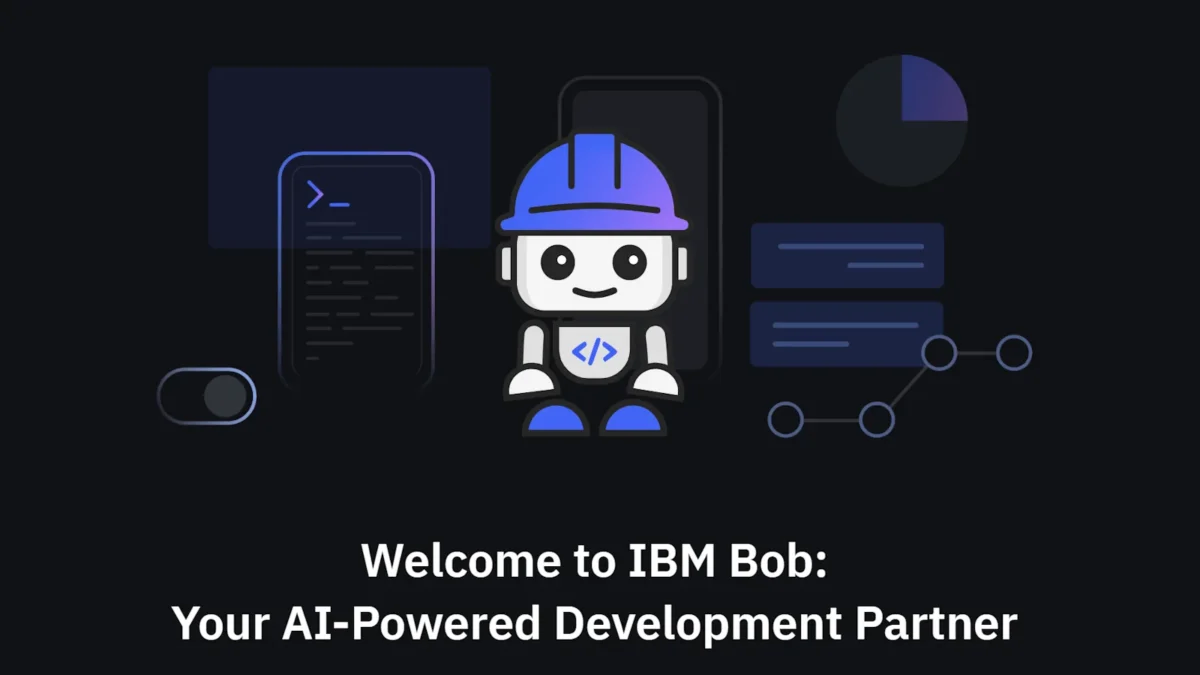
IBM Bob is out… so what do users and experts think?

You’ve got to love IBM’s approach to names. I’m a huge fan of Watson for both its approachable moniker and its extensive range of uses, and this week IBM announced the global availability of IBM Bob. Any BlackAdder fans will immediately be thinking of a different Bob (“unusual name for a girl”), but the IBM Bob is equally keen to help – this time to speed up development of code.
IBM Bob isn’t meant as a direct rival to Claude or GitHub Copilot – it can actually use Claude among other AI coding tools – but instead to aid dev teams in enterprises. IBM lists the following key capabilities (with quotes taken from its press release):
- AI-first SDLC orchestration: “Bob embeds agentic AI across the entire SDLC – from discovery and planning through design, coding, testing, deployment, and operations -coordinating specialized role-based agents, reusable skills, and governed workflows.”
- Intelligent modernization: “Bob coordinates specialized agents across code, tests, documentation, and pipelines to execute complete modernization tasks. For example, Bob helped cloud solutions and consulting services company Blue Pearl conduct a typical 30-day Java upgrade in just 3 days, saving over 160 engineering hours.”
- Security controls built in from day one: “Bob includes prompt normalization, sensitive data scanning, real-time policy enforcement, and AI red-teaming directly within the development workflow, not as an afterthought.”
- Auditability: “AI-generated code can reach production without sufficient review, creating compliance blind spots. Bob’s CLI (BobShell) creates self-documenting agentic processes in real time, so every action is traceable from start to finish.”
- Multi-model orchestration: “Bob dynamically routes tasks to a suitable model based on accuracy, performance, and cost, drawing on a mix of frontier models including Anthropic Claude, Mistral open source models, and IBM Granite, alongside specialized fine-tuned models for code reasoning, security, and next-edit prediction.”
- Transparency and developer control: “Bob’s approval model lets developers configure checkpoints that match their workflow, from manual approvals to auto-approve by task type, keeping humans in the loop.”
So that’s what IBM claims. This article, however, focuses on what users and experts think.
First impressions of IBM Bob
VERDICT Promising start
Let’s start with the more positive feedback.
“I’ve used it on a handful of prototype projects – enough to get a feel, not production work,” said Ana Riabova, AI Growth Leader at TripleTen. “What stood out was how rigorously Bob’s plan mode is structured: it forces you to articulate the final task before the agent executes. Claude Code has plan mode too, but Bob’s felt more deliberate, which is genuinely useful when you’re a non-engineer trying to be precise about what you want.”
“I just tested out IBM Bob and my first impression is that it’s definitely aimed for structured workflows and it is more about building the workflow than creative coding,” said Alexandra Hayes, Generative AI & SaaS GTM Consultant in charge of AI Strategy at AudioCleaner AI.
She added: “Structure is more of a priority than improvisation. In my opinion, Bob is stronger with workflow governance, integrations, and team consistency. Although, Claude is more flexible with governance and developer intuition.”
Elmer Morales, Founder and CEO at koder.com, was less taken. “A VS Code wrapper with a clunky onboarding experience,” was his first impression of IBM Bob. “Not what you’d expect from a company IBM’s size.”
We heard a similar vibe from Richard Demeny, Founder/CTO at Canary Wharfian. “I’m not impressed,” he said. “I’d put it roughly in the same league as Sonnet from Claude – generally okay, but definitely will not use it day-to-day, as it tends to mix up/leave things out and just miles behind from the more expensive Opus model from Anthropic.”
Let’s give the final word in this section to Olga Titova, who is a PM with responsibility for AI adoption in an enterprise. She hasn’t tried Bob personally yet, but praised the positioning: “[It’s] not trying to be another Copilot, it’s trying to be an entire development workflow wrapper,” she said.
“The idea of autorouting to cheaper models is interesting, as from what I’ve seen working with people trying AI in their workflows, model paralysis is real plus people are not very good yet at choosing the optimal model for their task in terms of cost efficiency.”
How does IBM Bob compare to Claude Code?
VERDICT Claude for practicality, IBM Bob for process
While IBM draws upon Claude Code along with other coding assistants, including its own, I wanted to know how people felt it compared directly to the Anthropic solution.
“Bob will actually use Claude, Llama, Mistral or one of IBM’s own Granite AI models, depending on the request,” said Tom Richards, IBM Systems & Data Security Lead at Northdoor.
“Each model has its strengths, weaknesses and associated cost so Bob provides an orchestration layer to balance cost whilst giving you the best of each model. However, Bob is aimed purely at coding assistance so some of the wider analysis activities that Claude can do.”
Sayali Patil, AI Infrastructure Reliability Specialist at Splunk, was also keen to emphasise that the produces “are solving different problems at different layers. Claude Code is fast, capable, and developer-centric. Bob is betting on orchestration across the full SDLC with compliance baked in from the start.”
She added: In my experience building monitoring and automation platforms at Cisco across 20-plus global enterprise customers, the tools that survived long-term adoption were always the ones that could answer the question: what happened, when, and who approved it. That is exactly what Bob Shell [see the video below] is designed to produce. Whether it delivers that in practice is the real test.”
Mark Vena is CEO at SmartTech Research. He hasn’t yet put Bob to the test, but still has strong views. “Honestly, Claude Code feels more developer-native, fast-moving and hacker-friendly, while Bob looks more like an enterprise software delivery system with IBM guardrails bolted in from day one.
“Claude Code may win on raw developer enthusiasm, but Bob’s advantage is that it speaks the language of CIOs, compliance teams and legacy modernization. The downside is obvious: if IBM makes Bob feel too process-heavy, developers may treat it like another corporate tool they are forced to use rather than one they love.”
But there’s one person who we can say categorically does not love Bob, and that’s Elmer Morales. “It doesn’t,” he said on how IBM Bob compares to Claude. “It’s a VS Code editor with a chat assistant. It’s like 2022 called.”
Can you see yourself or your business using IBM Cloud? If so, how?
OVERALL VERDICT Most say yes, but there’s a strong feeling against it too
“Absolutely!” said Mark Vena. “I see Bob being most useful in enterprise environments where the problem is not writing new code from scratch, but understanding, refactoring, securing and modernizing existing codebases. That is where IBM has credibility, especially in Java, mainframe, regulated industries and large-scale IT estates. For smaller teams building greenfield apps, Bob may be harder to justify unless it proves it can move as fast as tools like Claude Code, Cursor and Lovable.”
Northdoor is already putting IBM Bob to the test. “We’re evaluating the use of Bob to help with developer productivity for internal projects on [our] own assets along with streamlining the creation of scripts for monitoring activities,” said Tom Richards. “For our many IBM midrange clients running their core business applications on IBM i or AIX, Bob offers the ability for them to modernise code whilst allowing the next generation of developers to contribute.”
“I’m already using it for some prototype work,” said Ana Riabova, “but it’s not displacing my main toolkit. I work with code as a marketer – prototypes, data, automation – and Bob’s plan mode is a real plus for one-off explorations, but I still want model transparency for anything I’m iterating on. The bigger story is that IDE-shell tools like Bob and Cursor are how non-engineers actually onboard to working with code, and that shift matters more than the IBM-specific angle.”
In stark contrast to Mark Vena, Elmer Morales said: “Absolutely not. It brings nothing new to the table.” Richard Demeny is another Bob-sceptic and can’t see his business ever turning to the solution. “The only other model we use is actually ChatGPT, as it tends to produce better UI code, but generally, we always opt for [Claude] Opus.”
Is IBM the right company to lead this wave?
OVERALL VERDICT The consensus says yes…
So to our final question: is IBM the right company to lead the way for enterprise coding? It should be no surprise by now that Elmer Morales isn’t a believer. “IBM was the right company 20 years ago,” he said. “Now they’re irrelevant in the AI space. Bob brings nothing enterprises don’t already have. And then there’s the billing model: Bobcoins. It sounds like crypto is involved, and that alone will scare off any large enterprise procurement team.”
Mariia Golitsyna, who describes herself as a B2B growth and marketing expert said that in her experience working with enterprise clients “the bottleneck is rarely coding – it’s coordination and decision-making across teams. Tools like IBM Bob won’t just speed up development; they will allow business teams to initiate execution earlier, without waiting for engineering. That’s where the real shift happens.”
“It’s a step towards [vibe coding for the enterprise] that but unlike traditional vibe coding for prototyping or ancillary apps, the applications that clients will utilise Bob for will be amongst the most critical workloads within their organisation,” said Northdoor’s Tom Richards. “As a result, I believe the IBM name adds legitimacy and weight behind Bob which is much needed given the kind of impact it will have.”
Mark Vena even gives us a compelling image to enjoy. “This is basically vibe coding putting on a navy blazer and walking into the enterprise boardroom,” he said. “IBM is not the obvious company to make AI coding cool, but it may be one of the better companies to make it acceptable to enterprises that care about governance, audit trails, security and legacy systems. The big question is whether Bob can preserve the speed and magic of AI-assisted development without drowning it in enterprise bureaucracy.”
We’ll give the final word to Splunk’s Sayali Patil. “IBM has two things most AI dev tool vendors do not: deep mainframe relationships and decades of compliance credibility in regulated industries like financial services and healthcare,” she said.
“The developer experience gap is real and the brand carries legacy weight that younger engineers do not feel warmly about. But enterprise procurement decisions are rarely made by developers. They are made by the infrastructure and risk leaders who already have IBM contracts. That is a structural advantage that should not be dismissed.”
Other interesting things that IBM is up to…
About The Author

Tim Danton
NEXT UP