Trending Topics

 Trending
Behind the scenes at Wimbledon 2025: how IBM’s AI tools and hidden rooms provide a unique service

It’s hot. Ice melts in a glass of Pimm’s almost as quickly as thirsty punters can drink it. Everyone around me is hugging the shade like tennis-loving vampires. But there’s no shade outside Wimbledon’s Court 18 as I wait for Kevin Farrar, Head of Sports Partnerships at IBM UK, to provide a guided tour of IBM’s trio of hidden, below-ground rooms.
Kevin and I have met three times previously, but I’ve never been so pleased to see him. As always, a smile plays on his lips. Despite wearing a blazer top, he looks unbothered by the mercury-boiling temperatures. We shake hands, exchange pleasantries, as I stop myself from begging entry into the Broadcast Centre and the sanctuary it offers.
Luckily, I don’t have to beg. Within a minute we’re through two sets of twin doors and descending the steps that lead to the basement of the Media Centre complex. We pass the cafeteria where journalists and broadcasters from around the world recharge, but there’s no time for such luxuries. We push through another set of double doors and into one of the network of tunnels that allow players to bypass the crowds on their way onto the show courts.
But there’s no time for bumping into Alcaraz or Sabalenka: we’re here. Room 58, Digital AI and Cloud.
IBM at Wimbledon: the AI room
IBM and Wimbledon have been partners since 1990. That’s the year when Martina Navratilova clinched her ninth and final Wimbledon title, when Stefan Edberg defeated Boris Becker in a five-set classic.
Every year since then, the doubles partnership of IBM and Wimbledon have aimed to serve up something special. Something new. In the past few years that means AI, and it’s no different in 2025: if you fire up the Wimbledon app or visit Wimbledon.com you can instantly find out what’s happening via Follow Live and Match Chat.
Click “Follow Live” on the website and you’ll see something similar to the below. The “Live Likelihood to Win” feature tracks each player’s chances of victory since the start of the match, according to IBM’s AI, and allows you to quickly dive into the Match Chat.

That’s what the punters see. Behind the scenes, Kevin explains, sits IBM’s powerful system and the humans in the current room. “Some of the team are responsible for maintaining the digital platforms, so the apps and Wimbledon.com. We’ve got other members of the team who are focusing… on the innovation features.”
Their job is to monitor the questions and the answers, looking for discrepancies. “It’s a constant process of refinement and learning, both for the models and for the team as well,” Kevin says.
Early learnings from Wimbledon 2025
It’s early when I visit. To be precise, the morning of Day 2, and while Kevin won’t be drawn on details on what happened on Day 1 he says everything has gone to plan so far. That includes a phased rollout of the new features during the day. Perhaps it’s telling that I was the first journalist to visit IBM’s Wimbledon HQ this year; you want Day 1 to have passed smoothly without letting in outsiders.
And this year there is an element of risk in the Match Chat feature. Although you can use the pre-made prompts, as shown in the screenshot above, IBM also allows people to ask freeform questions. Just as they might ask a friend. I probe to find out what’s gone wrong so far, the weird questions that have caught Match Chat out, but if such things have happened then IBM is keeping quite. Most questions people ask, I’m told, are about what has happened in the match so far and the live Likelihood to Win.

I admit to Kevin that I was hoping to find a chattier bot than what is currently on offer. One with a little humanity. “It still feels like a machine is talking to you, as opposed to a human,” I suggest. Kevin’s answer is as blunt as it is is instant: “It’s not a human.”
He adds: “Obviously the model is learning all the time, we’re learning all the time, and it’s being refined. And that’s one of the great things about this feature, actually, is that we can see the types of questions that people are asking, and then that will enable us to refine the whole model moving forward.”
What lies beneath IBM’s Wimbledon app: data, models and watsonx
We move into the next room, which is all about data. And, at Wimbledon 2025, there’s a lot of data to deal with. Kevin reels off a rapid-fire list of live information from the match itself: speed of serve, serve direction, how the ball is returned (backhand, forehand, slice, topspin?), the rally count, whether the point ends with a winner, forced error or unforced error. And bear in mind that’s a single point.
Then there’s the player data. Detailed biographies, including how they’ve performed at Wimbledon in the past. Or consider all the other data gained from Hawkeye, based on a network of high-resolution cameras spread around every single court, such as tracking the players as they race for the ball.
So far, this is all structured data, easy to assign a value to. Now consider the mass of unstructured data that is also fed into the model. These could be news stories, opinion pieces, but also all with articles published by the AELTC (All England Lawn Tennis Club) editorial team on Wimbledon.com.
“Taking structured data and unstructured data, combining it, analysing it, enables us to create the insights that are the basis for the innovation features that we produce,” says Kevin. “All of this is using our watsonx family of services and products. So we’ve got watsonx.data that’s taking trusted data sources to train the particular model that’s relevant for the use case.”
This is used to train a large language model provided by a mix of IBM Granite and Llama by Meta. “So it’s not just IBM models, it’s open,” says Kevin. “Watsonx.ai Is then used to train the model in the nuances of the language of Wimbledon – it’s the Gentlemen’s Singles, the Ladies’ Singles, etc.”
The final step is to add the guard rails to prevent hallucinations or deliberate abuse from outside forces. Which is where the final IBM ingredient, watsonx.governance, steps in.
The final room: real-life experts
Back in 1985, Aretha Franklin explained how it used to be that behind every great man there had to be a great woman. Well, these times have changed, and it’s no longer true: behind every great news story and social media post, there has to be some great data.
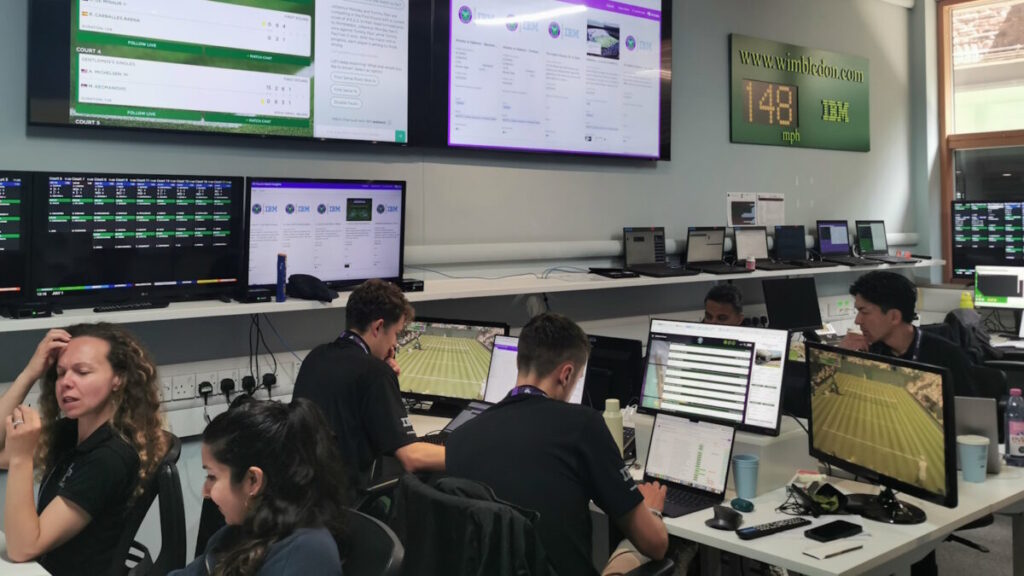
And some great women (and men) too. You’ll find them in Room 59, Match Insights, which was the final stop on my tour. “The team here are providing a service to the Wimbledon content team and to the press,” says Kevin. Some questions are relatively simple to answer, such as head-to-head results, but others require skilled assistance.
“We’ve got a combination of tennis specialists and data scientists in this room, so they can go and run the complex queries, get the information back, get the answers back, and then provide that as a service.
“They’re being proactive as well, in terms of looking for potential records that are coming up.” Kevin gives the fictitious example of Emma Raducanu going into a match with 495 aces at Wimbledon.
“The chances are that she’ll break the 500 mark during that match. This team are looking out for those types of things so that they can build the content so that the moment that happens, they can get that story out, they can give that to the content team at Wimbledon. And they can get that out on the social platforms, etc, or maybe on the broadcast graphics.”
For those curious about the technology that technologists rely upon, IBM’s Expert Insights team uses Airtable to show what they’re working on and allow journalists to grab the nugget of information that’s of interest to them.
Early reaction to Match Chat and IBM’s Wimbledon 2025 services
I pester Kevin for numbers. Are people using Match Chat? Is it delivering greater engagement figures compared to last year? He is reluctant to fall for my bait, instead saying that everything has gone well so far and the AELTC – IBM’s client in this case – is pleased with the results so far.
But late on Wednesday afternoon I do hear something concrete from IBM’s team. “We’ve seen a 300% increase in unique visitors engaging with this year’s ‘Match Chat’ feature compared to ‘Catch Me Up’ at the same point in last year’s tournament,” I’m told over email.
Which isn’t surprising. It still responds like a robot, but the Match Chat AI is genuinely useful within the tight parameters that IBM has set it.
Kevin and I shake hands outside Court 18, the blazing sunshine forcing me to don a hat that does me no stylistic favours. He remains all smiles, the heat having no apparent effect. Perhaps that’s because he’s checked his Likelihood of Success figures and likes what he sees.
Brief history of Wimbledon and IBM AI innovations
- 2023: Wimbledon partners with IBM to deliver AI commentary on matches
- 2024: IBM and Wimbledon’s Catch Me Up cards to give personalised write-up for every singles tennis player in 2024’s Championships
- 2025: IBM introduces Match Chat for Wimbledon 2025, a know-it-all tennis expert that tells you who’s likely to win
About The Author

Tim Danton
NEXT UP


