Trending Topics

 Trending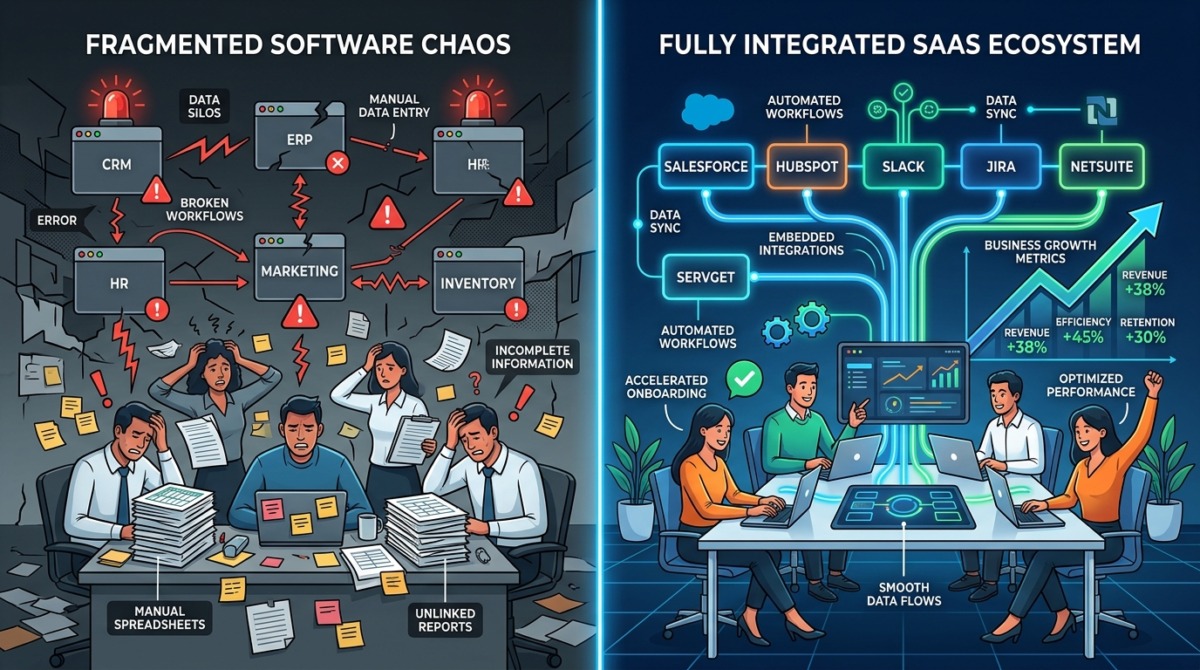
Why embedded integrations are becoming a product decision, not just an IT decision

This is a sponsored article brought to you by Latenode.
For years, software integrations were treated as a technical problem.
If two systems needed to exchange data, engineering teams built an API connection. IT handled access. Operations teams adjusted the process around it. Product teams often saw integrations as a supporting feature rather than a strategic part of the product experience.
That model no longer fits how SaaS products are bought and used.
Today, integrations influence product adoption, customer retention, onboarding speed, enterprise readiness, and revenue expansion. For many SaaS companies, integration strategy has become a product decision.
Customers expect software to fit their stack
Modern companies do not run on one platform. They use CRM systems, support tools, data warehouses, billing platforms, analytics software, spreadsheets, project management tools, email platforms, messaging apps, and internal databases.
A new SaaS product rarely replaces the whole stack. It has to fit into it.
MuleSoft’s 2025 Connectivity Benchmark Report found that the average enterprise manages 897 applications, yet only 29% are integrated. The report also found that 83% of respondents believe delays in connectivity initiatives create lost revenue opportunities.
This creates a clear product reality: if a SaaS product does not connect well, customers feel friction immediately.
They have to copy data manually. They ask for exports. They request custom integrations. They create spreadsheets as temporary workarounds. They depend on customer success teams to move information between systems. They may even delay rollout because the product does not fit their operational environment.
The core product may be strong, but weak integrations can make the entire experience feel incomplete.
Integrations now influence buying decisions
Enterprise buyers often evaluate software based on how well it fits into existing operations.
A product with strong integrations is easier to approve. It creates less migration risk. It reduces implementation effort. It makes security and IT teams more comfortable. It helps customer success teams onboard accounts faster.
A product with weak integrations creates hidden costs.
This is why integrations are now part of positioning, sales enablement, onboarding, customer success, and expansion strategy. They are not only backend infrastructure.
Postman’s 2025 State of the API Report found that 65% of organizations generate revenue from their API programs, while 93% of API teams still struggle with collaboration blockers.
That combination tells an important story. APIs and integrations are increasingly connected to business value, but many teams still struggle to build and manage them efficiently.
Build vs buy is becoming harder
SaaS companies can build integrations internally. At the beginning, that often seems like the obvious choice.
One CRM connector. One billing integration. One webhook-based workflow. A few fields mapped between systems.
But the cost grows quickly.
Each integration may require:
- authentication;
- OAuth management;
- field mapping;
- rate-limit handling;
- retries;
- error logs;
- permissions;
- testing;
- documentation;
- monitoring;
- customer support;
- long-term maintenance.
Then customers start asking for variations. One integration becomes ten workflows. One CRM connector needs different routing rules. One accounting integration needs customer-specific field mapping. One enterprise account asks for approval logic. Another asks for two-way sync.
At some point, the company is no longer just building its core product. It is maintaining an integration platform around it.
That is why many SaaS teams evaluate an embedded integration platform. The goal is to deliver customer-facing integrations faster while keeping connector logic, workflow configuration, and automation inside the product experience.
Integration UX is product UX
A good integration is not only a technical connection between APIs. It is a user experience.
Customers need to understand:
- which account is connected;
- what data will move;
- which permissions are required;
- how fields are mapped;
- when the workflow runs;
- what happens when something fails;
- who can edit the integration;
- where logs and errors appear.
If the integration experience is confusing, support tickets increase. If it is clear, onboarding becomes smoother.
This is why embedded integrations should not be hidden in a technical settings page and forgotten. They should be designed as part of the product journey.
For example, a customer setting up a CRM integration should not need to understand every API detail. They should understand the workflow: what triggers it, what data moves, and what result to expect.
Flexible integrations support enterprise growth
Enterprise customers rarely have identical workflows.
One customer wants a simple sync. Another wants conditional routing. Another needs approval before data is sent. Another wants enrichment before records are created. Another needs logs for compliance. Another wants different workflow templates for different teams.
Static integrations often cannot support this complexity.
Flexible embedded integration infrastructure allows SaaS teams to support more use cases without turning every customer request into a custom engineering project.
This matters for growth. Strong integrations can reduce implementation friction, help close larger deals, increase product stickiness, and make the product harder to replace.
Integrations are no longer optional
For SaaS companies, the question is no longer “Do we need integrations?”
The real question is whether integrations are treated as a backlog of technical tasks or as a product capability that supports adoption and revenue.
Companies that treat integrations strategically can move faster. They can serve more customer workflows. They can reduce internal engineering pressure. They can create a better product experience.
In a software market where every company already uses too many tools, the products that connect well have an advantage.
About The Author

Gabriel Jones
NEXT UP


