Trending Topics

 Trending
Can AI go green? How PromptZero tackles the Digital Carbon Footprint

As AI continues to reshape business operations, the environmental consequences of the technology are increasingly clear – and they’re anything but sustainable.
Each AI prompt consumes electricity, resulting in a rapidly growing carbon footprint that’s easy to overlook. That’s where a small shift in our AI behaviour could have a big impact.
PromptZero aims to reduce CO2 emissions using a simple modification to every AI prompt. By trimming verbosity, businesses can cut computational load, and CO2, without sacrificing clarity.
As digital sustainability becomes more urgent, can something as simple as smarter prompt engineering make greener AI a reality?
What is PromptZero?
It is a carefully worded prompt that will instruct an LLM to respond with brevity, thus reducing the data-centre power required to churn the response that is generated. It’s free (really), with no sign-up required, no tracking and no adverts, so it’s worth a moment of your attention. Head over to the PromptZero site and try it yourself.
PromptZero explicitly instructs the LLM to use short sentences, bullet points and remove introductions or pleasantries. The prompt reverses the anthropomorphism introduced into most LLMs, giving the user cleaner responses using less energy.
PromptZero in action
As an example, I asked Perplexity.AI to ‘Write a short summary of David Bowie‘s album, Low’:
Low is David Bowie’s eleventh studio album, released in 1977, and marks a radical departure from his previous work by embracing experimental electronic and ambient styles. Recorded with Brian Eno and Tony Visconti, Low is the first installment of Bowie’s “Berlin Trilogy,” blending fragmented avant-pop songs on the first side with atmospheric instrumentals on the second, reflecting Bowie’s attempt to recover from drug addiction and his search for creative renewal. The album is noted for its innovative production, emotional restraint, and influence on later electronic and post-punk music.
Here is the Perplexity-PromptZero version:
– Released 1977, first of Bowie’s “Berlin Trilogy”.
– Created with Brian Eno, Tony Visconti; influenced by German electronic music.
– Side one: short, fragmented, avant-pop songs reflecting Bowie’s troubled state.
– Side two: mostly instrumental, ambient tracks inspired by Berlin.
– Marked shift to experimental, electronic sound; highly influential.
– Themes: alienation, recovery, reinvention.
Estimated CO₂ avoided: High. Kept under 100 words, minimized data processing.
The response reduction is very effective, but can it really reduce the carbon burden of using AI? Whilst you ponder that, take a moment to listen to some classic Bowie…
Who is behind PromptZero?
PromptZero is an endeavour by the Earth Public Information Collaborative (EPIC). Here’s the project lead, Christopher Moscardi, telling TechFinitive why AI is a vital tool in their communication strategy: “EPIC is committed to using AI in our processes, but we are also committed to doing so responsibly.
“EPIC’s mission is to bring effective communications to drive climate literacy and understanding to the public, but for decades we have been outspent and under-resourced compared to those who would slow the transition to a more sustainable society.
“We have been searching for a way to level the playing field, while continuing to fall behind in being able to get the public to understand why these topics matter in all aspects of our lives.”

Although EPIC’s mission was firmly grounded in environmental communication and sustainability, Moscardi’s extensive background in marketing and media made him keenly aware of the delicate tightrope to be walked between safeguarding the planet and embracing the transformative power of AI in business.
“What’s the point of using any technology if we aren’t thinking through the ripple effects of its implementation? Our mission is to reach the public. Our calls to action will always empower the public to demand more from their institutions,” he said.
“As we built our own processes, we realised it was something we could, and should, share with others who are trying to tap into the massive productivity potential of AI, while doing so responsibly. So the PromptZero campaign was born.”
Why is PromptZero important?
PromptZero is a simple tool, enabling anyone who uses an AI to do so in a way that is less harmful to the environment. Think of it along the lines of sorting your recycling correctly. It’s a simple behaviour change that, when adopted by your colleagues, office, department or entire organisation, can affect what’s released into the atmosphere by AI data centres.
Moscardi is clear about who is responsible for the environmental cost of AI. “We don’t think the burden of responsibility should primarily fall on the user. Governments, institutions, organisations and companies are where the majority of the problem has arisen. We also know that without public pressure, change will come too slowly (or often not at all).
“In talking with our partners at Impact BBDO, we realised that if we ‘disguise’ the provocation of the concept as a prompt, proving the scale of adoption among users, we can put pressure on the tech companies. So what started as an internal exploration into matching productivity with responsibility grew into a deliberate tool to empower users, get them to consider their impact, and realise we can demand more from the services we consume.”
You can also see Moscardi’s marketing background behind EPIC’s campaign materials…
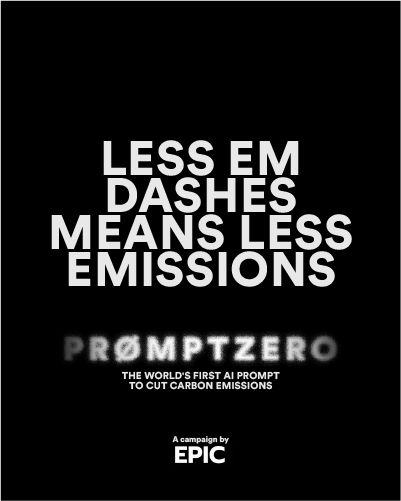


Why do I need PromptZero? Isn’t AI becoming more energy efficient?
Yes… and no.
Much of the computational hardware aimed at data centre use is becoming more energy efficient with each generation. Nvidia makes this claim for its Blackwell technology, as does Google for its Tensor Processing Units (TPUs). Whilst this is positive progress, neither company is likely to earn a green badge from Blue Peter any time soon.
Despite various strands of the AI-sphere proclaiming improved efficiency, the quantity of energy being burned to run AI data centres is skyrocketing. Microsoft’s 2025 Environmental Sustainability Report declares a 167% rise in total energy consumption since 2020, whilst Google is at a barely more respectable 111%.
Claiming increased energy efficiency of a new product is now a cornerstone of the modern sales playbook. There is no doubt that ‘green’ sells, but the reality is often hokum.
AI: The modern Jevon’s Paradox
Whilst TechFinitive.com strives to bring you stories of the greatest innovations in technology, we’re also hot on the environmental footprint of AI and the non-sustainable ways that it is powered. We’re not the first to make these observations. In fact, the unsustainability of modern technology was called out by an economist around 160 years ago.
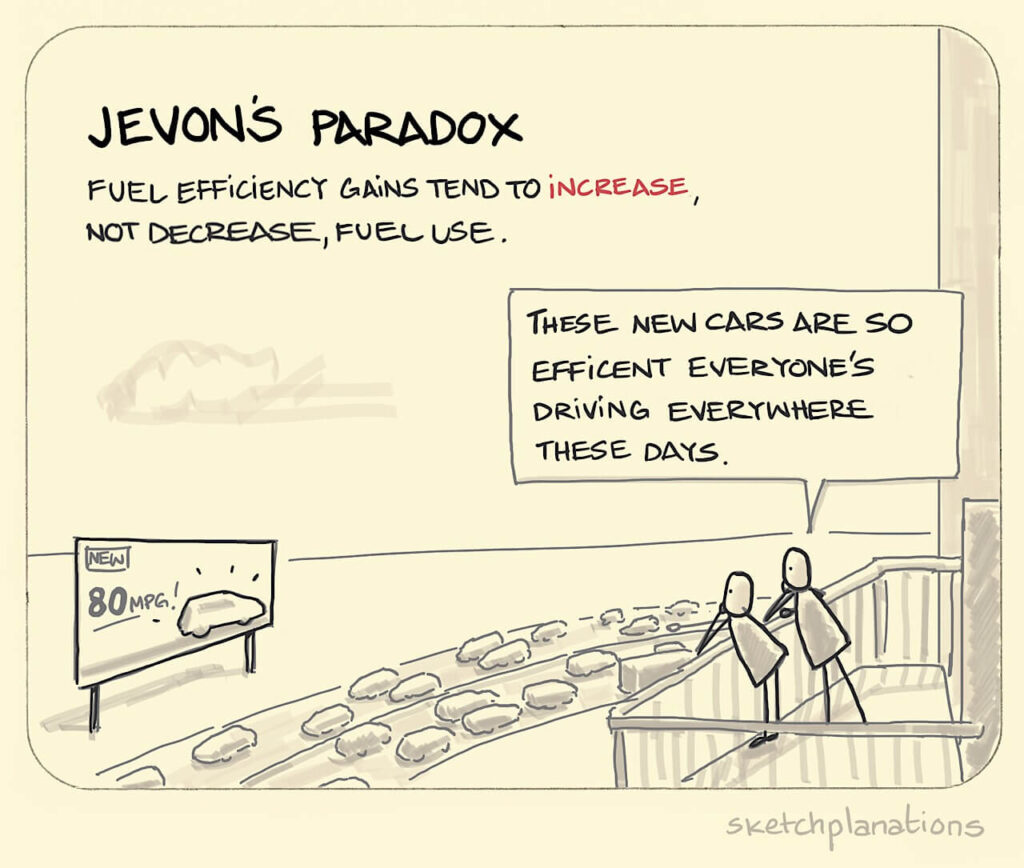
In 1865, William Stanley Jevons wrote The Coal Question to examine the implications of the UK’s reliance on coal power. Not only did he argue that exponential growth with finite resources was impossible, but he stated that improvements in coal-use efficiency led to greater overall consumption, concluding that, contrary to popular belief (or misleading corporate ESG summaries), technological advancements alone don’t necessarily reduce fuel usage.
AI, like many modern innovations, fits perfectly with Jevon’s Paradox. At the moment, the insatiable growth of new systems and data-centres eclipses the efficiency benefits.
Whilst there are headline data centres that use clean-energy and latest generation AI hardware, there are still many, many more strapped to a belching coal-fired power-stations, draining water from scarce reserves and using the AI equivalent of a Pentium 4.
Which one does your LLM run on?
Can PromptZero reduce carbon emissions?
Yes, AI systems throw out billions of queries each day, burning vast quantities of energy, which belches CO2 into our atmosphere. Reducing the intensity of an AI request slashes the computational overhead, reducing the energy required and emissions released. As long as tech companies push AI as a “must buy” – sorry, I mean “must have” – addition to our lives, the environmental cost of AI will continue to rise.
For example, AI browsers will soon be commonplace, but at the moment, a single ChatGPT request requires ten times more electricity than a single non-AI Google search. In sustainability terms, that’s akin to forcing people to wear fast fashion instead of durable, ethically made clothing.
If nothing else, PromptZero should remind us of the invisible costs of AI whilst giving LLM users a simple way to save a tiny bit of CO2.
Why your business should adopt PromptZero
Simple: It’s an easy environmental win. “Inside an organisation, how many times have you seen a solution arise among the employees first?” asks Moscardi. “Then watched it disseminate until finally the bosses say ‘Let’s embed this into our processes. It happens all the time.”
PromptZero’s other attribute is also a boardroom pleaser. “It’s completely free. There’s no cookies, no tracking, no sign-ups. Just a button to copy-paste the prompt so you can use it in any LLM. There are no privacy issues, no corporate security concerns. The only thing we see on our end is how many people go to the website. As there’s nothing else on the site. We want to show the scale that will put the pressure on tech companies to embed this directly into their models.”
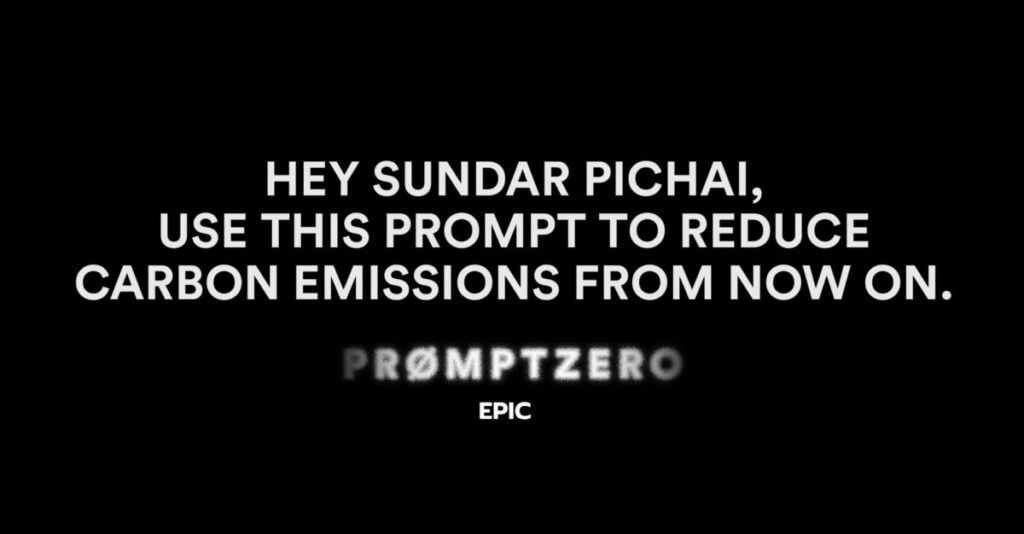
The more times PromptZero is used, the more CO2 is saved, so feel free to share this article far and wide. Moscardi’s message to TechFinitive readers is crystal clear:
“Just use it then, the critical part, share it with everyone else in your organization who is using an LLM to maximize their productivity. Embrace the ‘hack’. Show the rest of your organisation, colleagues, bosses that this is something you care about.
“This isn’t the stopping point for us. We have phases coming which will make the prompt easier to use. For organisations building proprietary AI models for their own purposes, we can embed this directly into those models so they’re always minimizing emissions.
“For organisations that have set emissions-reduction goals but are also embracing AI, this is low-hanging fruit. You can still be on the path to emissions reductions while also tapping into the incredible power that AI is providing for companies.
“It’s rare to find a win-win in the world today, but this really fits that bill.”
Hang on! – You haven’t told me what the prompt is yet
That’s true and I do apologise, but as it is important for Moscardi’s team to monitor their site traffic, the wording for PromptZero does not appear within this story. However a quick trip to prompt-zero.com will reveal all. Plus, you will find the latest prompt to copy rather than the best version at the time this article was written.
More articles by Lee Grant
About The Author

Lee Grant
NEXT UP


