Trending Topics

 Trending
10 use cases that already rely on enterprise AI

AI isn’t just hype: it’s powering fraud detection, risk management, drug discovery, and diagnostics. See 10 real-world enterprise use cases driving innovation today.

Edge-to-cloud, built to transform your business. Learn more about it here.
Artificial intelligence may dominate headlines with hype about sentient chatbots and “future of work” speculation, but AI is already very real in the enterprise world. From fraud detection in banking to speeding up drug discovery, the technology is already embedded in critical business processes. The most pressing issue facing C-suite and IT operations executives today is how to balance the imperative to scale AI deployment with the equally critical need for responsible and ethical governance.
Here are 10 use cases across industries where AI is already transforming enterprise outcomes.
Fraud detection and risk management
Banks and other financial firms were quick to embrace artificial intelligence, mainly because criminals adapt faster than legacy defenses. Old rule-based fraud systems struggled to keep pace, but machine learning can sift through millions of transactions as they happen, flagging odd behavior and stopping suspect payments before money leaves an account.
The same approach is also reshaping credit-risk modeling, allowing lenders to react to changing market conditions far more quickly than with older statistical methods.
Medical imaging and diagnostics
By training on millions of X-rays, CT scans, and MRIs, deep learning systems are now able to pick up early signs of cancer, heart disease, and neurological conditions with impressive accuracy. Rather than replacing radiologists, they often serve as an extra pair of eyes, highlighting details that could be overlooked. That means patients can be diagnosed sooner, treatment can begin faster, and overall costs to the health service are reduced.
Drug discovery and development

Bringing a new drug to market used to take a decade and billions of dollars. AI is shrinking that timeline by helping researchers identify promising compounds faster and model their likely effectiveness before clinical trials. Pharmaceutical firms already use AI to analyze biological datasets and simulate how molecules interact with proteins. The result is not only accelerated R&D pipelines, but also the ability to repurpose existing drugs for new conditions. In an era of ageing populations and rising healthcare costs, that’s a major breakthrough.
Predictive maintenance in manufacturing
Downtime is the enemy of productivity. Manufacturers now rely on AI to anticipate equipment failures before they happen, using data from sensors, IoT devices, and historical maintenance logs. By predicting when a component is likely to fail, enterprises can schedule repairs proactively, cut costs, and improve safety. Predictive maintenance is also greener: fewer unnecessary replacements mean lower emissions and less waste.
Supply chain optimization
Global supply chains are still feeling the pressure from geopolitical upheavals and shifting demand. To cope, many companies are turning to artificial intelligence to sharpen demand forecasts, spot bottlenecks, and fine-tune stock levels. Retailers now rely on these models to anticipate shopping habits at a local level, even down to individual stores, while logistics firms use them to redirect shipments in response to real-time conditions. The payoff is more efficient operations and better customer experiences, both of which are vital in crowded markets.
Threat detection
The cyber threat landscape changes daily, and human teams on their own cannot keep up. AI-powered security tools now sift through logs, network traffic, and endpoint behavior to spot activity that looks out of place, while machine learning models can distinguish between legitimate and malicious behavior. That means only the highest-risk events are surfaced for human analysts. This reduces alert fatigue and allows security operations centers to focus resources where they matter most. AI is no longer an optional add-on here – it’s the backbone of modern cyber defense.
Customer service and virtual assistants

Chatbots used to be a byword for frustration, but enterprise AI has moved them on. Today’s language models power customer service systems that can deal with complex questions, cut call centre traffic, and improve satisfaction. These assistants go further than simple FAQs. Linked into backend systems, they can update account details, process orders, or flag billing problems without human involvement. For businesses, the result is lower costs and a more consistent customer experience.
Energy management and sustainability
As organizations push toward net-zero goals, artificial intelligence is becoming central to how they manage energy. Smart meters and sensors feed data into AI systems that automatically fine-tune lighting, heating, and cooling in buildings, and utilities are also using the technology to balance grid demand and predict renewable output, making it easier to bring solar and wind into the mix. These tools help cut costs while cutting carbon, a win-win for companies facing scrutiny from both regulators and investors.
Financial forecasting and planning
Finance teams traditionally lean heavily on spreadsheets, regression analysis, and past data when setting budgets. AI changes that by layering in forecasts based on market swings, economic signals, and live business data. The systems don’t just sharpen the numbers; they can run different scenarios so CFOs can see how strategies hold up under pressure. For global firms working in unpredictable markets, that kind of flexibility is hard to ignore.
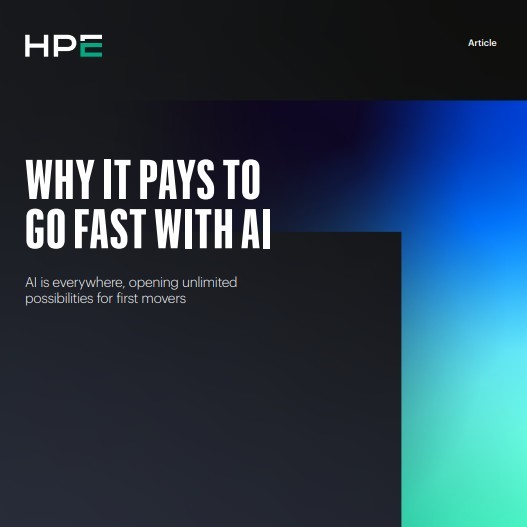
Why Speed Matters in AI Deployment
Moving fast with AI isn’t just about beating competitors – it’s about avoiding rising costs, stalled projects, and missed opportunities. But speed without structure can backfire. HPE highlights how success comes from pairing rapid execution with strong data, scalable infrastructure, and clear governance. Whether you’re scaling a pilot or launching enterprise-wide, knowing when—and how—to move fast can make all the difference.
Learn how to accelerate AI safely and effectively.
AI-driven product design and personalization
AI is also changing the way products are designed and brought to market. Consumer brands are using it to study customer habits and push out highly tailored recommendations. In heavy industry, generative tools help engineers sketch prototypes that juggle weight, cost, and durability in ways people couldn’t manage alone. The upshot is quicker product cycles and goods that land closer to what customers actually want.
Why this matters for enterprises
All of this points to a clear reality: AI is no longer experimental but already built into the way major companies run. The real task for IT leaders now is to scale, taking small pilots and rolling them out across the business, plugging them into existing systems, and ensuring it is all done securely and responsibly.
This is where the challenge of governance and speed converge. Platforms like HPE Private Cloud AI offer a strategic solution. It allows organizations to leapfrog from pilot to production while maintaining absolute control over their most sensitive assets. Specifically engineered to keep AI models and workloads off the public internet, HPE Private Cloud AI provides secure, high-performance infrastructure.
Just as crucially, the built-in software stack, HPE AI Essentials, acts as a dedicated and governed “sandbox.” This gives IT teams the flexibility to build, train, and deploy models close to the data through a controlled environment. This not only speeds up development but also acts as a built-in advantage for staying compliant with complex regulatory rules – turning the management of risk into a performance driver.
To achieve true scale, AI adoption can’t remain siloed within technical teams. The true prize lies in democratizing AI, empowering staff across finance, operations, and HR to leverage its capabilities. This requires more than raw processing power; it demands a unified and intuitive platform that shields users from complexity while ensuring the necessary data sovereignty and compliance requirements are automatically met.
Beyond the hype
The noise around AI won’t die down, but the time for separating hype from reality is over. These 10 use cases prove AI is already embedded in mission-critical processes across every sector. For leaders in the C-suite and IT operations, the takeaway is unambiguous: The era of the AI pilot is officially closed. The question is no longer if AI will shape your industry, but who will define the future. The organizations that move fastest to scale responsibly – connecting strategic control with enterprise-wide adoption – will be the ones to capture the greatest, most enduring value
About The Author

Carly Page
NEXT UP