Trending Topics

 Trending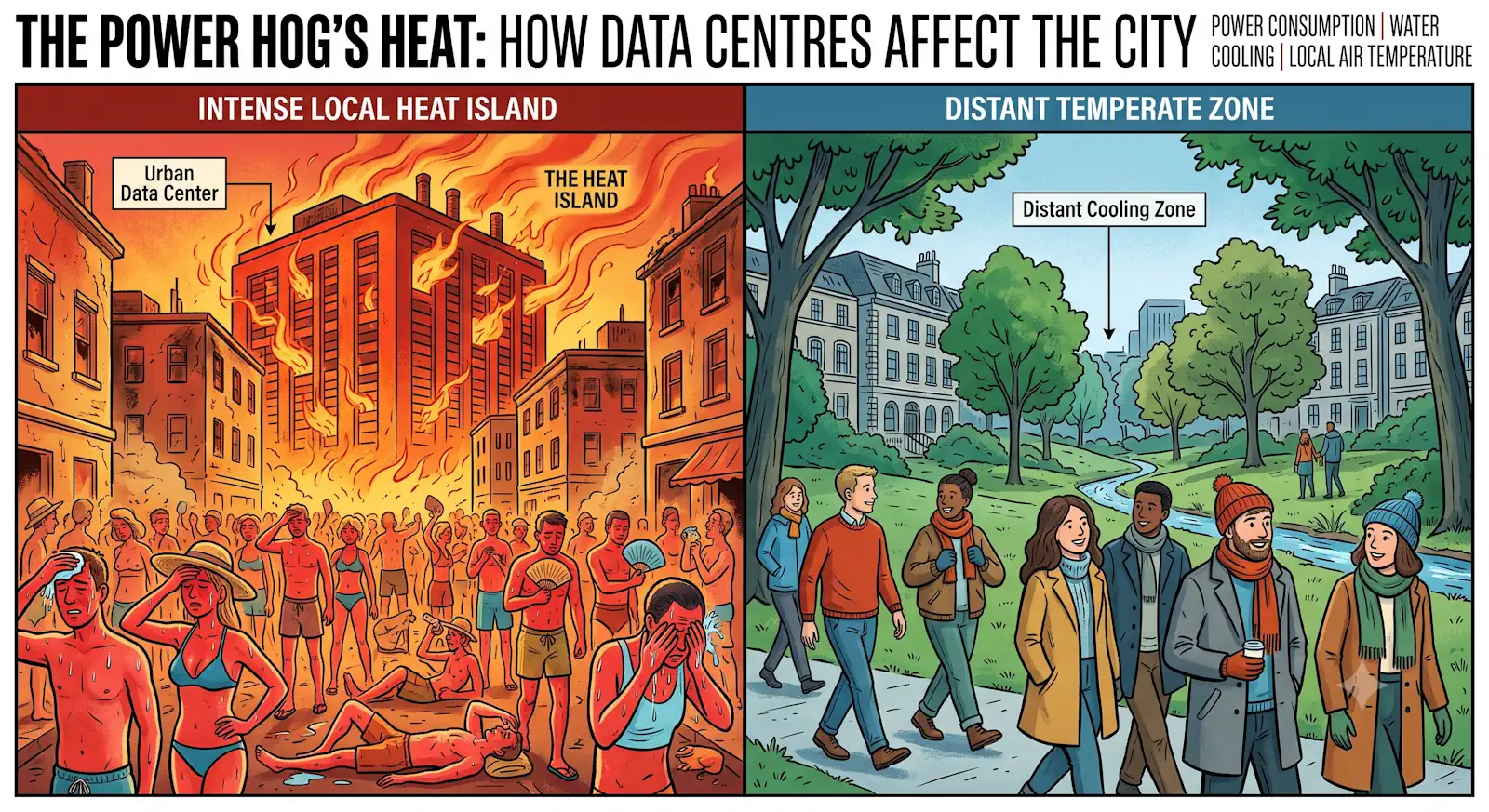
Data centres are making heatwaves hotter

You know where you don’t want to be during a heat wave? Next to a data centre – unless it’s this one colocated with a community pool.
Last week’s heat wave felt particularly painful to residents in Slough, UK, who are already suffering from record high temperatures. A Guardian story even referred to the data-centre filled town west of London as “an experiment” in life with AI infrastructure.
The report noted that Slough’s data centre hub ran a few degrees hotter than the rest of town during the heatwave, though added it was impossible to discern whether that was due to data centre equipment such as cooling or the well-known impact of heat islands called by concrete-filled industrial estates, but the current design of many data centres means they can cause both.
Residents of Slough aren’t alone. Concerns have been raised across Europe about waste heat emitted from data centres. Near Marseille, France, critics of a proposed data centre raised concerns about the impact of îlot de chaleur – or heat island – on neighbouring residents.
In Spain, activists have called out the dumping of calor adyacente – waste heat – into the local atmosphere rather than using it in district heating networks.
Similar complaints and campaigns have also surfaced in Frankfurt, Germany, and Zeewold, Netherland, with concerns raised about the waste heat released locally.
So what’s going on? Is the data centre effect real or a false alarm similar to protests around 5G masts?
The data centre heat island effect
On this occasion, it seem protestors are right to be concerned.
Researchers led by Andrea Marinoni at Cambridge University have found in a recent paper – pre-print, not yet peer-reviewed, more research is required – that AI data centres do indeed raise local temperatures.
“We estimate that the land surface temperature increases by 2°C on average after the start of operations of an AI data centre, inducing local microclimate zones, which we call the data heat island effect,” the paper noted, adding that the increase could be more than nine degrees.
The impact stretches for several kilometers around an AI hyperscaler’s data centre, the paper noted, and is consistent across data centres globally.
That’s a problem, as it means anyone living within that data heat island zone could see negative impacts in terms of their health and wider welfare. “We assess the impact on the communities, quantifying that more than 340 million people could be affected by this temperature increase,” the paper noted.
That will make heatwaves hotter, raise costs of home cooling, and perhaps even make those areas less liveable. This is particularly damning given that most data centres are located in areas of socioeconomic deprivation.
How to cool down a data centre heatwave
What can be done? For a start, require the use of smarter cooling systems that don’t exhale hot air at their neighbours. Even better, capture waste heat for reuse to offer free home heating to local residents – this is already technically possible, though it depends on local heating systems on how easy it is to implement widely.
Building design could also have an impact. Rather than big boxes surrounded by concrete, data centre companies could be required to install and maintain green roofs and plenty of tree cover, which can help reduce temperatures.
If adding greenery is too much, simply requiring roofs and pavements to be painted light colours or in reflective paint can have a noticeable impact. Cities should be doing this anyway, but they can also refuse to approve any data centre proposal that doesn’t include climate mitigation techniques.
These are small changes that any data centre company and its customers could implement without significant impact on their bottom lines. (Although beyond heat there are other concerning sources of pollution, including sound.)
Heatwave + Data Centres = Electrical meltdown
Such mitigations won’t address another data centre problem exacerbated during heatwaves: the high use of electricity.
The BBC reports that sales of home air conditioning units have rocketed to record heights, and that means a leap in power usage. And it turns out that when we humans get hot, so too do data centres, adding extra demand to already overstretched power grids.
It may be easy for most of us to ignore the heating impact of a data centre on those unlucky enough to suffer one as a neighbour, but it’s a lot harder to stay cool about this technology’s impact if it contributes to blackouts that knock your aircon offline on a 40C day.
“ChatGPT, how can I avoid heat stroke?”
More articles by Nicole Kobie
- UN calls on AI companies to stop hiding human costs of AI
- Remote work is bad for us – but that’s because we’re doing it wrong
- Workers don’t like AI – maybe companies should listen
About The Author

Nicole Kobie
NEXT UP