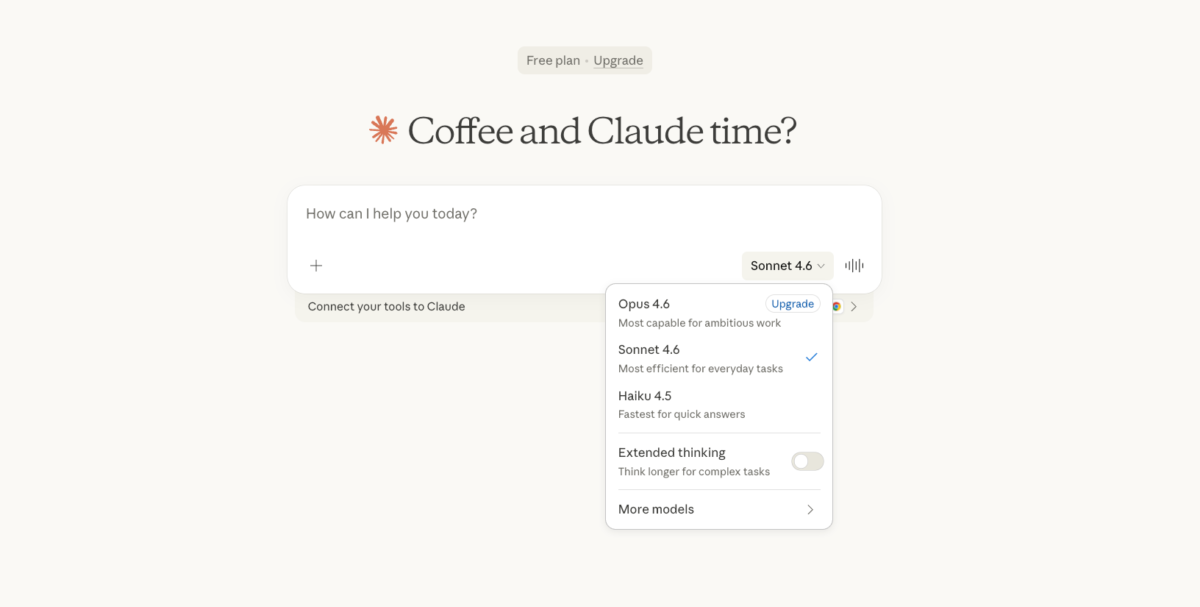
Anthropic has unveiled Claude Sonnet 4.6, promising its latest model is better at the awkward office tasks that companies might otherwise struggle to automate.
Claude was the first of the mainstream AI chatbots to introduce a model that could take charge of your computer in October 2024. The company admits that at launch it was “still experimental” and, at times, “cumbersome and error prone”.
It claims the newly released Sonnet 4.6 is much more adept at these tasks, seeing its score rise from 14.9% at the time of the launch to 72.5% for the latest model in the OSWorld benchmark, which measures the performance of AI computer use. It’s also a significant improvement on the score of 61.4% registered by the previous model, Sonnet 4.5.
“Early Sonnet 4.6 users are seeing human-level capability in tasks like navigating a complex spreadsheet or filling out a multi-step web form, before pulling it all together across multiple browser tabs,” Anthropic claims in a statement announcing Sonnet 4.6.
“The model certainly still lags behind the most skilled humans at using computers. But the rate of progress is remarkable nonetheless. It means that computer use is much more useful for a range of work tasks โ and that substantially more capable models are within reach.”
Demo of Claude Sonnet 4.6 office talents
The demonstration video above shows the types of tasks Anthropic claims the new model is capable of performing.
These include updating a shipping price for items on a website by automatically navigating its way through a bespoke CMS, changing brand colours in an email campaign, and checking if there are any flaws in the responsive design of a website.
Crucially, this capability isn’t tied to specific apps or integrations. Once Claude Cowork (a premium-only feature) knows the CMS/service you use for a particular role, it can navigate menus and make changes itself via a web browser.
“There are no special APIs or purpose-built connectors,” Anthropic states. “The model sees the computer and interacts with it in much the same way a person would: clicking a (virtual) mouse and typing on a (virtual) keyboard.”
Claude context window boost
Sonnet 4.6 is also getting a bigger context window โ the amount of information the AI can process in a single conversation.
Anthropic claims the new 1m token context window is big enough “to hold entire codebases, lengthy contracts, or dozens of research papers in a single request”. It also means the AI is less likely to forget information entered at the beginning of a long conversation chain.
Although Sonnet 4.6 doesn’t have the largest context window of the frontier GenAI models โ Google’s Gemini 3.1 Ultra can process up to 2m tokens โ it’s a sign that one of the biggest obstacles to doing serious work with the AI models is disappearing.
In particular, all of the leading models can now hold much lengthier conversations without having to drop sections or compress the data, sometimes with unpredictable results.
Sonnet 4.6 is available now in both paid-for and free tiers of Claude.
Barry has 25 years of experience working on national newspapers, websites and magazines. He was editor of PC Pro and is co-editor and co-owner of BigTechQuestion.com. He has published a number of articles on TechFinitive covering data, innovation and cybersecurity.
To provide the best experiences, we and our partners use technologies like cookies to store and/or access device information. Consenting to these technologies will allow us and our partners to process personal data such as browsing behavior or unique IDs on this site and show (non-) personalized ads. Not consenting or withdrawing consent, may adversely affect certain features and functions.
Click below to consent to the above or make granular choices. Your choices will be applied to this site only. You can change your settings at any time, including withdrawing your consent, by using the toggles on the Cookie Policy, or by clicking on the manage consent button at the bottom of the screen.
Functional
Always active
The technical storage or access is strictly necessary for the legitimate purpose of enabling the use of a specific service explicitly requested by the subscriber or user, or for the sole purpose of carrying out the transmission of a communication over an electronic communications network.
Preferences
The technical storage or access is necessary for the legitimate purpose of storing preferences that are not requested by the subscriber or user.
Statistics
The technical storage or access that is used exclusively for statistical purposes.The technical storage or access that is used exclusively for anonymous statistical purposes. Without a subpoena, voluntary compliance on the part of your Internet Service Provider, or additional records from a third party, information stored or retrieved for this purpose alone cannot usually be used to identify you.
Marketing
The technical storage or access is required to create user profiles to send advertising, or to track the user on a website or across several websites for similar marketing purposes.
To provide the best experiences, we use technologies like cookies to store and/or access device information. Consenting to these technologies will allow us to process data such as browsing behaviour or unique IDs on this site. Not consenting or withdrawing consent, may adversely affect certain features and functions.
Functional
Always active
The technical storage or access is strictly necessary for the legitimate purpose of enabling the use of a specific service explicitly requested by the subscriber or user, or for the sole purpose of carrying out the transmission of a communication over an electronic communications network.
Preferences
The technical storage or access is necessary for the legitimate purpose of storing preferences that are not requested by the subscriber or user.
Statistics
The technical storage or access that is used exclusively for statistical purposes.The technical storage or access that is used exclusively for anonymous statistical purposes. Without a subpoena, voluntary compliance on the part of your Internet Service Provider, or additional records from a third party, information stored or retrieved for this purpose alone cannot usually be used to identify you.
Marketing
The technical storage or access is required to create user profiles to send advertising, or to track the user on a website or across several websites for similar marketing purposes.