Trending Topics

 Trending
Big Tech vs Brussels: Why US states are demanding Google, Meta and Microsoft reject EU sustainability directives

Big Tech has been drawn into a new transatlantic battle over sustainability. In early October, letters were sent to Mark Zuckerberg, Satya Nadella and Sundar Pichai from the Attorneys General of 16 US states. The messaging within the near-identical letters was clear: Explain, within 30 days, how you will reject the EU’s “anti-American” CSRD and CSDDD sustainability directives.
It marked a dramatic escalation in Washington’s resistance to Europe’s attempt to standardise ESG and human rights due diligence rules across global value chains.
Behind the political theatre lies a deeper conflict over who sets the rules for the world’s digital and environmental future. Brussels, with its expansive regulatory reach, or a White House increasingly hostile to what it calls “climate radicalism.”
For US tech giants navigating both markets, neutrality may no longer be an option.
What are CSRD and CSDDD?
CSRD and CSDDD are two separate EU directives concerning how businesses report sustainability information.
2023’s Corporate Sustainability Reporting Directive (CSRD) aims to standardise ESG reporting throughout the EU. The previous framework had no formal reporting standard and limited scope to whom it applied. CSRD aims to improve the real-world reporting of ESG data, closing the loopholes that allowed for non-compliance.
The Corporate Sustainability Due Diligence Directive (CSDDD) is companion legislation to CSRD. It requires large companies to conduct due diligence on human rights and environmental impact within their own organisations – and throughout their supply chain.
We shouldn’t underestimate how ambitious both directives are in terms of their scope, nor overlook the resources required by organisations to comply. The EU has developed a framework to protect against human rights violations whilst tackling the negative environmental impacts of some businesses.
Why have CSRD and CSDDD upset The White House?
Although the CSRD and CSDDD are EU directives, they require companies to implement due diligence across their entire value chains. Essentially, the cost of doing business with an EU company may lead to a requirement to comply with CSDDD. Let’s use a theoretical EU-manufactured phone, the catchily named EUPhone, as an example.

Because the EU manufactures EUPhone, it falls within the scope of both the CSRD and the CSDDD. However, some EUPhone components (such as the battery and screen) originate outside of the EU. Their manufacturers must also comply with CSDDD as they’re part of EUPhone’s supply chain.
As this compliance requirement cascades along the supply chain towards raw materials, it simultaneously travels along the distribution chain towards the end user.
Setting aside the CSDDD’s environmental and social ambitions, companies face a complicated path to compliance. Recognising this, the EU delayed requiring member states to adopt CSDDD into national law. Whilst this played out in Europe, Donald Trump and the White House received a reminder that environmental regulation with the EU may have an impact on US trade.
Donald Trump vs the EU?
In September 2025, Donald Trump received a letter from James Uthmeier and John B McCusky, Attorneys General of Florida and West Virginia respectively, co-signed by 20 other state Attorneys General. The letter warned Donald Trump that:
“[CSDDD is really] a demand that ESG and DEI be incorporated into companies. Worse still, the CSDDD includes aggressive enforcement mechanisms; it allows for aggressive government enforcement – including through serious penalties – and also creates a private right of action against companies that do not fully implement these unconstitutional and immoral requirements.”
The CTA for Trump was to act swiftly to help companies that don’t wish to partake in ‘climate radicalism’ and those that ‘invest in or utilize fossil fuels’:
“To ensure these dangers do not come to fruition, we specifically ask that you direct the United States Trade Representative to oppose the European Union’s corporate sustainability directive.”
A few weeks later, the CEOs of Google, Meta and Microsoft also received stern warning letters from James Uthmeier and other Attorneys General.
The misguided policies of Google, Meta and Microsoft
Officials addressed the letters directly to Sundar Pichai, Mark Zuckerberg and Satya Nadella, maintaining a similar tone with subtle contextual differences. Each version references the company’s history on DEI (diversity, equity and inclusivity) and concludes (using Meta as the example):
“Bowing to the unlawful CSRD and CSDDD demands would be a return by Meta to these misguided policies and a step in the wrong direction.”
You can cut-and-paste Google and Microsoft’s names into the quote for the same result. DEI is currently under attack in the US for being a restrictive practice. The latest National Security Strategy, signed by Donald Trump, states:
“Re-instilling a culture of competence, rooting out so-called ‘DEI’ and other discriminatory and anti-competitive practices that degrade our institutions and hold us back.”
Like the CSDDD, DEI actively works to ensure fair treatment and full participation of people who have historically faced underrepresentation or discrimination. The White House decided that inclusion is unnecessary, and many Attorneys General have applied additional pressure on US tech giants to reinforce that narrative. The letters served for the Attorneys General to remind CEOs of big-tech that CSRD and CSDDD are ‘unlawful in the United States’.
Google, Meta and Microsoft have not publicly acknowledged the letters or made any statement if they will comply with its requests. What is particularly interesting is the timing of the letters. To understand why, we need to go back in time.
The EU Ombudsman and Omnibus I
In February 2025, the EU amended several EU sustainability laws via a package of proposals known as Omnibus I.
EU officials billed the Omnibus I proposal as a simplification of several sustainability rules, including CSRD and CSDDD, a move many businesses welcomed given complex value chain compliance.
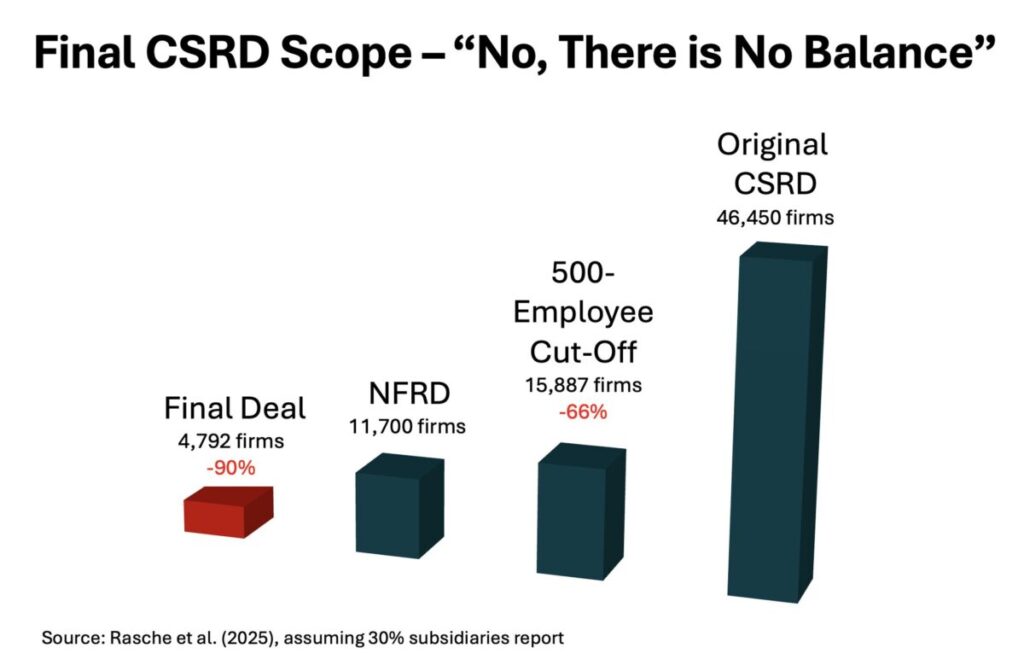
The simplicity measures also removed around 80% of companies from scope of CSRD and delayed reporting until 2028, which may not be a positive for ESG reporting to improve climate health, but is a kick in the bottom line for organisations which have already invested heavily towards compliance.
Stakeholders raised complaints about the proposed implementation of Omnibus I with the EU Ombudsman in April 2025. After an inquiry, the EU Ombudsman released a preliminary outcome at the end of November 2025 with a stern conclusion:
“Based on the three inquiries, the Ombudsman identified various procedural shortcomings in how the Commission prepared the legislative proposals at issue, which, taken together, amount to maladministration.”
October 2025: CSDDD under pressure
In addition, investigative reports have also surfaced which suggest that American fossil fuel companies, including Chevron, ExxonMobil and Koch, appeared to collaborate in order to dilute EU regulations. ExxonMobil’s CEO Darren Woods has publicly opposed the EU’s sustainability laws, calling them ‘bone-crushing’ and simultaneously paused €100 million investment in an EU recycling scheme.
In October, Reuters reported that Qatar warned the EU it could stop supplying LNG to Europe because the CSDDD poses risks to state-owned QatarEnergy.
Subsequently, the US Secretary of Energy and Qatar’s Minister of State for Energy Affairs sent a joint letter to the EU, requesting the removal of provisions they considered most damaging to the economy.
Also in October, the US Chamber of Commerce published a report criticising the CSDDD for attempting to regulate non-EU businesses, shortly before officials sent the three letters to Google, Meta and Microsoft.
October also saw another letter sent, this time signed by TotalEnergies and Siemens and co-signed by 46 CEOs calling for CSDDD. They also asked for a moratorium and revision of digital regulation, such as the Data Act and the AI Act. Several French companies have subsequently said that they didn’t sign the letter whilst other large multi-nationals have voiced support for CSDDD.
Viewed from one perspective, the October interventions may constitute a coordinated and targeted attempt to mobilise external pressure on the CSDDD process ahead of the EU’s Omnibus I vote on 13 November. Equally, they may be nothing more than coincidence.
PROTECT USA
Meanwhile, in the USA, a Washington senator has proposed the ‘PROTECT USA Act of 2025’. PROTECT being the acronym for Prevent Regulatory Overreach from Turning Essential Companies into Targets. The proposed bill aims to create a protected category for companies that are ‘entities integral to the national interests of the United States’ and they should not have to follow ‘foreign sustainability due diligence’ rules, such as CSDDD.
Although it is easy to frame these political protests as defiance against foreign-based bureaucracy, page 14 of the latest US National Security Strategy also removes any doubt about the importance of fossil fuels and the rejection of sustainability in the thinking at The White House:
“Restoring American energy dominance (in oil, gas, coal, and nuclear) and reshoring the necessary key energy components is a top strategic priority. Cheap and abundant energy will produce well-paying jobs in the United States, reduce costs for American consumers and businesses, fuel reindustrialization, and help maintain our advantage in cutting-edge technologies such as AI. Expanding our net energy exports will also deepen relationships with allies while curtailing the influence of adversaries, protect our ability to defend our shores, and—when and where necessary—enables us to project power. We reject the disastrous “climate change” and “Net Zero” ideologies that have so greatly harmed Europe, threaten the United States, and subsidize our adversaries.”
Whatever your position, a vast amount of lobbying has taken place. Some to protect commercial interests, others to curtail the huge administrative burdens of compliance and some to support groundbreaking legislation which aims to improve the health of the planet and protect the lives of its most marginalised inhabitants.
What next for CSDDD?
The Omnibus I proposals were provisionally agreed on 9 December 2025 and are scheduled to be put to a parliamentary vote on the 16 December 2025.
Whichever way the vote falls will be controversial. Introducing the ‘simplified’ Omnibus I package is seen by some as deregulation. Andreas Rasche, Professor and Associate Dean at Copenhagen Business School, points out that under Omnibus I, fewer firms and organisations are within the reporting scope of CSRD than its predecessor, the NFRD.
To quell suggestions that the EU had bowed to geopolitical interference from the US and Qatar, European Council President António Costa reiterated that allies ‘do not threaten to interfere with the democratic life or the domestic political choices of these allies’.
What’s clear is that this marks a difficult period for global tech firms such as Google, Meta and Microsoft, who do a lot of business in the US and Europe. All are driving the AI revolution, which, irrespective of technological capabilities, is responsible for a spike in energy production and increased carbon emissions. Technology and sustainability are inseparable in the AI era, but their relationship is more awkward than What Ever Happened to Baby Jane?
The Omnibus I compliance deadline has been pushed back to July 2029, which is an awfully long time in politics. It is safe to say that arguments about CSRD and CSDDD are far from over and it remains to be seen how Messrs Zuckerberg, Nadella and Pichai will react.
More articles by Lee Grant
About The Author

Lee Grant
NEXT UP