Trending Topics

 Trending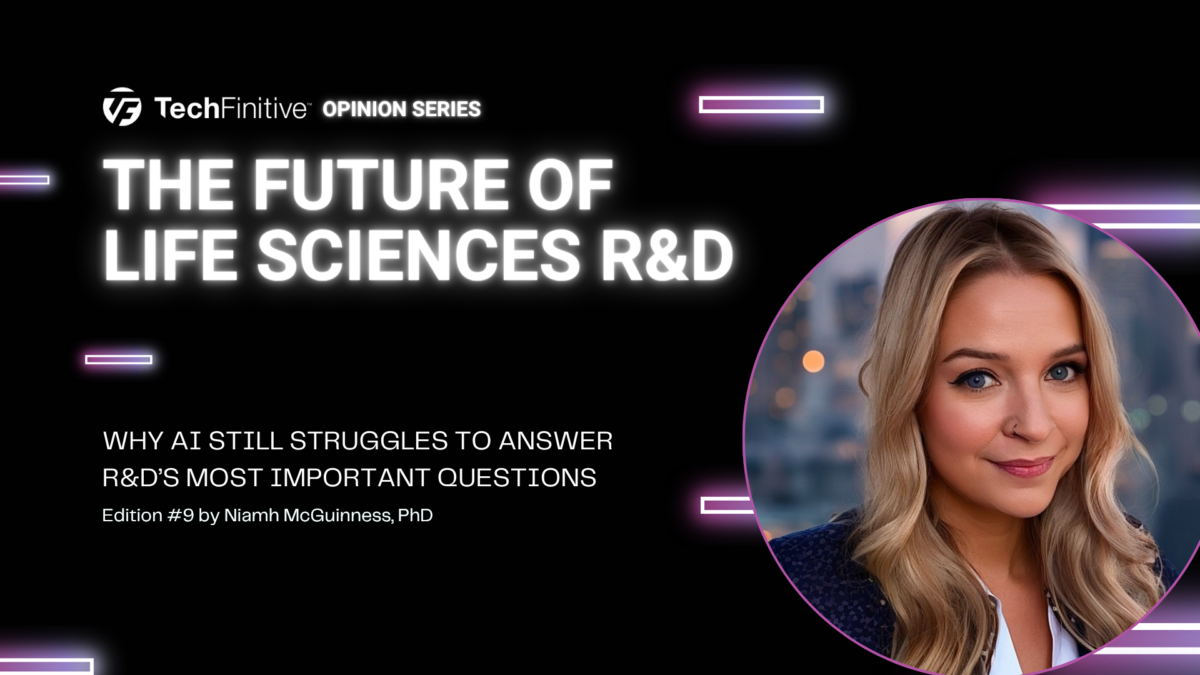
Why AI still struggles to answer R&D’s most important questions

As part of our new “The future of life sciences R&D” series, exploring how emerging technologies – from AI and digital trials to synthetic biology and advanced data platforms – are reshaping the future of drug discovery, clinical research, and scientific innovation, we invited Niamh McGuinness, PhD, Senior Director, Pharma Solutions, within IQVIA’s Applied AI Science organisation, to share her views.
Here, McGuinness examines why the success of AI in life sciences depends on the quality and structure of the scientific content that supports it. Drawing on examples from drug discovery and biomarker research, McGuinness explores how connected, enriched, and traceable scientific knowledge can help researchers move beyond faster answers towards deeper, more reliable inquiry and lay the foundations for the next generation of agentic AI in R&D.
Harvard biologist E.O. Wilson once famously said, “We are drowning in information, while starving for wisdom. The world henceforth will be run by synthesizers, people able to put together the right information at the right time, think critically about it, and make important choices wisely.” Although the quote dates to 1998, it remains highly relevant today. The life sciences industry has never had greater access to scientific knowledge. Every day, thousands of new publications, clinical trial updates, conference presentations, regulatory documents, and real-world evidence sources are added to the global scientific corpus. Artificial intelligence (AI) has emerged as a powerful tool to help researchers navigate this complexity: retrieving, summarizing, analyzing, and synthesizing scientific content at a scale far beyond human capability.
The persistent challenge of scientific complexity
However, AI has not eliminated the core challenge Wilson describes. While AI can generate answers rapidly, scaling reliable scientific inquiry across the R&D lifecycle remains difficult because the information needed to answer critical questions is often fragmented across disconnected sources, formats, and teams. This creates silos that make it difficult to connect insights across functions.
Many organizations attempt to address this challenge through scientific databases, publisher-specific tools, AI point solutions, or internally developed content repositories. While these approaches can solve individual needs, they often create new silos, require significant maintenance, or struggle to scale across teams, workflows, and content sources.
As AI is introduced into these environments, it encounters the same obstacles as human researchers: fragmented content, and inconsistent terminology. Different sources often describe the same scientific terms and concepts in different ways, making it difficult to consistently connect related evidence sources across the scientific landscape. As a result, many AI initiatives generate answers quickly but struggle to produce reliable, traceable outputs at scale. Answers may be based on incomplete information, and users often lack an easy way to verify the supporting evidence.
Building a foundation for AI-ready science
This reality is driving a shift toward AI-ready scientific content foundations that prepare information sources for consistent scientific inquiry across the enterprise. One example is IQVIA AI Scientific Navigator. It begins with hundreds of millions of documents, integrated from a wide range of scientific domains. Because there’s no limit to the sources that can be added, it can grow to encompass an organization’s entire scientific content universe. Organizations can augment public sources with IQVIA-exclusive content, proprietary sources, and their own private information in their own secure environment. Content is enriched using scientific vocabularies and document structure, helping researchers and AI systems consistently connect related concepts and evidence across sources while preserving traceability back to the original record. The result is less duplicated work, more reliable use of AI, and faster, more defensible scientific answers.
One biotechnology company used IQVIA AI Scientific Navigator to accelerate scientific discovery by enabling researchers to rapidly interrogate and connect evidence across the biomedical landscape. By reducing the time required to identify and evaluate promising targets, the organization shortened the average timeline between target identification and Investigational New Drug (IND) submission by three years. The achievement stemmed not simply from faster search, but from the ability to connect disparate evidence, uncover previously hidden relationships, and provide transparent, evidence-backed insights that researchers could act on with confidence.
Similar success was achieved at a Top 10 pharmaceutical company seeking to accelerate biomarker discovery in multiple sclerosis. Traditional approaches required extensive manual review of literature and supporting evidence to identify candidate biomarkers. Using AI Scientific Navigator, researchers systematically explored a broader body of evidence, linking disease and drug hypersensitivity findings across publications with their own genotypic database. This led to a 50% increase in biomarkers identified, creating more opportunities for future research while keeping each finding traceable to the supporting evidence.
The future of AI-augmented inquiry
These examples illustrate a critical point about the future of AI in life sciences R&D: the greatest value lies not in generating summaries or reducing reading time, but in augmenting scientific inquiry itself. Researchers need to evaluate competing hypotheses, identify evidence gaps, validate findings, and make decisions grounded in trusted sources. AI can accelerate each of these activities, but only when supported by a framework built on scientific rigor and transparency, underpinned by an enriched content foundation.
As organizations move toward increasingly agentic AI systems capable of conducting multi-step scientific investigations, enriched content foundations will become even more important. AI agents evaluating therapeutic targets, identifying biomarkers, assessing competitive landscapes, or supporting clinical development decisions require access to connected, trusted, and explainable knowledge. Without that foundation, even the most sophisticated models will struggle to produce reliable outputs at scale.
Organizations that invest in AI-ready scientific content foundations like AI Scientific Navigator will be best positioned to unlock the full potential of AI across the R&D lifecycle, empowering researchers to ask better questions, uncover deeper insights, and accelerate the path from scientific discovery to patient impact.
About The Author

Ricardo Oliveira
NEXT UP