Trending Topics

 Trending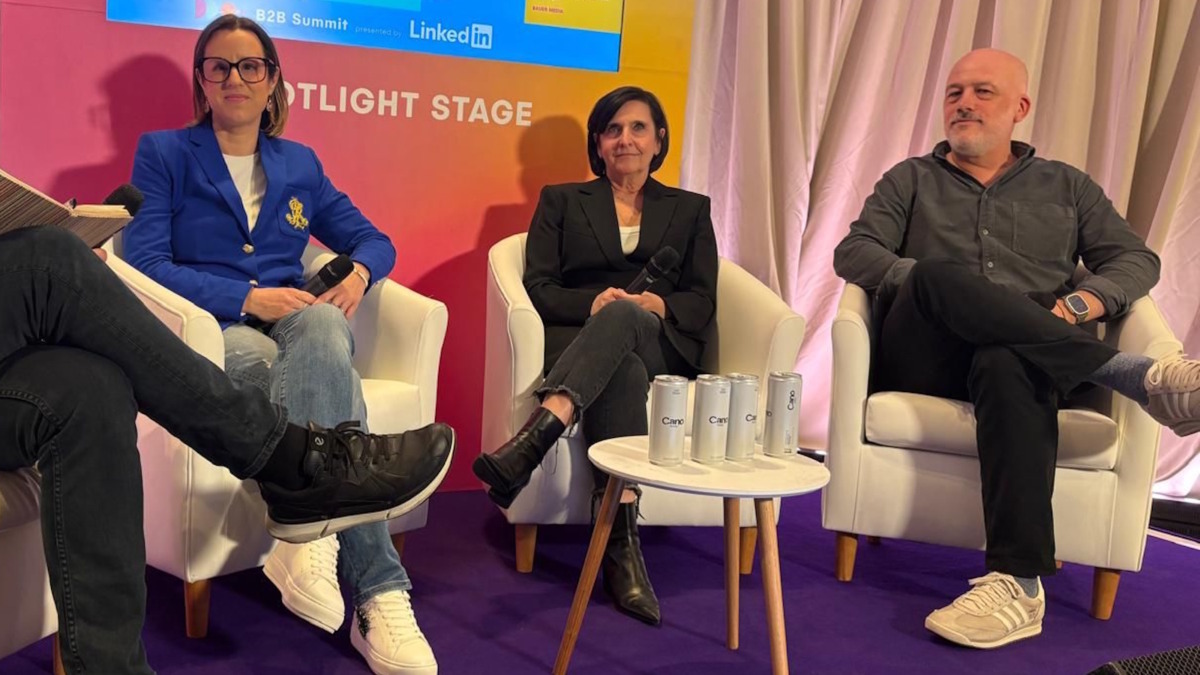
8 ways AI is rewriting B2B brand authority (and what Tom Cruise’s height has to do with it)

Every year, Advertising Week Europe brings together thousands of marketing, media, technology and creative professionals to discuss the biggest trends. Last year TechFinitive hosted a panel discussing how to deliver authentic marketing in an AI world. This year we went a step further: to delve into how AI is rewriting brand authority altogether.
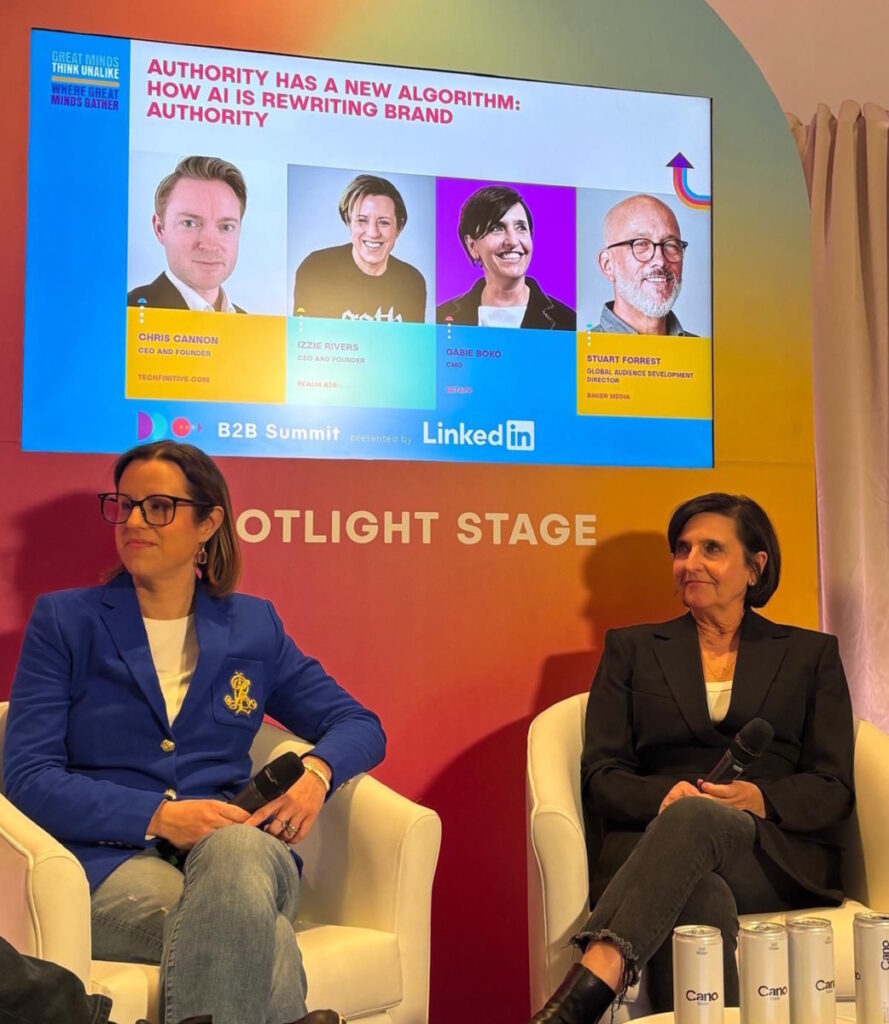
We invited three people with a range of viewpoints. Izzie Rivers is CEO and Founder of Realm B2B, who has driven transformative marketing programs for global brands. Gabie Boko, Chief Marketing Office of NetApp, who has spent over two decades in senior marketing roles for companies such as Sage, SAP and HPE. And Stuart Forrest, Global Audience Development Director of Bauer Media Group, a magazine publisher and audio broadcaster.
Here, we concentrate on eight themes that emerged from a session hosted by TechFinitive Founder and Managing Director Chris Cannon entitled “Authority Has a New Algorithm: How AI Is Rewriting Brand Authority”.

Focus on metrics that matter
Your traffic has fallen off the cliff. No-one wants to write blogs for your brand website anymore. Everyone is shouting about AI, including the board. But that doesn’t mean it’s panic stations, our experts say. You need to focus on the metrics that matter.
“You you have to look at those engagement metrics and then really tie them into an internal stack on the client side, where you can try and get to that CDP [customer data platform] or that individual-level understanding of what these people or accounts are doing and then how they’re moving through the funnel,” said Izzie Rivers.
It isn’t a new challenge but one that’s been ongoing for a decade, she added. “This is something people have been trying to solve for years, so it’s not a new problem that’s been brought up by AI in any way, shape or form. But really understanding what that critical path to sale is within the organisation and how bringing amplification in the top [of the funnel] is impacting that is important.”
As a CMO, Gabie Boko looks at the problem from an impact point of view. “What I’m doing is not just thinking of it as a tactic,” referring to the role of AI in brand discovery. “It’s actually changing the model. If you don’t change the model, then you’re just looking at a volume of content or a volume of scale or volume of data.”
She gave the example of switching approaches from SEO and attempting to “flood the LLMs” when you actually need to focus on the result. “I’ve really had to go back in and say, ‘What’s the model?’ Because if the model is broken, then throwing an AI or an algorithm on top of that is just going to give me the same old crap.”
Subject expertise matters now more than ever
“There is overwhelming evidence… that expert content is absolutely crucial for the value of LLMs to consumers,” said Bauer’s Stuart Forrest. “But at the moment, LLMs pay for two of the three things that make their product valuable. They pay for silicon. They pay for power. They don’t pay for content. And that is something which as an industry is existential for us.”
But if there’s a silver lining it’s that this expertise, whether from in-house experts or journalists, still has value. “We’re no longer in a world where there’s a premium just on creating content,” said Stuart. “That’s no longer a motive for anyone. So actually, you know, in amongst all this slop, I think consumers in a B2B or B2C context, will lean further into genuine expertise.”
“Consideration phase” traffic has been decimated: stop chasing rainbows

It has always been a challenge to drive consumers – B2B or B2C – to a brand website, said Realm B2B’s Izzie Rivers, and now it’s even tougher. “The consideration phase has been shortening and shortening for years anyway, then along comes LLMs and AI, and they’re now eating into that share.
“At the beginning, I remember about a year and a half ago, we thought well this will just be about a 30% attrition,” she added. “And then I was seeing 80% traffic loss in some places. Then I remember the narrative was ‘but only in top funnel pain points’, right? People that are looking for overall technology issues or overall finance issues. We’ll be fine because we answer the real deep pain points as to why somebody might need a piece of technology.
“No. LLMs are disrupting long-tail search because people are looking for really in-depth responses on things,” said Izzie. “The answer for us is very much in, how are you putting your brand out there in better content to be more discoverable in other environments as well as LLMs, not just in LLMs?”
Write for people AND for machines

Stuart Forrest had a similar view, but this time from a publisher’s standpoint. “My message to my journalists is always, you have two core jobs. You have to optimise for the machine, which determines whether you appear in front of your consumer. And then you have to optimise for how the consumer is going to experience it, so that they engage with it.”
This remains true, he added, whether you’re writing impactful coverlines for magazines on sale at the newsstand, for Google search or now for LLMs. “I think the thing we’re trying to get inside is, from a consumer perspective, what’s the point at which they’re prepared to accept that synthesized answer [from an LLM] and see that as sufficient? And, what’s the point where they actually want to continue and engage with that content further? That’s where we need them to be to continue to help businesses.”
Consider a bookend strategy
One side effect of AI is that it’s creating “a bookend opportunity for the brands, at least in tech and B2B, which becomes super personal” said Gabie. “We can’t host enough live events [now].”
She points to the “broad live events that happen top of funnel”. These give people the chance to educate themselves about the product or company, and work out whether or not they’re interested in gaining more knowledge. “And then we’re able to bookend that with a demo, another live [event] or something else.”
In other words, the “surge of AI”, to use Gabie’s phrase, is creating an opportunity, because people want the authenticity of a live experience. “That’s a big shift for us because in the era of digital, you as a marketer got rid of live events, right?
“You thought, ‘I can solve everything this way’, but now I can’t solve everything that way. So I have to go put money in the live experience.”
This does bring challenges, because you need to know where to invest your budget. “I have to make sure that… my brand experience doesn’t die in the middle,” said Gabie. “And it’s complicated because my budget doesn’t allow for that. Am I optimising in the middle? Am I optimising at the top? Or should I optimise at the bottom of the sales team? So, it’s really an interesting shift, and that’s why I say it’s kind of back to the 1990s, 1980s when you had to be in all those places.”
How tall is Tom Cruise vs what film should I watch this weekend…
Building on Stuart Forrest’s point, Izzie Rivers said it boils down to “active intent”. “You’re not going to ChatGPT because you want to read a thoughtful piece of journalism”, she said. The trick for brands is to insert themselves when the reader, watcher or listener is nearing the point of engagement.
“There’s a very strong link, I think, between what I would characterise as the consequence of inaccuracy and whether somebody’s prepared to go on,” agreed Stuart. “If I want to find out how tall Tom Cruise is, I’ll probably just accept the answer which ChatGPT gives me. But if I really want to know what is the best Tom Cruise movie I could watch this weekend – this is not a B2B query, I realise – then that person’s still going to go on to one of our entertainment websites.”
For Izzie, coming from a paid media perspective, everything boils down to value. ” I don’t think we’re necessarily losing that traffic because when we come to the stage of the consideration funnel, where someone wants to engage with a brand. They want the information from the brand. They don’t want chat GPT telling them the wrong cost for a piece of tech, or seeing what the comparison is with other competitors. So, to keep valuable traffic, there’s a better way of engaging them on there. But when it comes to the more awareness and top level engagement things, I think that’s where we’re seeing attrition.
It might be time to “blow up” your brand website
There were long-standing rules on the mix of content on brand websites, but that has changed. And it may be time to be radical. “We’ve discovered that we can’t change [our brand website] in pieces,” said NetApp’s Gabie Boko. “We actually have to blow it up and start over.”
That’s because what used to work may not do so anymore because, in the age of AI, it no longer drives traffic. The questions it used to answer are now solved by AI summaries. “We tried it the easy way, the fast way, doing pieces, experiment, run fast,” said Gabie. “That’s not going to get us very far. So now we’re like, all right clean sheet of paper. Where does this go and how do we get out in front of it?”
“Scratch the blog,” said Izzie Rivers. “It takes too long. You need people to actually [write] it.”
And one more thing: “People don’t go to our website to read our perspectives on paid media, as much as I would like them to,” said Izzie. “But people are consuming things in short bursts on social media.”
Final thought
So if we were to distil these eight themes into one key takeaway from the briefing, what would it be? “I think it’s clear that everything is changing at an unprecedented rate,” said TechFinitive MD Chris Cannon. “But it’s also clear that authority and credibility should always be a priority. Get that right and the rest will follow.”
About The Author

Tim Danton
NEXT UP


