Trending Topics

 Trending
What you need to know from the Lenovo/IDC CIO Playbook 2026

Lenovo and IDC have just published their third CIO Playbook for Europe and Middle East (EMEA). Titled “The Race for Enterprise AI”, it promises insights based on interviews with 800 IT and business decision-makers, but if there’s one insight we can immediately share it’s that it’s 57 pages long. So consider this the short version, based on both the playbook and a briefing session with an IDC researcher and Lenovo experts.
Before we delve into our take, there are three attention-grabbing findings from the report. First, that almost half of AI proof-of-concepts have progressed into production; the exact figure is 46%. Second, that organisations expect returns of $2.78 for every dollar invested.
Yet we are still at the beginning of this race for enterprise AI, it seems, with only 16% of organisations using agentic AI significantly as of today. Over half, 54%, are still exploring or piloting use cases, which leaves three in ten yet to join the agentic AI race.
As this is a CIO Playbook, IDC has also drawn out “strategic imperatives” based on its research:
- You can’t ignore enterprise AI: it has become a “core engine of business performance”
- Positive ROI drives AI investment… and AI investment is now happening at scale
- Hybrid, secure and integrated environments have become an essential standard for enterprise AI
- It’s increasingly necessary to build trust and governance if you want your AI deployments to scale
- Agentic AI has emerged as the next step in workflow automation, but again it requires control mechanisms
We touch upon most of these topics in this article. But without further ado, here are our takes from the report and the briefing.
Hybrid AI is becoming the default model
The simplest way to run AI services is to use the public cloud. However, if one thing is clear from this research it’s that CIOs are moving away from this and to infrastructure they can control.
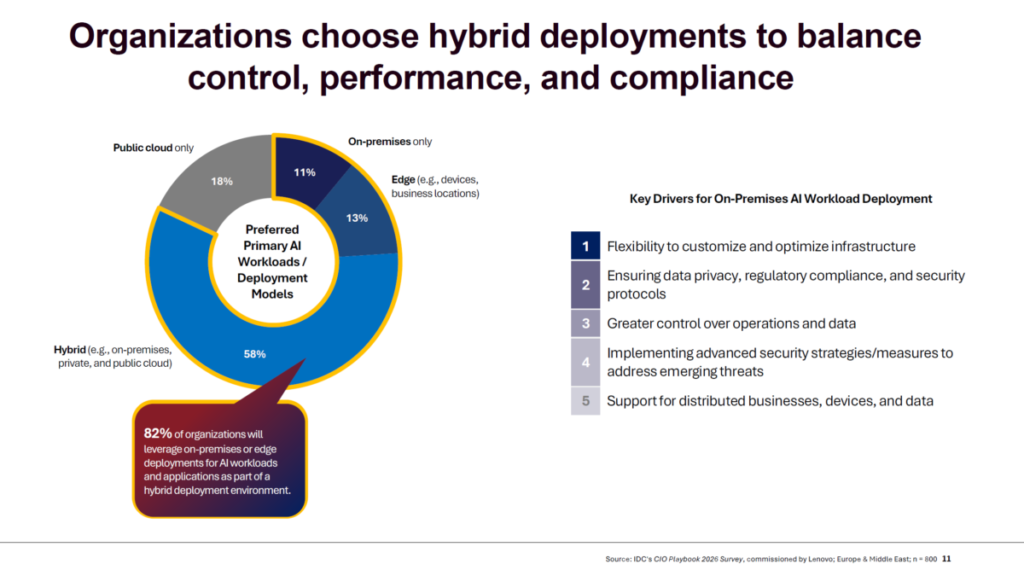
“You can see here [the slide above] that 82% of companies say that when they think about running AI workloads, they are looking for anything that is hybrid, on prem edge,” said Ewa Zborowska, Research Director for AI, IDC Europe.
“So pure public-cloud-only Infrastructure to run AI is not necessarily the first choice,” she added. “And it is a little bit like when you think about cloud use in general. Customers are very much aware that cloud is okay when you want to test and develop, when you want to learn things, but once you go into production, you look at your applications, you look at your workloads, and you decide where it makes most sense to run it.”
The answer, with a 58% return, is that hybrid AI is the number one destination.
Enterprise AI is moving from curiosity to business changer
Zborowska said that before the briefing, she had looked at the CIO Playbooks from 2024 and 2025 to get an idea of what had changed. Before, enterprise AI was more about “let’s play with it, let’s test and develop… maybe we set up a team of people who will try to do it”.
In the 2026 CIO Playbook, she explains, there’s a very different attitude. “Today, it’s one of the technologies that really has this potential to change how we operate and how we do business. So we want to do it not just out of curiosity: we want to do it because we really want to see what we can get out of it in terms of growing business.”
And this isn’t about driving efficiencies or cost cutting, she said. “It’s much more what new things we can do, or how can we do what we do in a new way that will also create additional value?”
Which leads on to our next point…
AI is changing the way CIOs are perceived
As part of its research for the CIO Playbook 2026, IDC performed a number of face-to-face interviews with CIOs. Interviews that not only confirmed the way that AI is already changing the ways businesses work, but that also confirmed its “impact on how they [CIOs] are perceived within the company,” said Zborowska.
That’s “because they are perceived as a partner for business, not someone who makes sure that, you know servers are working and email is okay”.
We suspect that importance is only going to grow.
FOMO is real: Your rivals are moving into production rather than proof-of-concept
If you’re currently running proof-of-concept pilots that never transition into full production, then it’s time for FOMO. According to IDC’s Ewa Zborowska, your rivals are transitioning fast.
“We see that almost half of proof-of-concepts transition into production,” she said. “And you may think half is not that impressive. I can tell you, a year ago, it was 10% and back then, we discussed whether 10% is a success or not.”
Luckily that question is now moot. “So now having half of proof-of-concepts of pilots turned into production, I think is a very nice improvement, and also a piece of evidence that we are moving from just trying into really putting [enterprise AI] into production.”
Shadow AI remains a real danger: keep your employees engaged
The thing about shadow IT in any form is that it’s so difficult to track. But we know it’s a problem, and we know that shadow AI is not only costing organisations money but also putting their security at risk. What to do about it?
One answer from the CIO Playbook is to create “secure experimentation environments”. This goes hand in hand with having oversight of what employees do with AI, and establishing guardrails.
“You can never be too careful,” said Zborowska on the subject of security, “but being careful and putting rules in place need to go hand in hand with how you work with, for example, your employees, because they need to be your partner in this.”
Otherwise, she warns, people will think “you’ve done too much and they try to go around your rules”.
What Lenovo would love you to take away from the CIO Playbook 2026
Let’s not be innocent. Lenovo commissioned this report because it aligns with its commercial interests: encouraging enterprises to invest in AI infrastructure. Ideally infrastructure that Lenovo supplies.
“Earlier this month, at Tech World in Las Vegas, we shared how Lenovo is accelerating enterprise AI beyond experimentation and into production and doing it at scale,” said Alberto Spinelli, CMO EMEA for Lenovo in the briefing.
“So we introduced Lenovo agentic AI services, which are designed to help organisations move from isolated automation to controlled enterprise-grade agents. And these services are focused on exactly what CIOs are asking for today. So governance, human oversight, lifecycle management and the ability to scale agentic AI responsibly across all their day-by-day, real business processes.”
Lenovo also announced its partnership with Nvidia to build AI Gigafactories at Tech World, added Spinelli. “This is about giving enterprises faster access to the compute architecture and expertise that they need to build and run AI, whether that’s training, inferencing, agentic workloads – and doing this without having to start from scratch.”
And he believes this reflects “a simple reality” that enterprise AI needs “industrial scale foundations and not just bespoke one-off builds”.
Finally, said Spinelli, there’s Lenovo xIQ, also launched at Tech World in January. “[This] is our intelligent management layer that helps enterprises to optimise performance, reliability and energy efficiency across all the increasingly complex AI environments, because at-scale AI success isn’t just about models, but it’s really about how well the entire system is operated, secured and optimised over time.”
If you want to read the whole report, head here.
Related articles
About The Author

Tim Danton
NEXT UP


