Trending Topics

 Trending
SpaceX IPO makes Musk the first trillionaire, thanks to your pension funds

SpaceX’s IPO may have broken records and made Elon Musk a trillionaire (on paper) but there are already fears that the company could be overvalued.
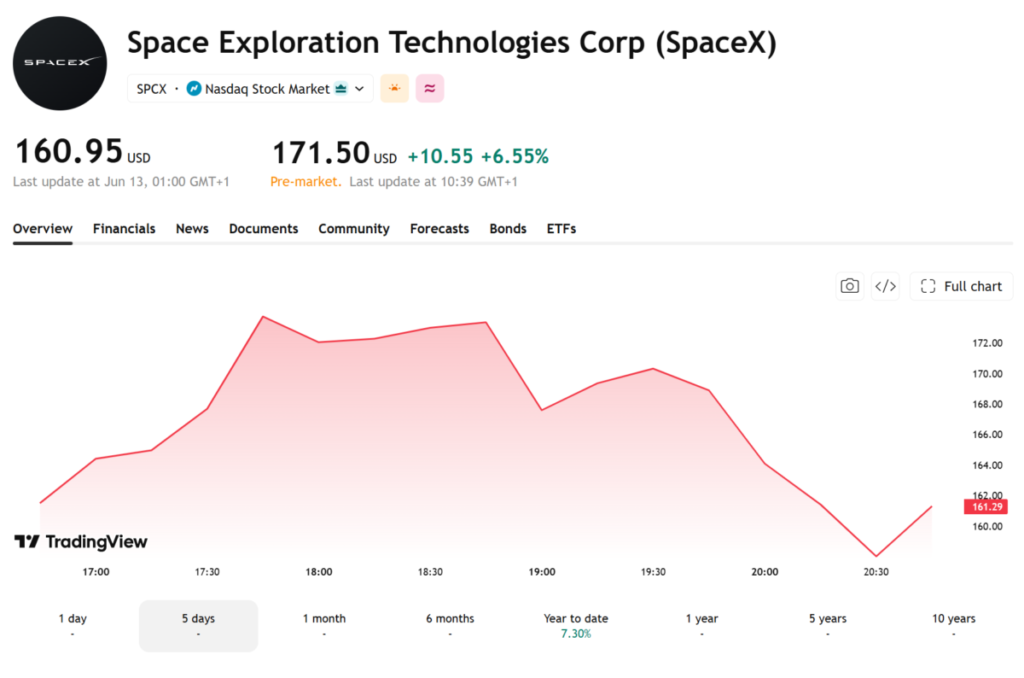
On the first day of trading, SpaceX stock rose 19% from its IPO at $135 a share to almost $161, raising $75 billion in capital. This despite the fact that two out of the three arms of the company are making heavy losses.
Understanding SpaceX IPO
According to the SpaceX S1 filing with the US Securities and Exchange Commission the company now has three parts.
Space, covering its rocketry business, AI and Connectivity aka Starlink. Of these, only the latter is actually making a profit, around $4.4 billion last year.
During that same year the Space division lost $4.9 billion, and another $4.3 billion in the first quarter of 2026 alone. Meanwhile AI has burned through over $6 billion, and is still well behind OpenAI and Anthropic in terms of adoption.
Musk’s plans, as the pre-IPO filing elucidated, aren’t short on ambition.
“Our mission: To build the systems and technologies necessary to make life multiplanetary, to understand the true nature of the universe, and to extend the light of consciousness to the stars,” it states.
More prosaically, his Space business wants to fire AI data centres into orbit and couple those with Starlink to feed data between low-Earth orbit and the surface. The next step is Mars, a planet Musk originally predicted his company would land on by 2018.
“I am accumulating resources to help make life multiplanetary and extend the light of consciousness to the stars,” he said five years ago, echoing the language in the S1 filing.
“Elon promises”
These are what’s known in Silicon Valley as “Elon promises.”
He predicted that by 2020 there would be a million fully automated robotaxis on America’s streets; currently there are a few hundred and they still require human overseers. They also have a less than perfect driving record, compared to rivals like Waymo.
Nevertheless, the IPO was oversubscribed and the price rose accordingly – incidentally making some staff very wealthy, not just Elon.
This was helped by the fact that NASDAQ relaxed its rules to allow SpaceX to be listed on index tracker funds – used by most pension providers – much earlier than is usually the case.
The venerable S&P declined to do the same, so your retirement money won’t necessarily be going into SpaceX as quickly.
SpaceX IPO: Should you back it?
It’s possible that taking a punt on SpaceX shares will pay off.
Under the steady hand of President Gwynne Shotwell, the company has revolutionised the orbital delivery business by making reusable rockets work. Something NASA and Arianespace can’t do. And it’s the only American player in town, as Jeff Bezos’ Blue Origin startup is still suffering problems.
However, financial analyst firm Morningstar thinks that SpaceX stock is massively overvalued. It reckons the real price should be closer to $63 per share.
But that probably won’t bother Musk since his control of the company is absolute. While he owns less than 50% of the shares, the voting system behind them means he has a level of control over the company similar to Mark Zuckerberg at Meta.
Ultimately, Musk’s vision of a multi-planetary civilisation and a space-based economy is a good one. But as a short-term investment, SpaceX is going to have some rocky times ahead, particularly if there are more rapid unscheduled disassemblies of its latest rocket platform:
Related articles
About The Author

Iain Thomson
NEXT UP