Trending Topics

 Trending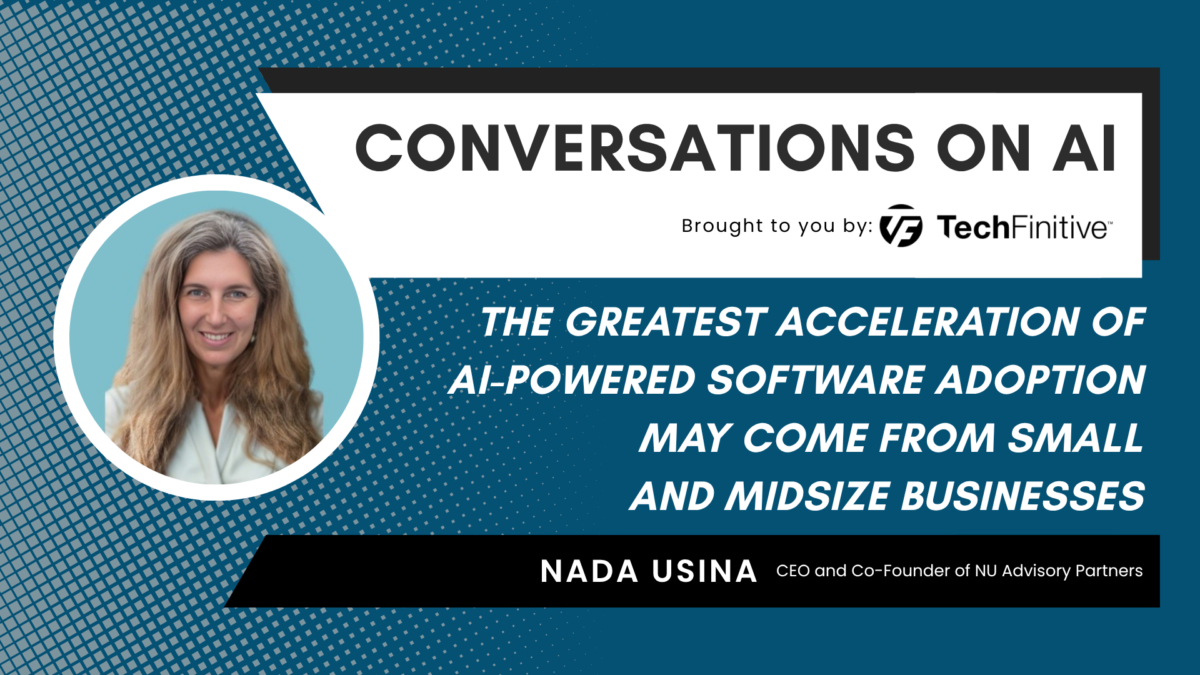
Nada Usina, CEO and Co-Founder of NU Advisory Partners: “The greatest acceleration of AI-powered software adoption may come from small and midsize businesses”

Nada Usina has spent most of her professional career helping leaders navigate change. Four years ago, having built up experience and expertise spanning technology, sports, entertainment, digital media and industry, she co-founded NU Advisory Partners, an AI-native executive search and advisory firm.
Nada sees a clear divide between where AI is creating something genuinely new and where businesses are using it to merely replace what already exists. With AI enabling “entirely new categories of products,” for example, she believes product development is being significantly undervalued.
When it comes to the software already embedded in large organisations, Nada adopts a more cautious approach. Having conducted over 100 AI training sessions, she says most companies are testing new options whilst continuing to use their pre-existing systems. Replacing those systems is therefore not a simple technology decision, but “a classic change management exercise”.
That slower pace may present an unexpected advantage for some, Nada argues, claiming “the greatest acceleration of AI-powered software adoption may come from small and midsize businesses”. As many such companies never adopted costly enterprise software in the first place, they have fewer systems to replace and fewer layers of change to navigate. Nada believes that this may allow them to move more quickly into AI-powered systems.
But as Nada reveals in our interview, she remains sceptical that many companies are using AI as a marketing label rather than a fundamental part of their product. Her starting point is to ask a straightforward question: “If you removed it, would the product break or become meaningfully worse?” If the answer is no, she argues that AI may not be delivering much beyond the surface level. Ultimately, she argues, AI should be able to handle increasing demand as the business scales. Otherwise, the technology may be doing considerably less than its marketing suggests.
The question, then, is where can we see AI’s impact, and where are people getting ahead of themselves? We asked Nada where she believes AI is being underestimated, and where it may be doing little beyond its marketing value.
Everyone says AI is transforming software, but where do you believe the industry is still overestimating its impact and where is it underestimating it?
When you break down the different aspects of how companies are using software, we can better see where the AI impact is being underestimated vs. overestimated. There is the front-end facing product development, where there are groundbreaking new engineering and innovative offerings being brought to the market. Some of this software is so far advanced thanks to AI that it is creating entirely new categories of products and I think this area is being underestimated.
Then you have the internally-used software tools powering workstream capabilities within an organization, from expense management to CRM systems. This is where we are overestimating AI’s impact in thinking that companies are simply dropping the old for the new.
At NU, we have conducted more than 100 AI trainings where we work closely with top board members and C-Suite leaders on how to best implement AI, and what we frequently see is that most are testing several new options, but always while continuing to use their existing systems. This is a classic change management exercise, and AI-powered software adoption that impacts the operations within will typically move more slowly in large enterprises.
The greatest acceleration of AI-powered software adoption may come from small and midsize businesses. Many were never heavy users of enterprise-grade software, so AI could allow them to adopt capabilities that were previously too expensive or complex.
Many SaaS vendors now describe themselves as “AI-powered.” What actually separates companies creating real customer value from those simply adding AI features?
First, look at whether AI sits on the critical path to the customer outcome. If you removed it, would the product break or become meaningfully worse? When the answer is yes, AI is more central to what the company has built. If the product doesn’t get worse without it, the AI-powered label probably says more about the marketing than the customer experience.
Second, I would look at what happens as more customers use the product. Each interaction with the model or system should help improve the experience or make the product more useful. Over time, that creates a proprietary data flywheel and a real advantage. That is very different from shipping an AI feature once and allowing it to sit there unchanged.
Third, the economics should begin to reflect the technology as well. As customer volume grows, an AI-powered company should be able to handle more of that growth without adding people at the same rate. If every new customer or increase in volume requires the same amount of human support behind the scenes, AI is probably doing less of the work than the company claims. The margin improvement may take time, but leaders should be able to show how the model changes as the business scales.
If you were launching your company today with AI available from day one, what would you build differently?
I did, in fact, recently launch my own company: NU Advisory Partners is an AI-native executive search and advisory firm specializing in senior executive, operating, and board roles. Part of our timing was driven by the opportunity we saw in generative AI and how it could improve executive search, which is a legacy industry with outdated and inefficient models that hasn’t changed in 50+ years.
Even so, the advances over the past three years have gone far beyond what we could have predicted when we started. AI has changed how we operate on the back end, how we gather and assess information, and how quickly we can deliver strong outcomes for clients.
To best leverage these rapid shifts, make sure to build flexibility into your technology and operating model rather than relying too heavily on any single large language model or platform. At NU, we make agility part of the team’s responsibilities, encouraging everyone to test new tools, question existing processes and share what works. That mindset has been just as important as the technology itself.
The biggest lesson from building an AI-native firm is that there is no finished version of the company’s AI strategy. The capabilities will continue to evolve at an unprecedented pace. Leaders launching companies today need to create teams and systems that can evolve with them while staying focused on where the technology genuinely improves the work and the client outcome.
How is AI changing the role of your customers? Are you replacing repetitive work, augmenting decision-making, or fundamentally changing how people do their jobs?
AI is changing the role of our customers in several ways. One major change is that AI is replacing repetitive and time-consuming tasks that were often handled by very talented researchers or analysts whose time was better suited for deeper thinking tasks. AI can gather and organize a much broader set of information in far less time, but it still requires critical thinking from the people with hands-on experience asking the questions and interpreting the results. The quality of the outcome depends heavily on knowing what to ask, understanding the context and recognizing where the data may be incomplete.
For our team, the time saved through AI allows us to focus more of our attention on the higher-touch, customized aspects of executive search. If we receive a strong briefing from a client, it should not take eight weeks to identify the relevant candidate pool. We can get to that view much faster and spend more time on the more human elements like understanding the individuals within it, evaluating fit and advising the client through the decision.
Customers who receive an ongoing service need to be prepared to respond to the data with greater clarity and conviction. For example in our industry, if the data tells us there are only a handful of people who match what they are asking for, they need to be ready to act on that information. They may decide to move quickly or rethink parts of the brief. We can have that conversation much earlier now. It gives the client more confidence in the choices they are making and helps us reach those decisions faster.
We have also used AI throughout our administrative infrastructure, which has helped us operate with lower overhead. That efficiency ultimately gives our team more capacity to focus on the work that requires judgment, experience and a close understanding of the client.
Beyond productivity gains, what business outcome are your customers most excited about when they invest in AI?
Productivity gains are still at the center of what excites most of our clients about AI, but productivity means much more than simply completing the same task in less time. They are looking at the return on their investment, how their people spend their time now, how quickly the business can grow and what that growth could mean for the company’s valuation.
The outcome they care about most depends on the business. For one company, it may be giving employees more time to focus on customers or solve difficult problems. For another, it may be reaching the next stage of growth sooner because the team can evaluate information, test ideas and make decisions faster. Take healthcare for example, where the potential is much more tangibly life-changing. Those leaders are exploring whether AI can accelerate research, lead to earlier and more accurate diagnoses, improve patients’ lives and bring us closer to curing diseases.
Across industries, our clients have an unprecedented amount of enthusiasm about the prospect of delivering better outcomes for the people they serve. The real measure of success is whether the technology advances the company’s larger mission by meaningfully improving people’s lives.
If you could give one piece of advice to another SaaS executive planning their AI strategy today, what would it be?
My advice would be to embrace AI fully and invest far more in training than you think you will need. That applies to employees, customers and anyone else who will be affected by the tools.
Every meaningful change requires training, but the pace of AI development makes this moment different. People are being asked to learn new systems while those systems are still evolving. Training has to be ongoing, practical and closely connected to how people actually work. Teams need time to use the tools, ask questions and understand where they can make the biggest difference.
That education should also extend beyond the technical team. Someone in sales, finance, operations or customer service may find an entirely different use for the same technology. If only a small group understands what the tools can do, the company will miss many of the opportunities AI creates.
The same is true for customers. A strong AI capability has limited value if customers do not understand how to use it or how it fits into their business. SaaS leaders should treat customer education as part of the product experience and devote real time and resources to it.
The topic of the rise of the Forward Deployed Engineer role comes up frequently with our clients. This ties directly into the trend we’re seeing where the companies that get the most from AI will be the ones that bring their people and their customers along with the technology. Full immersion, supported by continuous training, gives the company a much better chance of getting the best from the technology and the people using it.
If you enjoyed this interview, you’ll love these Opinion pieces
About The Author