Trending Topics

 Trending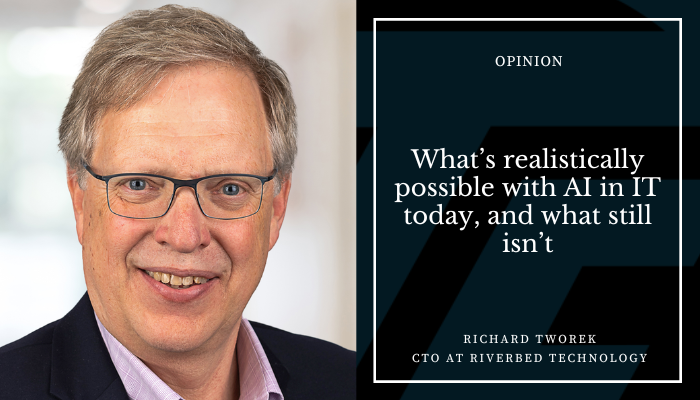
What’s realistically possible with AI in IT today, and what still isn’t

This article is part of our Opinions section, where we invite industry professionals to share their views on the most pressing technology questions of our time. Here, Richard Tworek, Chief Technology Officer at Riverbed Technology, explores what AI can realistically achieve in IT operations today and why many organisations still struggle to realise its full potential.
You will learn how fragmented visibility, siloed data and incomplete operational context limit AI effectiveness, despite growing investments in automation and analytics. The article highlights the importance of unified observability, data quality and real-time telemetry as the foundations for moving from AI-assisted operations toward more autonomous, self-healing IT environments.
Is artificial intelligence working for you? For many, AI is already improving IT operations by helping teams identify anomalies faster, correlate signals, prioritise incidents and automate repetitive workflows. In the right environments, AI can significantly reduce investigation time and improve operational efficiency.
However, AI struggles to act reliably when it lacks complete, trusted context. In most enterprise environments, fragmented data and incomplete visibility across devices, applications, and networks prevent AI from seeing the full picture. As a result, AI can assist teams with insights, but it cannot consistently act with confidence or autonomy.
Crucially, the quality of AI outcomes will always depend on the quality of the underlying data. In other words: “Enterprises are not short of models, copilots or agents. They are short of the operational foundations needed to make those tools useful.”
This lack of actionable data leaves a gap between what AI is capable of in theory and what it can reliably deliver in practice. Overcoming that shortcoming by implementing better data foundations is the only way to ensure AI investments fulfil their operational potential without demanding ongoing human involvement.
Where AI is already delivering value
Despite these limitations, AI is already proving its value in practical, operational ways. As it stands, the most effective AI initiatives target the acceleration, correlation and prioritisation of digital issues – areas of a business where finding faster fixes can directly influence productivity, performance and the calibre of digital experiences.
For instance, because AI is far quicker at analysing large volumes of telemetry than humans, it can significantly reduce the time required to identify anomalies that derail performance. It does that by correlating data across complex architectures, helping teams to pinpoint the underlying root causes of enterprise-wide incidents.
Consequently, AI can then also streamline how these incidents are handled. By assessing the real-time impact, it empowers IT support teams to triage issues based on business relevance – thereby reducing the burden of repetitive manual workflows like ticket categorisation and initial diagnostics.
Increasingly, these capabilities extend beyond impact assessment to recommending remediation actions and next-best steps, guiding teams toward faster resolution. Over time, this creates a pathway toward automating many of the most common operational workflows, allowing issues to be proactively identified and resolved before they affect end users.
There are plenty of use cases to be optimistic about. But it’s worth remembering that all these benefits exist firmly within the remit of assisted operations, as AI enhances decision-making but doesn’t completely own it. Yet that is precisely where expectations are shifting, as organisations look to evolve from assisted insight toward more autonomous, self-healing systems.
Why incomplete visibility limits AI effectiveness
Structurally, all these advantages are made more complex due to fragmented IT landscapes. Multi-cloud applications, distributed devices and networks spanning both on-premises and edge locations all cause complications. Data is generated everywhere, but rarely unified in a logical way – like trying to navigate the London Underground without a map.
This lack of operational context means AI can struggle to understand how different systems interact, because data collected from different tools is often inconsistent in format, frequency and quality. Plus, any issues that span multiple domains – like when an application error affects the end user’s device – are harder to interpret without full visibility.
What all this means is that while AI is more than capable of identifying issues, it can’t always resolve them with the level of precision organisations would need to feel confident about for full automation. The process still requires human input, and disruptions are still accepted as inevitable rather than avoidable.
Data fabrics bridge the gap between AI assistance and autonomy
Despite all of this, McKinsey research reveals only 23% of organisations are engaging in technology infrastructure best practices. If those organisations want to move beyond basic AI assistance and towards autonomous IT – from insights to action – then they will have to redesign the quality and the structure of the data that feeds the models.
This is where it’s more important than ever to make data fabrics the focal point of any AI strategy. Not only does a better data framework improve the rate at which data moves, but it also provides a way to better structure and connect it across every corner of an organisation.
In more practical terms, this curates a complete and consistent view of the overall IT environment – a data coherency that unifies networks, applications and devices into a single overview. Being able to see how these elements behave together equips AI systems with the right information at the right time, minimising delay or fragmentation.
Moreover, a better infrastructure also helps to preserve the fidelity of data, maintaining the level of detail required for precise analytics and informed decision-making. Combined with accelerated data movement, this gives enterprises a more responsive and interconnected system – one built with the correct conditions for AI to perform its duties independently at scale.
Turning insights into action: what needs to change
Let’s say that the ideal scenario for an enterprise is where AI agents handle the majority of digital issues, only escalating the most complex incidents to specialist support teams. For this self-healing digital environment to be a reality, several foundational changes need to happen – including comprehensive improvements in operational visibility and data quality.
Enterprises looking to move from AI-assisted operations towards greater autonomy should prioritise:
- End-to-end visibility across the full domain
In simple terms, AI can’t act on what it can’t see. Visibility must be unobstructed across networks, applications, devices and user experiences – minimising blind spots wherever possible and offering a single source of truth for AI to work from.
- High-fidelity, real-time telemetry
AI-driven decisions have to be fuelled by granular, constantly refreshed data. High-fidelity telemetry guarantees any agentic actions will be informed by the real-time operational reality, as opposed to data sampling or inference.
- A unified data foundation ready for AI
Siloed data models compromise AI’s ability to correlate signals and understand cause and effect. Consolidating toolsets into a consistent structure allows insights to be generated across the full ecosystem – protecting investments in both AI and infrastructure.
- A single layer of intelligence
To confidently trust AI to progress from insights to action, organisations need an intelligence layer designed to interpret signals, prioritise responses and trigger the appropriate next step. Otherwise, even the most intricate analytics will be ineffective.
As part of a broader AI strategy, all these changes revolve around trusting automated technology to act as well as analyse. But achieving that operational apex is impossible without addressing the integrity and accessibility of data. Organisations that improve visibility, observability, and data coherence are better positioned to develop operating models that pre-empt and prevent issues before users are affected.
A more realistic view of what’s next
It’s easy to imagine a world where humans can sit back and let AI handle all the monotonous tasks that keep systems running without disruption. Yet despite that rapid technological progress we’re witnessing every day, the next phase of progress will hinge on the quality, accuracy and completeness of the data that shapes the AI outcomes.
When it comes to getting the most from AI innovation, it’s increasingly obvious that investing in stronger data foundations, unified architectures and greater observability will unlock significantly more value. And with the sophistication of end-to-end DEX platforms, the necessary infrastructural upheavals can take shape much more easily than before.
Moving forward, the end goal is ironically understated. For all the investment and complexity, the trustworthiness of AI for autonomous operations will ultimately be measured by what never happened – the issues prevented, the bottlenecks averted, the helpdesk tickets avoided.
The time for asking what AI can do has passed. Now, the most realistic question is whether your data environment is equipped to fully support it.
About The Author

Ricardo Oliveira
NEXT UP