Trending Topics

 Trending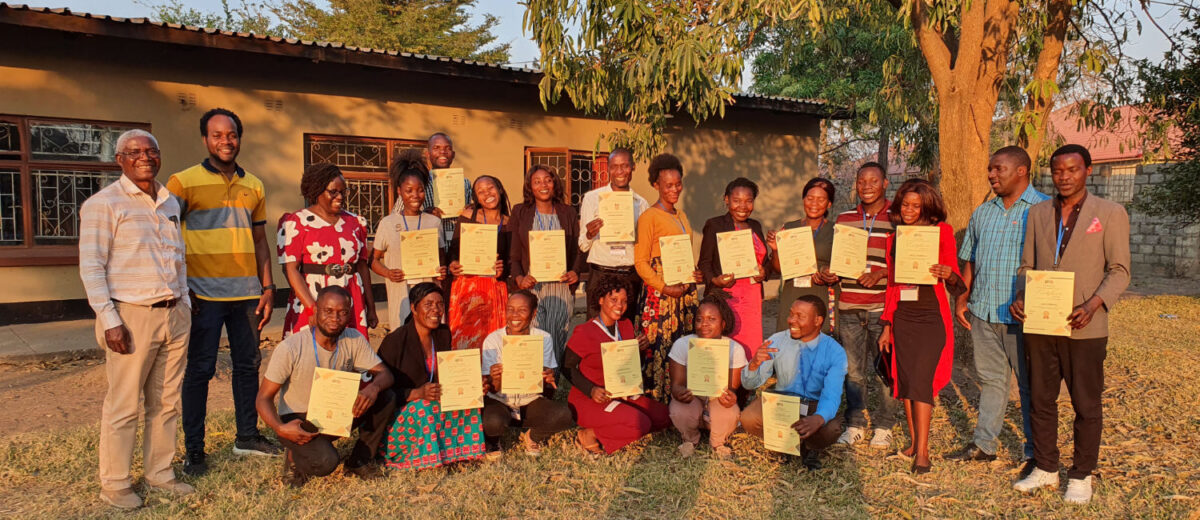
Empowering Zambia’s teachers: Technology and ingenuity fuel hope for half a million children

While conversations about education in the global north can often centre on resources and access, the realities in the global south can be shaped by entirely different challenges. Think intermittent power, internet dropouts and the effects of climate change. In Zambia, teachers and volunteers are finding innovative ways to overcome these barriers by blending technology and local ingenuity.
We’ll hear from a team of passionate volunteer educators working in the heart of southern Africa. Their mission is to train teachers. It’s a vital foundation stone that will help the half a million Zambian children in their city who cannot access a state-funded education. They’ll reveal how they use technology to drive sustainable change whilst adapting to a changing climate to address educational inequities in their communities.
Their work not only supports education but also advances sustainable development goals by building digital literacy and resilience. Community schools in Zambia are working tirelessly to bridge the gap between the education many children receive and the opportunities they deserve.
Teacher training in Zambia
To the south of Zambia’s capital, Lusaka, is a former residential house. It is the headquarters and Resource Centre, for TTCSZ (Training Teachers for Community Schools in Zambia). Their mission is simple:
To ignite positive change in Zambia by nurturing and equipping community school teachers to excel in their academics, thus making a lasting impact on the lives of students in their community schools.
Zambia is a large country, almost three times the size of the UK, but Lusaka is comparatively small and densely populated. Around 3 million people occupy a space around a quarter of the size of London.

Due to political shifts in the 1990s, communities in Zambia began creating their own schools to educate children. Many families cannot meet the costs or manage the vast distances to the nearest state provision. Estimates suggest community schools make up 20% of the total education enrollment. In Zambia, official figures for 2024 record that 492 community schools were active in Lusaka.
However, a 2016 UNESCO report highlighted the opportunity-gap between rich and poor in various places around the world. For example, across 76 countries, 20% of the richest 25 to 29-year-olds complete at least four years of tertiary education. For the poorest, that figure plummets to 1%.
In all countries, basic education (primary school) is fundamental in terms of developing human resources. In Zambia, the on-demand, pop-up nature of many community schools means that many can’t cover their running costs. Most teachers are unpaid, untrained volunteers.
Therefore, the work of TTCSZ is vital. From its Resource Centre, it has taught around 200 volunteer teachers. It has also provided bursaries for some to study primary education degrees at Chalimbana University and the University of Africa.
The technical challenges at a Zambian school
Chris Phiri is one of TTCSZ’s ICT teachers. He explained how instability within Zambian infrastructure presents technical challenges for their Resource Centre.
“Their operations have not been spared by the common challenges being faced across Zambia,” Chris told TechFinitive. “Extended times without power have seriously affected the operations, especially with ICT programs.
“The NGO tries to maximize times when the power supply is restored by keeping the Resource Centre open for the teachers and students.”
Currently, there is a fundraising effort to install solar at the Resource Centre. Introducing a continuous source of electricity is a vital barrier to jump as computers don’t react well to sudden power-outages. This initiative allows for uninterrupted training whilst keeping the infrastructure running without error.

Naturally, prolonged periods without power affects internet connectivity, impacting the training being delivered by TTCSZ. “Unstable internet causes online training sessions to drop,” said Chris. “Teachers struggle to access online resources, limiting their ability to learn and implement new teaching strategies.”
Despite the infrastructure challenges, Chris has developed technological fallbacks to keep the teaching on track, especially when the internet goes down. “TTCSZ is providing teachers with offline-enabled resources, such as downloadable training materials or educational apps. This helps them access important information at times without a stable internet connection.
“We’re using mobile-based solutions, such as SMS or USSD. This enables teachers to receive updates, access resources, or participate in training sessions even with limited internet connectivity. We’re also exploring alternative connectivity solutions like satellite internet or mobile hotspots to provide more reliable internet access.”
For areas where the technological and connectivity issues remain high, TTCSZ has created community-based approaches such as peer-to-peer support or mentorship programs. For TTCSZ, the technology is vital but the teaching remains paramount.
Funding for Zambian teacher training
As many community schools lack financial reserves, there is an increasing reliance on input from the third sector. TTCSZ is a Zambian registered NGO that works in partnership with a UK-based charity, Teachers For Zambia (T4Z). T4Z’s mission is to provide the resources required to support teacher training whilst TTCSZ uses its local knowledge and placement to deliver teacher training within its community.
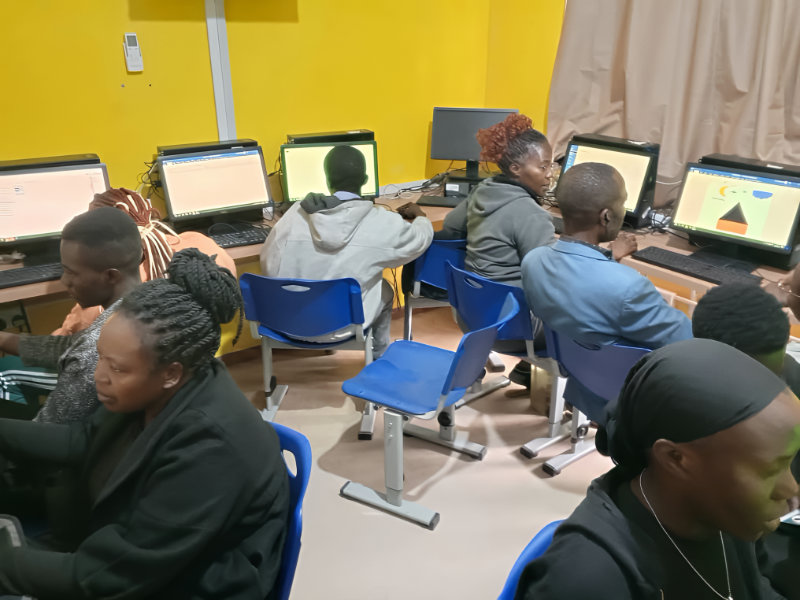
One of the critical tools for modern teaching is the computer. Some machines are provided by TTCSZ’s partner, Camara Education UK, which supplies and installs refurbished desktops. These machines are pre-installed with educational packages and Microsoft software. However, the majority of TTCSZ’s fleet comprises of donated or repurposed machines, so repair is a vital service. The team at the Resource Centre is kept very busy.
Repair in Zambia
Aside from the undeniable environmental benefits of repair, there are cost and convenience wins too. These facets gain greater significance in areas of Zambia where Amazon next-day doesn’t exist and spares can be hard to source.
Kunda Phanuel looks after TTCSZ’s technology (assisted by Chris Phiri). “Spares are not always easy to source, especially for devices that are not common,” said Kunda.
“Mostly, the available spare parts are second hand. For parts that cannot be found, we sometimes make some modification just to get the device back to life.”
He explains that one barrier they soon hope to overcome is access to the repair tools. “[There is] a lack of working machinery that is essential for excellent servicing of devices. Items like soldering station, hot-air, flux, soldering paste, quality thermal paste and quality soldering wire. Also, cleaning tools and good quality toolkits”.
Although these can be sourced, Kunda explains that they’re expensive in the local markets.
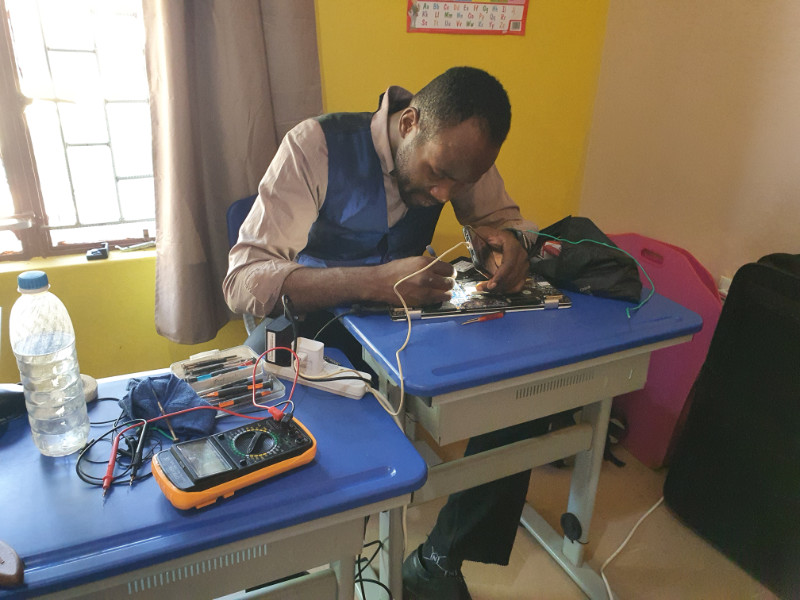
Kunda’s innovations to keep machines working, is hugely important to TTCSZ. “When devices get fixed, I see the joy it brings to the users. That is so priceless. Second, is the relief of having life restored to the device when all hope was lost.”
There isn’t a cupboard full of spare laptops or tablets at TTCSZ. Every machine in the building needs to work. “We don’t have enough computers and our vision is to have computers in all schools. It really breaks our hearts when the few that we have begin to fail.”
The ‘privilege’ of Windows 11
Whilst many areas of the world are currently falling over themselves to migrate from Windows 10, not everyone has the resources to comply. Kunda Phanuel explained TTCSZ’s plan for October 2025.
“Windows 10 support coming to an end makes us take security measures even more seriously than ever if we are to continue using the same operating system,” he said. “However, we can always upgrade to Windows 11 for a few computers with specs that meet the requirements.”
While Microsoft promotes Windows 11 as the blue-ribbon of technological progress, the reality is they are causing millions of working machines to be scrapped. This is an environmental crime and its ‘just buy a new one’ diktat is beyond the financial and ethical barriers for many.
“For old computers that cannot be tricked into running Windows 11 operating system, they may continue running on the same system,” said Kunda.
Managing technology in the Zambian climate
By the standards of many countries in the global north, Zambia is a challenging environment in terms of resources and infrastructure. I asked Chris Phiri how climate change affects his community.
“Zambia faces significant environmental challenges because of climate change, affecting daily life and communities,” he said. “Unreliable seasonal patterns such as changes in rainfall and temperature impact agriculture, making it challenging for farming, which is a crucial sector for Zambia’s economy.
“Droughts and floods disrupt crop production, whilst deforestation contributes to environmental degradation, loss of biodiversity, and increased greenhouse gas emissions.”
Depending on where you live in the world, climate change may have varying degrees of impact on your daily life. If you live in a peaceful, air-conditioned apartment with running water and an abundance of food, you may not feel it in the same way as the residents of Tuvalu, an island in the Pacific. Due to rising sea levels, the entire country has been offered relocation to Australia as, by 2050, scientists predict that Tuvalu will be under the waves.
The ramifications of climate change have been reported for many years, particularly its impact on the education of children. UNESCO’s 2016 report also highlights:
Poor children in the countries most at risk of climate change disasters are less likely to complete secondary school
The reality of climate change
In Lusaka, Kunda Phanuel told me how the changing climate has a direct impact on electricity production. “Zambia largely relies on hydropower. Poor rainfall translates to prolonged hours of load shedding (scheduled rolling blackouts). This always affects minor businesses and the production industry. This negativity affects the economy too and makes life more expensive and harder to live for ordinary Zambians.”
A common phenomenon of our changing climate is that when rain does fall, it’s often more intense, leading to flooding. A 2024 report from the World Meteorological Organisation stated:
Africa bears an increasingly heavy burden from climate change and disproportionately high costs for essential climate adaptation
Kunda Phanuel has seen this for himself. “With too much rainfall comes floods and waterborne diseases like dysentery and cholera due to poor waste management and drainage systems. Some parts of the country do not have access to clean water and rely on underground water, which can be contaminated.”
Chris Phiri agrees. “We have frequent power outages and limited access to clean water,” he said, but he also highlights how Zambians continue to use available technology to adapt to the challenges of a changing climate. “There’s a growing focus on solar energy to reduce dependence on hydropower. Some farmers are adopting practices like conservation agriculture, agroforestry, and using drought-resistant crop varieties to enhance resilience.
“Local communities engage in tree planting and sustainable land use to mitigate climate impacts. Social networks and community groups provide support and resources during difficult times.”
The importance of education in Zambia
“In Zambia, people will do anything to survive and mostly it is to be selling in the streets,” said Kunda, explaining what life is like for Zambians who cannot access education.
“Considering that a large part of the population survives on barely a dollar per day, most families end up starving or having a single meal per day throughout the famine period. Hard times call for hard measures. Most Zambians are built to survive on the bare minimum just to make it through to the next season.”
It cannot be overstated how vital it is for children to receive an education.
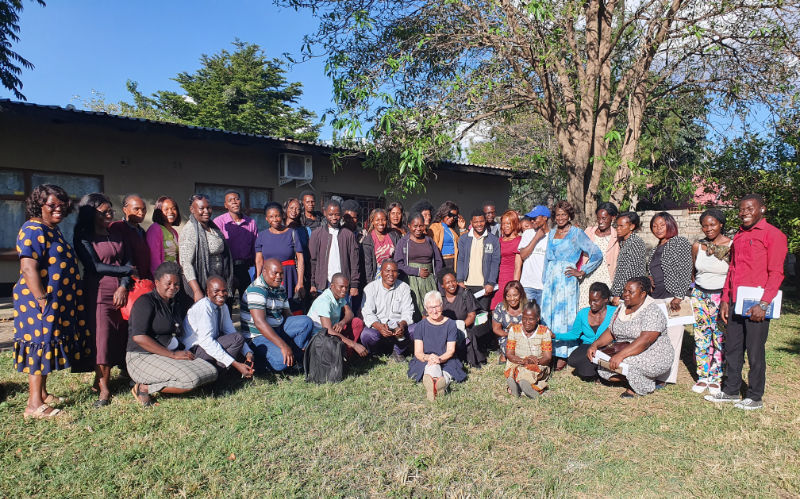
TTCSZ’s work shows that technology can be adapted to local realities, becoming a powerful tool for change. In Zambia’s community schools, innovation is born of necessity. Yet, while local educators use tech sustainably to shape brighter futures, global technology giants still drive rising CO2 emissions.
A reminder that innovation must serve both people and planet.
If you would like to assist the work of TTCSZ and T4Z, allowing them to continue their mission to educate the children in their community, there are many ways to get involved and make a difference.
Related articles
- Interview with Solace Kidisil, Group COO of Nsano, who oversees business and technical operations that stretch across 30 African countries
- Acer Africa & Schoolscape call for pioneering educators to share their innovations – and win an all-expenses paid trip to BETT UK
- The widening tech skills gap: a global crisis in need of solutions
About The Author

Lee Grant
NEXT UP


