Trending Topics

 Trending
Microsoft Build 2025: AI everywhere with more models, agents and developer tools

You thought Microsoft was going big on AI before? At this year’s Build conference, it unveiled a host of new tools, from practical user-level features like in-PDF translation to the general availability of Windows AI Foundry – and a wider availability of models.
The new features and tools are being touted as the rise of the age of AI agents and the beginning of building the agentic web, which Frank X Shaw, Chief Communications Officer at Microsoft, said was “where AI agents make decisions and perform tasks on behalf of users or organisations.”
Practically, it means new software tools for building and deploying AI agents – and introducing new models to Azure, highlighting Microsoft’s shift beyond OpenAI.
“Our north star is clear: to make Windows the best platform for developers, built for this new era of AI, where intelligence is integrated across software, silicon and hardware,” said Pavan Davuluri, Corporate Vice President for Windows and Devices, in a blog post.
Microsoft Build 2025: Windows AI Foundry
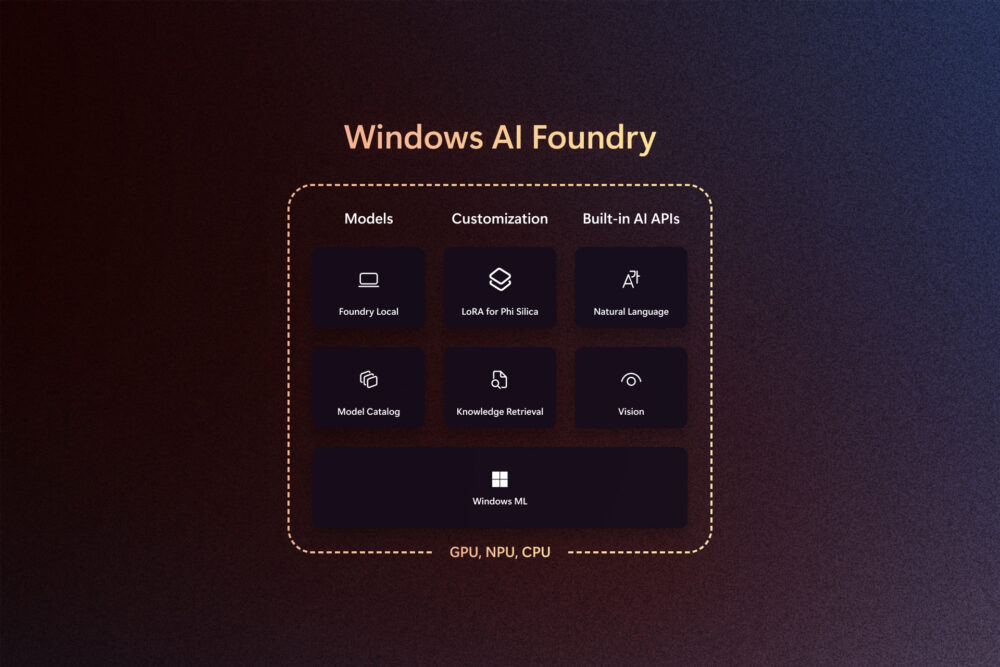
The key announcement was Windows AI Foundry, a replacement for Copilot Runtime, to help developers build AI tools and products using Microsoft’s own models as well as other open-source AI models.
“Windows AI Foundry offers a unified and reliable platform supporting the AI developer lifecycle across training and inference,” said Shaw in a blog post. “With simple model APIs for vision and language tasks, developers can manage and run open source LLMs via Foundry Local or bring a proprietary model to convert, fine-tune and deploy across client and cloud.”
One big piece of news is Microsoft will offer – and host in its own Azure data centres – access to AI models beyond OpenAI, including those from Elon Musk’s xAI. “With Azure AI Foundry Models, we’re bringing Grok 3 and Grok 3 mini models from xAI to our ecosystem, hosted and billed directly by Microsoft,” Shaw said.
“Developers can now choose from more than 1,900 partner-hosted and Microsoft-hosted AI models, while managing secure data integration, model customization and enterprise-grade governance.”
He added: “We’re also introducing new tools like the Model Leaderboard, which ranks the top-performing AI models across different categories and tasks, and the Model Router, designed to select an optimal model for a specific query or task in real-time.”
GitHub AI coding tools

GitHub’s AI coding tools are adding an agent that can actively fix bugs or create a new feature, all while following existing security policies, with all work requiring human approval before being deployed.
“Using state-of-the-art models, the agent excels at low-to-medium complexity tasks in well-tested codebases, from adding features and fixing bugs to extending tests, refactoring code, and improving documentation,” GitHub CEO Thomas Dohmke said in a blog post.
“You can hand off the time-consuming, but boring tasks to Copilot that will use pull requests, CI/CD, and all of your existing tooling while you focus on the interesting work.
Plus, Microsoft said it would be open sourcing GitHub Copilot Chat in VS Code, making the AI bits of GitHub Copilot extensions part of the VS Code open-source repository.

Microsoft also unveiled Microsoft 365 Copilot Tuning, to let customers train models on their own, domain-specific data, development tools for Teams including support for the Agent2Agent protocol, and a computer use tool to give agents the ability to handle enterprise tasks on desktop and web interfaces.
AI for the web
Microsoft also unveiled support for Model Context Protocol (MCP) in Windows and Windows AI Foundry. Called the “USB-C port of AI”, MCP was created by Anthropic and is a protocol to connect AI-powered tools, such as apps or agents, to other bits of software, such as Windows. This is currently available in private developer preview.
“MCP integration with Windows will offer a standardized framework for AI agents to connect with native Windows apps, enabling apps to participate seamlessly in agentic interaction,” said Davuluri. “Windows apps can expose specific functionality to augment the skills and capabilities of agents installed locally on a Windows PC.”
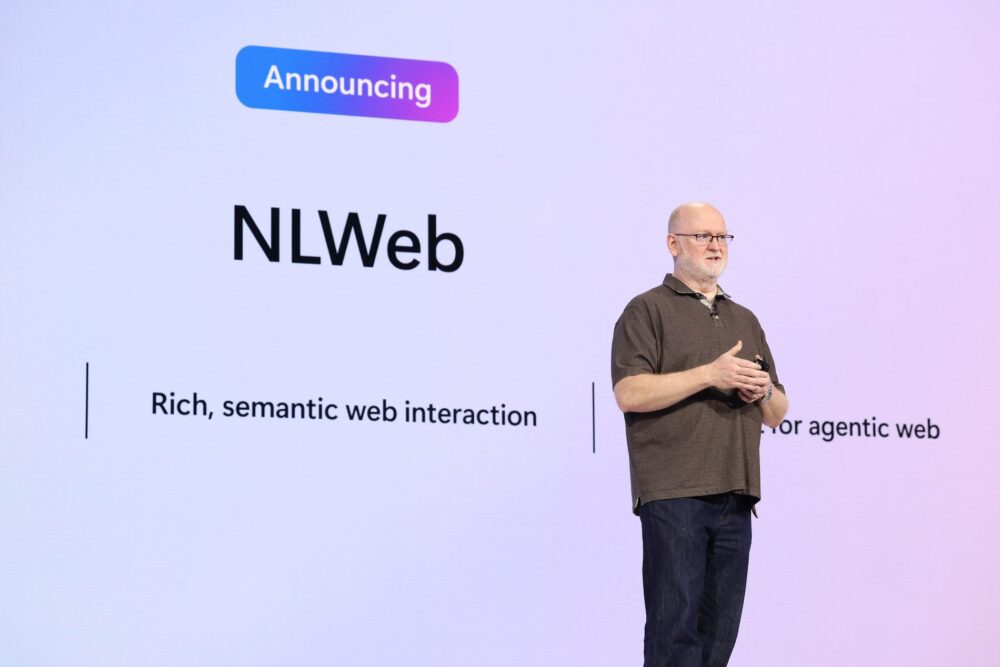
Alongside MCP, Microsoft introduced NLWeb, which Shaw wrote could play a “similar role to HTML for the agentic web” by making it easier for websites to provide a “conversational interface” with human users while making content accessible to AI agents if they choose.
Microsoft unveiled a long list of other features that may prove helpful to Windows users even if they aren’t readying an army of AI agents, notably that from next month, the Edge browser will support language translation inside PDFs by simply clicking a button.
Microsoft also said the Copilot Wave 2 spring release is already rolling out, and will include an updated app for human-agent collaboration, new image generation, Search and Memory tools, as well as Researcher and Analyst, which are reasoning agents. Copilot AI will also be coming to Outlook mail and calendar to fix navigation, summarise attached documents, and assist with meeting prep.
One last thing from Microsoft Build 2025
Microsoft Build 2025 wasn’t all about AI.
Microsoft also announced that it had open-sourced Windows Subsystems for Linux, which allows a Linux environment to run inside Windows, and introduced new “growth features” in Microsoft store – think analytics reports and app campaigns to encourage user signups – and improvements to Windows Developer tools.
So, no, not all about AI. Just 99% or so.
More Microsoft & AI news, if you needed any
About The Author