Trending Topics

 Trending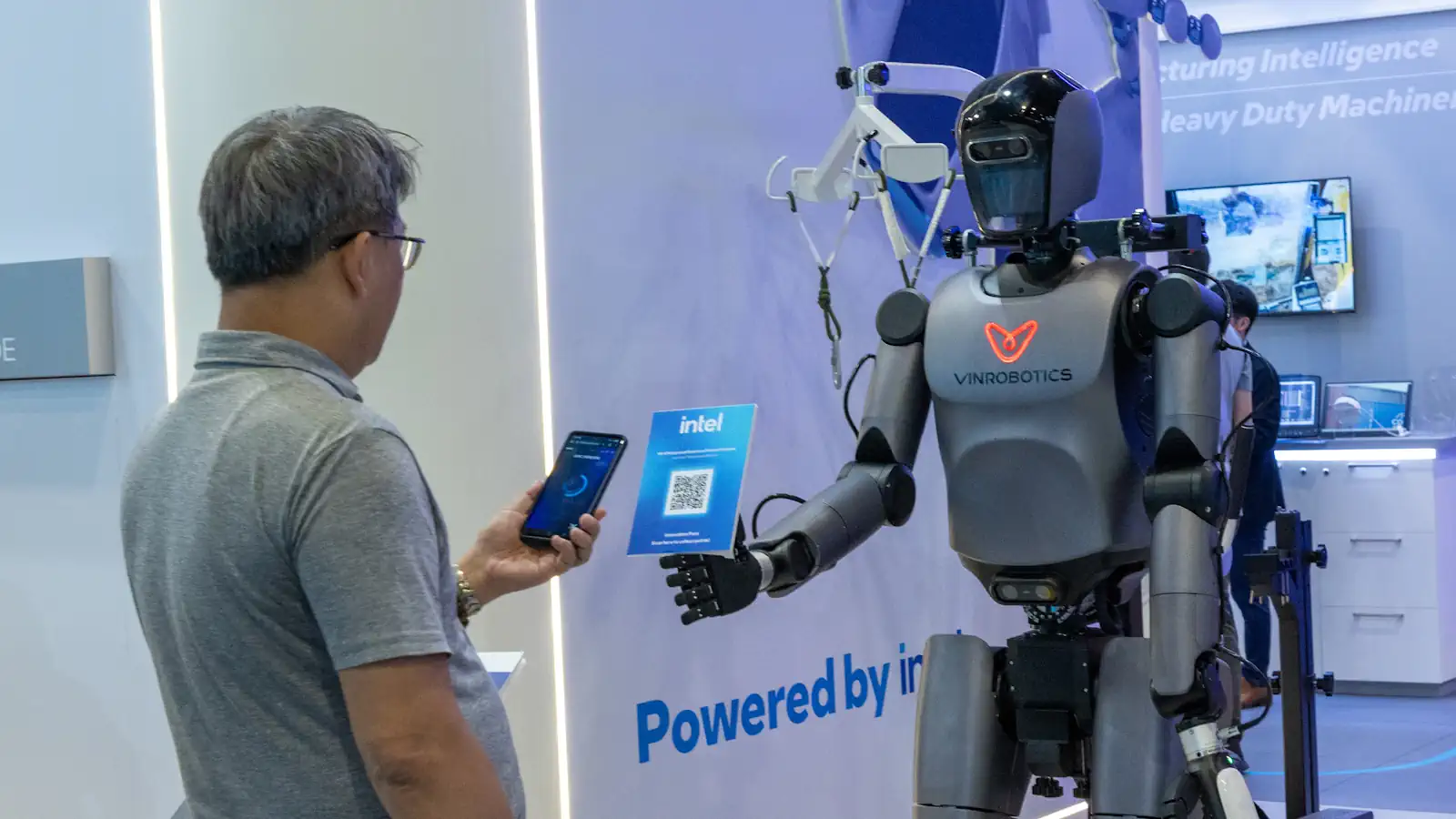
Is your business ready for robots? Intel’s new report suggests not (but handily suggests how you can prepare)

Robots won’t be feeding you cups of tea in your home anytime soon, but they are coming to the workplace. And a new Intel report, The Robotics Readiness Gap, suggests that organisations simply aren’t ready.
While we’ve had robots in industry for decades, their work has been built around repetition. On a car production line, there’s no difference between one car and the next, and certainly no need to interact with humans. But the next era of robotics, falling under the umbrella term of Physical AI, is different.
“Robots are increasingly capable of understanding the world that they’re operating in,” said John Healy, Vice President and General Manager, Industrial and Robotics Division, Intel. “They have gathered the capability to sense that world through multiple different sensors, video and vision being a major one of those.”
So the next generation of robots will sense, work next to humans, take autonomous decisions.
“Many respondents [to the survey] told us that they believe that the deployment of robots as an augmentation of their existing workforce will become more cost effective over three years than adding more human workers,” said Healy.
He added.: “But what we also found is that in addition to that pace of adoption, readiness for adoption at scale is lagging.” And that’s where the readiness gap comes into play.
The S factor: Five areas the industry needs to prepare for robots
Based on interviews with 800 senior business and IT leaders across six countries (USA, UK, Germany, Japan, China and South Korea), The Robotics Readiness Gap report draws out five factors for a successful human-robot workforce. All conveniently beginning with S.
Strategy
The first is strategy. Despite the survey suggesting that “two thirds of leaders believe they will be ready to manage mixed human-robot implementations by 2030, just a few short years from now,” said Healy, few leaders had prepared a strategy for this.
They will have a “human and robot workforce, working synergistically”, he added, but “only 40% of those leaders had a formal human-robot workforce strategy in place”.
Skills
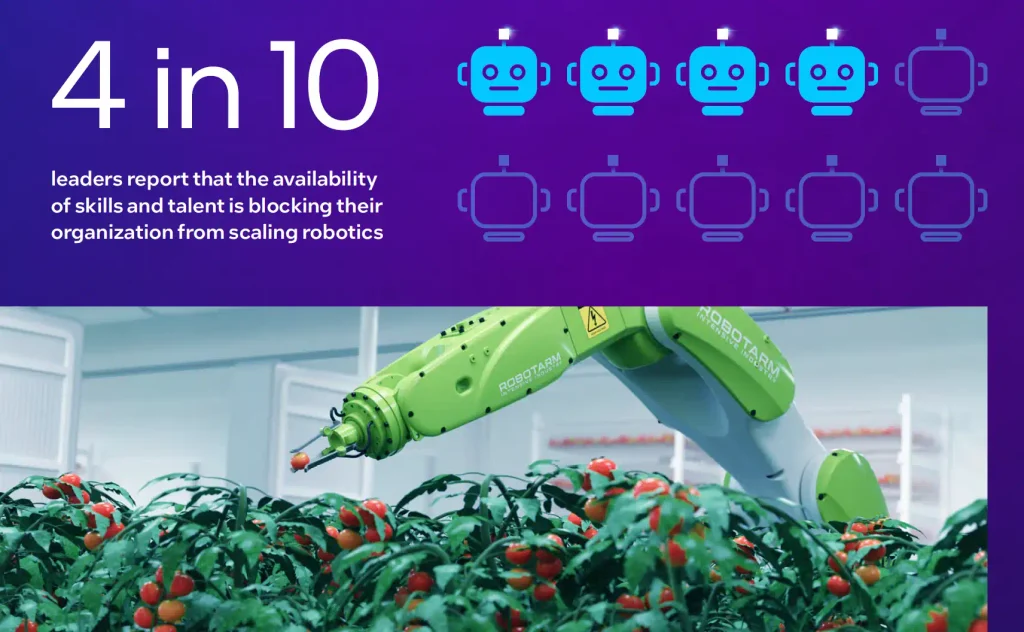
“Many of the survey [respondents] believe the fleet of the robots they deploy will double their output as a result of deploying those fleets [of robots], and that is a consequence of incrementing on the skills capability of the organisation,” said Healy.
He predicts new categories of work, new roles (such as a deployment roboticist on the factory floor), and a shift from robots as an operational tool to an IT-like function.
“Some of the gaps that are emerging in skills are in the areas of edge computing and on-device AI skills,” said Healy. “We typically have traditional robot specialists who understand safety, controls, deployment, maintenance and management in a physical environment, whereas AI specialists will typically understand autonomy, machine learning, model refinement, intelligent decision making.”
What we will need in the future are people who can blend those two skillsets.
Safety
One interesting finding from the survey is that many leaders believe that robotics is making their workplace safer. “[Robots] take on dangerous tasks, physically demanding tasks. Robots can reduce injuries in the workplace,” said Healy. “They can create safer working environments.”
They can also perform tasks that are simply too dangerous for humans, such as in mining. Robots can explore “environments that are not hospitable for human workers at all”. That means potentially new mines in previously impossible-to-explore places.
However, 55% of survey respondents cited safety as a reason to delay deployment. “You cannot solve for safety at the end; you define for safety at the beginning,” said Healy.
Shape
Then we come to shape, the form each robots take. While we naturally think of factory-line robot arms and humanoid robots, there are many other shapes that robots can take.
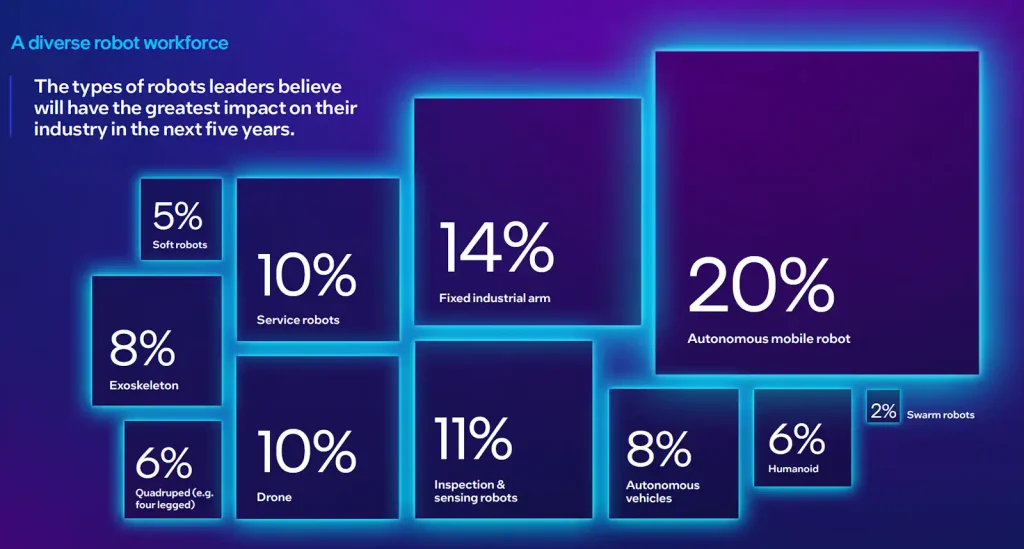
The instant takeaway from the above excerpt is that only 6% of leaders believe that humanoid robots will have the biggest impact on their industry in the next five years. But one in five believe that autonomous mobile robots will.
What might such autonomous mobile robots look like? Some might resemble robot vacuum cleaners, but bigger and more industrialised. They could whizz around factory floors, avoiding and interacting with humans as the needs dictate.
“Robots need to be defined to fit the work and what they interact with,” said Healy. “So a robot in a manufacturing environment doing precision engineering may have multiple appendages or arms as it holds complex componentry… It doesn’t need two arms like a humanoid. It may need multiples, more like an octopus.”
But public-facing robots will need to be “much more presentable with a more face-like and more human-like structure to be more approachable and to be more engaging”, he added. Examples are already cropping up in care homes.
Scale
Our final S is scale, the need for organisations to shift from a limited rollout of robots to a fleet. Something that will make a real difference to their business.
Here, Healy emphasised the need for a solid foundation, namely architecture. Again, an area where traditional IT skills come to the fore.
To provide the real-time controls necessary to manage robots in a workplace, the robot must be able “to respond in very short times to the stimulus or the environmental change that it sees,” said Healy.
“In fact, three quarters of critical robot decisions will require sub-100ms latencies, as we saw from from our survey, which is why Edge-native implementations become so important to ensure robot deployments can be managed and enabled and sustained at scale on a viable underlying architecture.”
The big question: Is your organisation ready for robots?
As always with a report prepared by a vendor, there’s an element of “well they would say that, wouldn’t they?”. What Brits know as Mandy-Rice Davis applies. And it’s true that those five S factors tie in nicely with what Intel is selling, from embedded chips for robots to the AI infrastructure mentioned last.
Intel isn’t alone in believing that robots are coming, however. TechFinitive has spoken to industry experts and Intel’s rivals in this space over the past six months – read our recent interview with a Boston Dynamics VP for example – and there’s consensus that Physical AI is real.
But we’ll leave the final word to Intel, for it’s one we do agree with.
“Whether robots will transform your industry is really maybe not the question,” said Healy. “It’s are you ready to take advantage of them, and have you thought it through as comprehensively as you may need to do?”
You can download Intel’s The Robotics Readiness Gap report here.
Related articles
About The Author

Tim Danton
NEXT UP


